

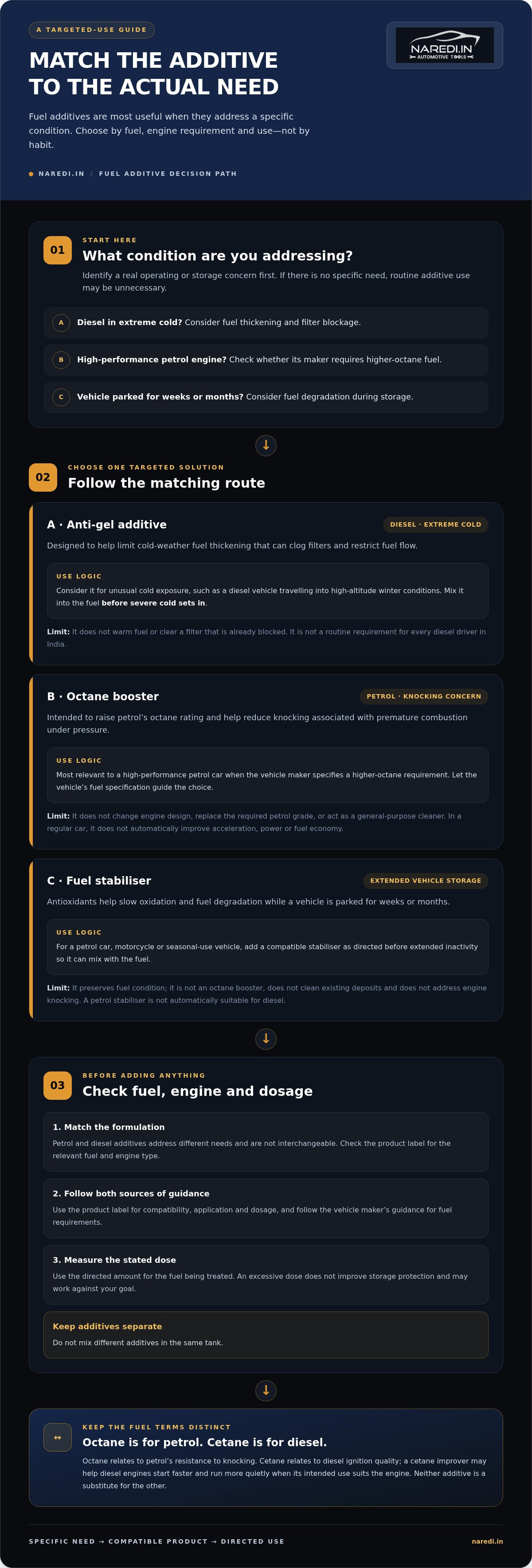
More additives do not automatically improve engine performance. Automotive fuel additives are most useful when they address a specific need, such as diesel fuel thickening in cold weather, knocking in a high-performance petrol engine, or fuel degradation during long-term storage. In normal conditions, routine use may be unnecessary.
Choose a targeted solution, because the wrong additive or an excessive dose may work against your goal. Follow the product label and your vehicle’s guidance, and do not mix different additives in the same tank.
Learn how anti-gel additives, octane boosters and fuel stabilisers work, when each may help in Indian driving and storage conditions, and how to use them as directed. This guide also explains when an additive is unlikely to make a useful difference, helping you choose for a specific need rather than adding a product out of habit.
Key Takeaways
- Match an additive to the specific need: cold-weather diesel, knocking in a high-performance petrol car, or fuel stored during a long period of inactivity.
- Use the product label and vehicle guidance to determine dosage; avoid combining different additives in one tank.
- Consider whether an additive addresses a real operating or storage concern before using it as part of routine driving.
- Separate fuel-related concerns from starting-system needs: battery chargers and testers address battery condition, not fuel quality.
Anti-gel additives for cold-weather diesel
Choose an additive for the fuel and condition it is designed to address. For diesel in extreme cold, anti-gel products target fuel thickening and filter blockage. Petrol additives address different engine needs.
Diesel Anti-Gel Use in Extreme Cold
A diesel anti-gel additive helps limit fuel thickening in cold temperatures that can clog filters. This may matter when a diesel vehicle faces unusually cold conditions, as restricted fuel flow can affect starting and engine operation. Additives work best as a preventive measure, mixed into the fuel before severe cold sets in. They do not warm the fuel or clear a filter that is already blocked.
In India, extreme cold is a specific operating condition, not a reason for every diesel driver to use anti-gel routinely. Consider the vehicle’s route and exposure: a diesel car travelling into high-altitude winter conditions may face different risks from one used in a warm climate. Follow the product label for fuel compatibility and dosage.
Diesel Formulations and Engine Benefits
Petrol and diesel additives are formulated for different fuel and engine needs. Diesel products may target cold flow, injector cleanliness or cetane, while petrol formulations may address deposits or knocking. Cetane improvers are designed to enhance diesel combustion and can help diesel engines start faster and run more quietly. Choose according to the engine and the specific issue, not simply because the container says “additive”.
For context, the U.S. Environmental Protection Agency states that conventional vehicles convert 12-30% of gasoline’s chemical energy into kinetic energy to move the car forward. This figure describes energy conversion, not the benefit of an additive or a comparison between fuel grades.
Premium petrol or diesel is a fuel grade sold for particular engine requirements; an additive is a separate formulation for a targeted purpose. In India, choose fuel according to the vehicle maker’s specification. An additive does not automatically make regular fuel equivalent to premium fuel.
For Indian cars and motorcycles, match the additive to the engine. Consider anti-gel only for diesel exposed to extreme cold, and a cetane improver only when its intended use suits the diesel engine. Petrol and diesel formulations are not interchangeable, so use only a product labelled for the relevant fuel and engine type.
Octane boosters for high-performance petrol cars
An octane booster is a petrol additive intended to raise the fuel’s octane rating and help reduce engine knocking. It is most relevant to a high-performance petrol car that requires higher-octane fuel. Adding one to a regular car does not automatically improve acceleration, power or fuel economy. Let the vehicle maker’s fuel specification guide your choice.
Octane describes petrol’s resistance to premature combustion under pressure. If combustion occurs too early in an engine designed for higher-octane fuel, knocking can result. An octane booster may address that specific fuel-related concern, but it does not change the engine’s design or replace the required petrol grade. Check the label for the intended fuel and follow its directions.
Premium petrol and an octane booster are different options. Premium fuel is sold as a fuel grade, while a booster is a separate additive intended to increase octane. A performance car’s manual states its relevant fuel requirement. If the engine is designed for regular petrol and runs normally, using an additive solely for a performance claim may not provide a practical benefit.
Octane and cetane apply to different fuels. Octane relates to petrol engines and resistance to knocking; cetane relates to diesel ignition quality. A cetane improver is not a substitute for an octane booster, and neither should be chosen based only on a shared “performance” label. Petrol and diesel formulations are not interchangeable. Carbon deposits are a separate concern from octane rating, so an octane booster should not be treated as a general-purpose cleaner.
For a high-performance petrol car, match the additive to the manufacturer’s fuel requirement, check the product’s petrol compatibility, and measure the dose precisely. Don’t combine it with another additive in the same tank. A targeted performance additive makes sense when its stated purpose matches the engine’s actual requirement, not as a routine upgrade for every petrol vehicle.
Fuel stabilisers for stored vehicles
A stabiliser is intended to slow fuel oxidation and degradation while a vehicle is parked for weeks or months. It is for long-term storage, not routine cleaning or addressing engine knocking.
Stabilising Fuel in Idle Vehicles
A fuel stabiliser helps preserve petrol during extended inactivity. This may matter when a car, motorcycle or seasonal-use vehicle will sit unused for weeks or months, as degraded fuel can make restarting less straightforward. Use a product formulated for the fuel in the tank and follow its label for dosage and application.
Plan for the storage period. Before parking a petrol vehicle for an extended time, add the stabiliser as directed so it can mix with the fuel. A stabiliser is not an octane booster: it addresses fuel storage, not a petrol engine’s octane requirement. It also does not clean existing deposits.
Antioxidants in Fuel Stabilizers
Antioxidants in stabilisers help slow oxidation, which contributes to fuel degradation during storage. This matters when fuel remains in a tank for an extended period. The product is intended to preserve fuel condition, not change how the engine is designed to run.
Choose a stabiliser according to fuel type and storage purpose. A petrol stabiliser is not automatically suitable for diesel, so check the label for compatible fuel. Measure the stated dose for the amount of fuel being treated; adding extra does not improve storage protection.
Keep the stabiliser’s purpose distinct from that of other additives. If a stored vehicle later runs poorly, a stabiliser will not clean a blocked component or diagnose an engine fault. Fuel-cleaning products address deposits, while an octane booster targets petrol octane. These are different from limiting oxidation during storage.
If a vehicle will be unused for weeks or months, make stabilisation part of the storage plan rather than a routine fill-up habit. Treat the fuel before parking, follow the product directions and keep the instructions for later. The aim is to preserve fuel during inactivity, not increase performance.
Fuel additive safety and dosage
Safe use starts with matching the product to the fuel, engine and stated purpose. Read the label before adding anything to petrol or diesel fuel.
Manufacturer Guidance and Warranty Coverage
The vehicle maker’s guidance sets the relevant fuel requirements and helps protect warranty coverage. In India, aftermarket additives used to boost performance or fuel efficiency may put a warranty claim at risk. Follow the owner’s manual and warranty terms before using one, especially while the vehicle is still covered.
Use only the labelled dose for the amount of fuel being treated. Do not combine different additives in one tank, as mixing can alter their chemical balance. A petrol injector cleaner, for example, is not automatically suitable for diesel injectors. Check fuel compatibility, directions and warnings, and make sure the product addresses the issue you want to solve.
Regulation and Standards in India
There is no universal additive dose or formulation for every Indian vehicle; compatibility depends on the product and engine. Treat the package directions as product-use guidance, not proof of vehicle-maker approval. The owner’s manual remains the reference for the fuel specified for the vehicle.
Before buying online or in a store, inspect the sealed packaging, label, fuel type, dosage instructions, warnings and manufacturer identification. Look for clear directions on whether the formulation suits petrol or diesel and whether it is intended for cleaning, corrosion control or another stated function. If the label mentions ethanol compatibility, compare that claim with the fuel and vehicle guidance rather than assuming all formulations are suitable.
For safer use, measure the dose accurately and choose only a product intended for the fuel in the tank. More additive does not mean better injector cleaning or stronger protection. Keep the container and its instructions available, and stop using the product if its directions conflict with the vehicle manual.
Choose a fuel-compatible performance additive by its stated purpose, then follow the label and vehicle guidance precisely.
Naredi.in: Battery Chargers
naredi.in offers performance additives for fuel-related needs, as well as battery chargers for vehicles that need battery charging rather than fuel treatment. Fuel additives do not recharge a weak battery. A battery tester can help assess battery condition, while a jump starter can provide a starting boost. Match the product category to the concern.
Choose according to the problem: fuel, battery condition or a starting issue. Matching the product to the need keeps your next step practical and avoids using a fuel additive to address an unrelated battery concern.
Visit naredi.in to explore its battery chargers and related automotive products.
Make your next choice with confidence
Let the vehicle’s actual need guide your next step. Choose a product with a clear purpose that suits the fuel or system involved and aligns with the manufacturer’s guidance. This keeps automotive fuel additives in their proper role and helps avoid treating every performance concern as a fuel problem.
naredi.in offers Performance Additives for fuel-related needs, alongside Battery Testers and Battery Chargers for battery concerns. Identifying which system needs attention helps you choose a relevant product category instead of guessing.
Bring your requirements into focus before choosing. Contact naredi.in to discuss your needs and explore the appropriate automotive products for your situation. A considered choice is a practical first step toward confident vehicle care.
Frequently Asked Questions
Do you really need additives?
Usually, no. A normally running vehicle using fuel that meets its manual’s specification does not need an additive by default. Consider one when its purpose matches a specific condition, such as prolonged storage or knocking in a high-performance petrol engine. Routine use may be redundant during a car’s first year or even two years of ownership. Follow the vehicle maker’s guidance before adding a product.
What are automotive fuel additives and how do they work?
Automotive fuel additives are products mixed with fuel to address specific fuel-system or combustion concerns. Depending on the formulation, they may target injector deposits, knocking, corrosion or fuel degradation during storage. Detergent formulations use molecules with a fuel-compatible portion and a polar group that can interact with deposits. Each product has a specific purpose, so an injector cleaner will not necessarily address knocking or preserve stored fuel.
What types of petrol and diesel fuel additives are available in India?
Common categories include petrol octane boosters and injector cleaners, as well as diesel cetane improvers, injector cleaners and cold-weather anti-gel products. Fuel stabilisers are intended for vehicles stored with fuel in the tank. These categories serve different needs: an octane booster targets petrol’s resistance to knocking, while a cetane improver is formulated for diesel combustion. Check the product label for fuel type and intended use.
Do fuel additives improve mileage, power, or emissions, and what evidence supports these claims?
Benefits depend on the formulation and the engine’s condition; an additive isn’t a universal mileage or power upgrade. One study on a direct-injection gasoline engine found that deposits on injector nozzles caused a 9.4% loss in fuel flow with base fuel. That finding concerns deposits and flow, not a guaranteed improvement in mileage, power or emissions from using a cleaner.
How often should fuel additives be used, and what is the correct dosage?
Use the product label’s dosage for the amount of fuel being treated, rather than applying a routine dose to every fill. One recommendation for fuel-system cleaner is every 5,000-10,000 km, or when the car feels sluggish or less efficient. Product directions can differ by formulation, so don’t transfer one cleaner’s interval or dose to another additive.
Are fuel additives safe for BS6 engines, turbocharged vehicles, and vehicles with catalytic converters or DPFs?
Use an additive in a BS6, turbocharged or emissions-controlled vehicle only when its label identifies compatibility with that engine and fuel system, and the vehicle manual allows it. Check compatibility with the catalytic converter or diesel particulate filter (DPF) specifically. Don’t assume that a petrol or diesel additive suits every vehicle simply because it shares the same fuel type.