

Automotive Battery Tester India: A Practical Buying Guide
Could a battery tester give you a clear reading and still miss the fault you’re trying to find? Choosing an automotive battery tester India buyers can use confidently isn’t just about a digital display. Different test methods assess different things, and a result is useful only when the tester suits the vehicle’s battery and you understand what it cannot diagnose.
It’s reasonable to want a dependable tool for checking battery condition, especially when battery voltage, chemistry and vehicle requirements vary. This guide explains the differences between voltage checks, electronic and conductance-style analyzers, and load testers. It also shows how to compare battery compatibility before buying, and why a test result is one part of a diagnosis, not a complete verdict on the vehicle’s starting or charging system.
Use the checklist to match equipment to the vehicles you test and your routine, whether you’re a hands-on owner or equipping a workshop. naredi.in is an automotive-tools retailer and authorized Pan-India distributor established in 2014. Its products are sourced directly from OEM manufacturers and described as 100% genuine. Checking specifications against your needs helps you choose suitable equipment.
Key Takeaways
- Choose an automotive battery tester in India by matching its test method and supported specifications to the batteries you assess.
- Compare voltage and battery chemistry support with the vehicle and battery manufacturer’s specifications before buying.
- Understand what voltage checks, electronic analyzers and load testers can tell you, and where their results have limits.
- Use a practical checklist to move from your vehicle list to the tests and workflow your equipment must support.
- naredi.in is an automotive equipment retailer and authorized Pan-India distributor established in 2014, with products sourced directly from OEM manufacturers.
Why the Right Automotive Battery Tester Matters for Indian Buyers
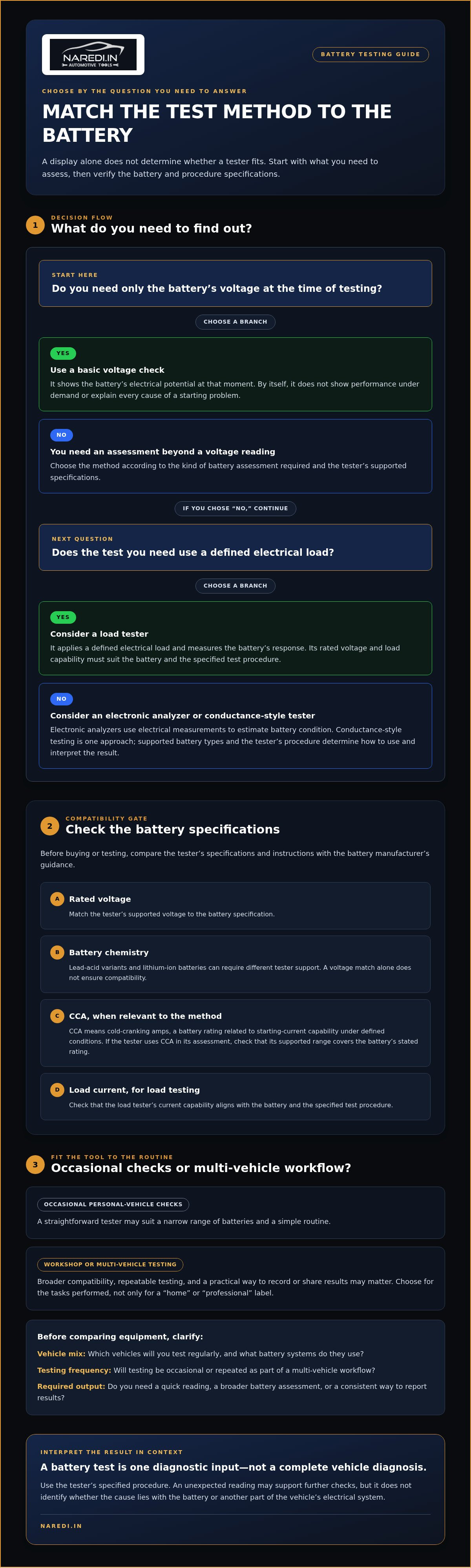
A battery tester is useful when its test method answers the question you’re trying to resolve. A voltage reading shows the battery’s electrical potential at the time of testing, but doesn’t show by itself how the battery performs under demand or explain every cause of a starting problem. Choose equipment based on the vehicles you work on, their batteries and how often you test them.
An automotive battery tester is diagnostic equipment that assesses a battery’s condition using a specified test method. Different tools provide different kinds of information, so a display or long feature list alone won’t tell you whether a tester fits your task. Start your buying decision with compatibility and workflow, not appearance.
What can an automotive battery tester help assess?
A basic voltage check measures voltage at the time of testing. An electronic analyzer or load tester assesses battery performance using a different method, according to its specifications. These results can help investigate a weak-starting concern, but they describe the battery, not the vehicle as a whole.
For an overview of the category and its different forms, see this battery tester reference. The practical point is to interpret readings in context: an unexpected result may support further checks, but it doesn’t identify whether the cause lies with the battery or another part of the vehicle’s electrical system.
Who needs a basic tester or workshop equipment?
A straightforward tester may suit occasional checks on a personal vehicle, especially if you have a narrow range of batteries and a simple routine. A workshop or multi-vehicle operation may need broader compatibility, repeatable testing and a practical way to record or share results. Choose based on the tasks you perform, not only on whether a tool is labelled for home or professional use.
Consider the vehicles you expect to test. A household may check a scooter and a car, while a workshop may handle different vehicle classes and battery specifications throughout the day. Before comparing equipment, clarify:
- Vehicle mix: Which vehicles will you test regularly, and what battery systems do they use?
- Battery compatibility: Does the tester support the battery voltage and chemistry specified for those vehicles?
- Testing frequency: Will you use it occasionally or repeat tests as part of a multi-vehicle workflow?
- Required output: Do you need a quick reading, a broader battery assessment or a consistent way to report results?
Your answers help distinguish a tool that can perform a useful check from one that fits your full testing routine. Compare its capabilities with the battery manufacturer’s specifications, then treat each result as one diagnostic input. A battery tester cannot explain faults beyond its test scope.
How Battery Test Methods and Specifications Shape the Result
A tester’s method determines what its reading represents. Before comparing displays or extra functions, identify the battery you need to assess. Rated voltage and chemistry affect compatibility. Specifications such as CCA and load current matter when they’re relevant to the test method and match the battery manufacturer’s guidance.
Electronic testing and conductance-style analysis
Electronic analyzers use electrical measurements to estimate battery condition. Conductance-style testing is one approach, but the supported battery types and the tester’s procedure determine how to use and interpret the result. Check the tester’s specifications and instructions for supported chemistry and voltage. An estimated battery result can inform troubleshooting, but it doesn’t establish the condition of the entire vehicle electrical system.
Load testing and reading limits
A load tester applies a defined electrical load and measures the battery’s response. Its rated voltage and load capability must suit the battery and the intended procedure. An unsuitable load or a result compared outside the stated testing conditions can be misleading. A battery-test result is meaningful only when it’s obtained using the tester’s specified procedure.
Use these specification terms to check whether a device fits the task:
- Voltage: The battery’s rated electrical potential. Match the tester’s supported voltage to the battery specification.
- CCA: Cold-cranking amps, a battery rating related to its starting-current capability under defined conditions. If a tester uses CCA in its assessment, check that its supported range covers the battery’s stated rating.
- Load current: The current a load tester applies during testing. Its capability needs to align with the battery and the specified test procedure.
- Battery chemistry: Lead-acid variants and lithium-ion batteries can require different tester support. Don’t assume that a voltage match alone ensures compatibility.
The U.S. Department of Energy’s manual on battery test procedures illustrates how methods and conditions are defined for advanced electric-vehicle battery devices. Its scope differs from routine checks with a handheld automotive tester, but the underlying lesson applies: measurements need a defined procedure and suitable equipment.
Use this comparison to connect the method with the specification to verify:
| Method | What it assesses | Suitable use | Specification to verify |
|---|---|---|---|
| Voltage check | Voltage at the time of measurement | Quick electrical check | Supported voltage |
| Electronic or conductance-style | Estimated battery condition using electrical measurements | Routine assessment with a compatible battery | Voltage, chemistry and supported CCA range, if used |
| Load test | Battery response to an applied load | Assessment using a defined load procedure | Rated voltage and load capability |
When comparing the automotive battery tester India market offers, start with the battery label and manufacturer guidance, then compare the tester’s method and supported specifications. Explore automotive battery testers with those requirements in mind rather than choosing by display features alone.
Compare Automotive Battery Tester Types by Use Case
Tester types suit different jobs. A compact voltage checker provides a quick reading, an electronic analyzer may estimate battery condition using its supported measurement method, and a load tester evaluates the battery’s response to an applied load. None is right for every buyer. Match the method to your routine, then check that the tester supports the battery voltage and type you need to assess.
| Type and method | Typical workflow | Key specification | Suitable buyer |
|---|---|---|---|
| Basic voltage checker measures voltage | Connect and read voltage for a quick check | Supported battery voltage | Vehicle owner with occasional checks |
| Electronic analyzer uses electrical measurements | Enter or select battery details, then review the result according to the tester’s instructions | Supported voltage, battery types and test range | Owner or technician needing broader battery assessment |
| Load tester applies a defined electrical load | Follow the specified load procedure and observe the battery’s response | Rated voltage and load capability | Experienced user or workshop with a suitable testing workflow |
Compact testers for occasional checks
For a limited number of vehicles, simple handling and a clear workflow may matter more than extra functions. Start by checking supported battery voltage and test method. A compact design or larger screen doesn’t establish compatibility, and a basic tester shouldn’t be assumed to assess the starter or charging system. Those checks apply only when the tool specifically supports them.
Workshop testers for repeated diagnostics
Regular testing makes repeatable procedures, broad compatibility and practical reporting more valuable. Support for multiple voltages can help if your workload includes batteries with different rated voltages. It adds little if you test only one compatible battery category. Compare the supported range and testing workflow with the vehicles you handle.
Reporting features should meet a real need. A printer may help produce a record for a customer or service file, while connectivity is useful only if it fits how results are stored or shared. A display should make readings easy to use, but screen size alone doesn’t indicate test capability. A workshop that documents results may value reporting, while an occasional user may prefer a simpler process.
Keep battery testing separate from starter and charging-system checks. A weak battery reading may prompt further investigation, but it doesn’t establish that either system is faulty. Consider these checks only when the tester states that it supports them and its instructions cover the task. Prioritize method, compatibility and workflow over a long feature list.
A Practical Checklist for Choosing a Battery Tester in India
A useful shortlist starts with the vehicles and batteries you actually test, not a feature-heavy product title. Follow these steps to turn your requirements into specifications you can compare when choosing an automotive battery tester in India.
- List the vehicles. Note the vehicles you own or service, including the vehicle types and battery systems in your regular workload. For a workshop, include less common vehicles only if you expect to test them often enough to affect your choice.
- Identify battery specifications. Use battery labels and vehicle documentation to record rated voltage, chemistry, CCA rating and other relevant parameters. Follow the battery manufacturer’s guidance if the label doesn’t provide the details you need.
- Define the tests. Decide whether you need a voltage check, an electronic battery assessment or a load test. Include starter or charging-system checks only if they’re part of your task and the tester explicitly supports them.
- Compare tester capability. Match the tester’s supported voltage and battery chemistry to the manufacturer’s specifications. Check whether its stated CCA range or load capability covers the batteries and procedure you intend to use.
- Review the workflow. Consider how often you’ll use the tester, how results will be read or recorded, and whether its instructions fit your routine. Compare only functions stated in the product specifications.
Match the tester to batteries and vehicles
Start with the actual battery, not an assumption based on vehicle type. Two batteries with the same rated voltage may still differ in chemistry, and voltage support alone doesn’t prove that a tester suits both. Check the product specifications for supported chemistries, test ranges and any stated test standards. Compare those details with vehicle documentation and battery-manufacturer instructions before deciding.
Compare usability, reporting, and product support
For occasional checks, portability and a readable interface may be practical priorities. For repeated workshop use, consider whether results need to be saved or shared, and whether a reporting function supports that process. Review the listed contents, such as included leads, along with the operating instructions and warranty terms on the product page. Don’t assume a feature is included because it’s common on another tester.
Make a shortlist from your written requirements, then compare available automotive battery testers by supported specifications and stated functions. This keeps your purchase aligned with your actual testing workload.
Find Automotive Battery Testers Through naredi.in
The right tester is the one whose method and supported specifications fit the battery and the task. Start with your vehicle and battery requirements, then compare them with each tester’s stated capabilities. For buyers looking for an automotive battery tester in India, this grounds the choice in practical compatibility rather than a long feature list.
naredi.in is an automotive equipment retailer and authorized Pan-India distributor established in 2014. The business states that its products are sourced directly from OEM manufacturers and are 100% genuine. Use each product’s specifications to decide whether it suits your testing needs.
What to compare in the naredi.in battery tester range
Review each listing individually. Compare its supported voltage and battery specifications with the batteries you intend to test, and note its method and stated functions. Accessories and functions can vary by product, so use the listing details and operating information rather than assuming a feature is standard across the range.
- Voltage and battery support: Match the stated range and supported battery types to manufacturer specifications.
- Test method: Confirm that the tester performs the kind of assessment your task requires.
- Parameters: Compare any stated CCA range or load capability with the batteries and procedure involved.
- Included items and instructions: Review the listed accessories and guidance to understand the intended testing workflow.
Choose equipment that fits your testing workflow
For a hobbyist checking a limited number of vehicles, prioritize a clear workflow and the tests you’ll perform regularly. For a workshop, consider the vehicles and battery types you encounter, repeat testing needs, and whether reporting is part of the process. A printer, display or other function is valuable when it supports your workflow, not simply because it appears in a product description.
Keep your shortlist practical. A tester with broad specifications isn’t automatically the right fit if its method or supported battery types don’t match your use. A simpler tool can be appropriate when it covers the batteries and checks you perform. Compare published specifications side by side, and interpret each result within the tester’s stated procedure.
Browse automotive battery testers through naredi.in and compare product specifications with your vehicle mix and testing routine. Matching the method, supported batteries and day-to-day use helps you select suitable equipment.
Make Your Next Tester Choice With Confidence
Before choosing, write down the batteries you handle, the checks you perform and the information you need from each test. Keep this list handy as you compare product listings. It makes it easier to identify a suitable tester and avoid prioritizing features that won’t help with your day-to-day work.
The right automotive battery tester India buyers select should serve a clear purpose, whether for an occasional check at home or repeated workshop use. Let your actual workflow guide the decision. A result is most useful when the equipment, battery and test procedure are aligned.
Ready to put your requirements into practice? Browse automotive battery testers at naredi.in and compare the specifications that matter to your vehicles and testing routine.
Frequently Asked Questions
Can a car battery tester tell me whether my battery needs replacement?
A tester can provide evidence about battery condition, but its result alone shouldn’t decide whether to replace it. Follow the tester’s procedure, then compare the result with the battery manufacturer’s guidance and the vehicle’s symptoms. For example, a poor reading after the battery has been correctly charged and retested may support further evaluation. A tester reading doesn’t confirm battery age, warranty status or the cause of every starting issue.
Is a battery tester the same as a battery charger?
No. A battery tester assesses the battery using its specified method, while a charger supplies electrical energy to recharge a compatible battery. Some automotive equipment may combine functions, but don’t assume a tester can charge a battery or that a charger can assess its condition. Check the device’s stated functions and instructions. If the battery is discharged, follow its manufacturer’s charging guidance before interpreting a test result.
What happens if I use a tester with the wrong battery voltage?
The result may be invalid or the tester may not operate as intended. Depending on the device and connection, using equipment outside its stated voltage range could also create a safety or equipment risk. Read the battery label and tester instructions before connecting leads, and stop if the voltage is unsupported or unclear. Don’t rely on a reading produced with a mismatched setup to make a battery decision.
How much CCA range should an automotive battery tester support?
There isn’t one CCA range that suits every battery. Check the CCA rating on the batteries you expect to test, then compare it with the tester’s stated range and method. If your workload includes batteries with different ratings, the supported range should cover the intended tests. When buying an automotive battery tester India customers can use, prioritize actual battery labels and manufacturer instructions over a broad range printed in a product title.
Can one automotive battery tester check cars, motorcycles, and commercial vehicles?
Sometimes, but vehicle category alone doesn’t establish compatibility. A tester must support each battery’s voltage, chemistry and relevant test parameters, and its instructions must cover the intended procedure. A unit suitable for a car battery may not cover every motorcycle or commercial-vehicle battery. List the batteries in your workload and compare their specifications with the tester’s stated support before using one tool across them.
Are digital battery testers more accurate than load testers?
Not necessarily. Digital describes the interface or measurement approach, while load testing applies a defined electrical load. The methods assess batteries differently, so their readings aren’t automatically interchangeable. Accuracy depends on using a suitable tester correctly, following its procedure and interpreting results within its specifications. Compare the test method and intended application rather than treating a digital display as proof that one device is more accurate.
Can a battery tester diagnose an alternator or starter problem?
Only if the specific tester supports those checks and its instructions explain how to perform them. A battery assessment alone cannot establish that an alternator or starter is faulty. A weak-starting symptom can have more than one cause, so don’t treat a battery result as a component diagnosis. Check the device’s stated functions and use an appropriate procedure for any separate starting or charging-system assessment.