

Battery Test Meters: Compare Types, Features and Prices
A voltage reading can tell you more about a battery than its charge indicator suggests. A battery test meter using a DC voltmeter can estimate charge when you know the battery’s nominal voltage, while other testers assess condition through current and voltage response. For lead-acid vehicle batteries, the 421 test is one condition-testing procedure.
Choosing a tester depends on what you need to learn: an approximate charge level, how the battery responds to a test, or a broader assessment of its condition. The meter type matters because a voltage estimate and a load-based test answer different questions. This guide compares common tester types, explains how DC voltage readings help estimate charge, and outlines features to consider. You’ll also learn how universal household testers differ from automotive battery testers, so you can match the tool to the battery and task instead of relying on a reading that answers only part of the question.
Key Takeaways
- Choose a tester based on whether you need a charge estimate or a deeper indication of battery condition.
- For lead-acid vehicle batteries, understand what the 421 test evaluates and how a load-based reading differs from a simple voltage check.
- Match household battery testers to the battery types and sizes you use, rather than assuming one meter suits every battery.
- Use a DC voltmeter to estimate charge only when you know the battery’s nominal voltage, and interpret the reading in that context.
- Compare product ratings and reviews for relevant testing functions, battery compatibility and ease of reading before deciding.
Lead-acid vehicle battery testing
Lead-acid battery tests can indicate charge and assess condition, but these are different results. Choose the right test based on whether you need to check voltage, current response, or charging-system operation.
Battery and Alternator Checks
Battery and alternator checks assess the battery alongside the vehicle’s charging system. This distinction matters because a weak battery reading alone won’t show whether the battery or charging system is responsible. Compare the battery’s condition with the alternator’s charging output using a tester designed for both checks. A battery test meter that only estimates charge cannot provide the same information as a combined diagnostic tool. Treat the two readings as related, but not interchangeable.
Integrated Battery Testing
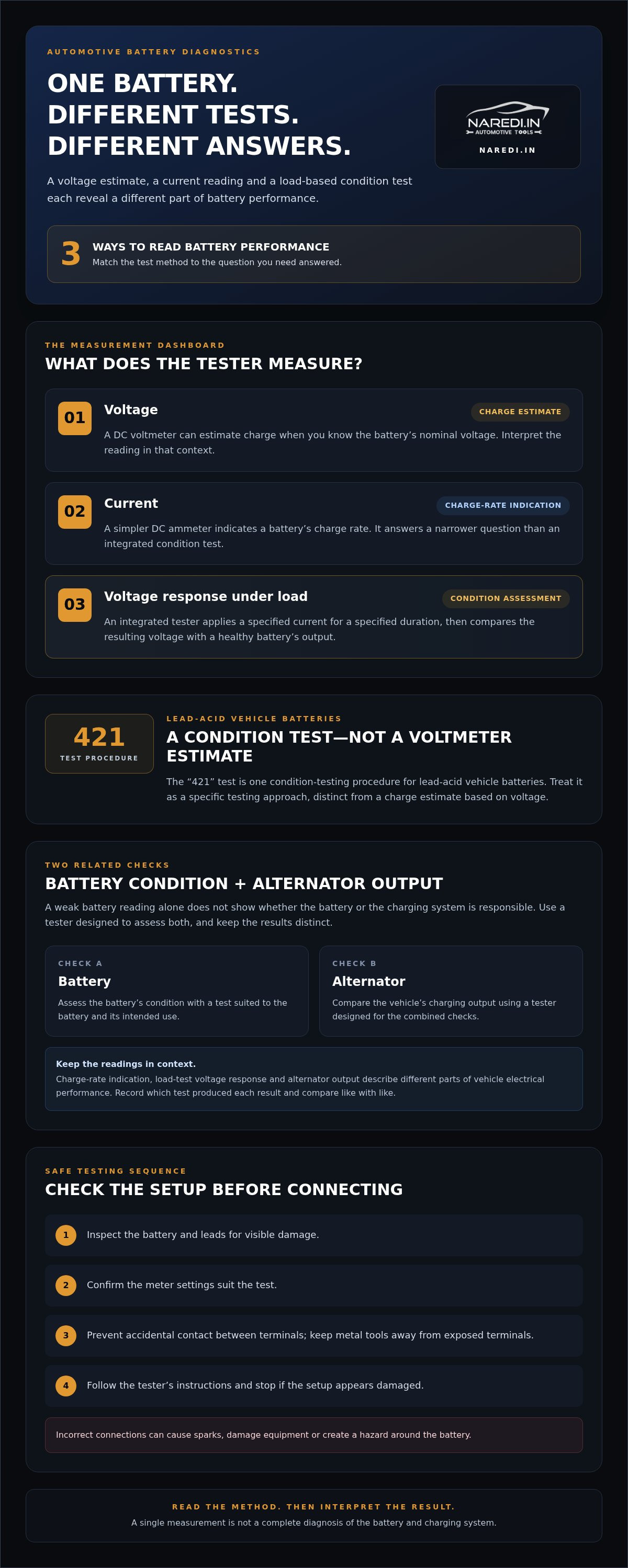
An integrated battery tester assesses condition by applying a specified current for a specified duration, then comparing the resulting voltage with the output of a healthy battery. This reveals more than a resting voltage estimate. It shows how the battery responds to a defined test, which can help distinguish one that appears charged from one that performs poorly under load. Follow the tester’s procedure and interpret the result for the battery type being assessed.
A simpler tester can be a DC ammeter that indicates a battery’s charge rate. It answers a narrower question than an integrated condition test. For lead-acid vehicle batteries, the “421” test is one condition-testing procedure. It should be understood as a specific testing approach, not as a charge estimate from a voltmeter. The key comparison is what the instrument measures: current, voltage, or response under a specified load.
Battery Testing Safety Precautions
To test safely, prevent accidental contact between terminals and follow the tester’s instructions. Before connecting a meter, inspect the battery and leads for visible damage, then confirm the meter’s settings suit the test. Keep metal tools away from exposed terminals and stop if the setup appears damaged. Incorrect connections can cause sparks, damage equipment, or create a hazard around the battery.
Interpret each result in context. A DC ammeter’s charge-rate indication, an integrated tester’s voltage response, and an alternator check describe different parts of vehicle electrical performance. Record which test produced the reading, then compare like with like. This makes repeat checks more useful and avoids treating one measurement as a complete diagnosis of the battery and charging system.
Universal household battery testers
For car, bike, inverter, and household batteries, match the tester to the battery’s chemistry, voltage, and the test method you need. A household model and an automotive tester may measure different things.
Household and Automotive Tester Types
A universal household tester checks compatible consumer batteries, while a digital automotive tester assesses vehicle batteries. The distinction matters because a household model may show basic charge, while an automotive unit can assess vehicle battery condition. The listed battery tester category contains 5 products. Compare the supported battery formats and displayed measurements before choosing. A clear digital display can make readings easier to interpret, but it doesn’t replace checking compatibility.
A household tester designed for removable cells, for example, isn’t automatically suitable for a car battery. An automotive tester may use battery clamps and provide a condition assessment. Treat its stated functions as separate capabilities: charge indication, voltage measurement, and condition testing aren’t interchangeable. Choose based on the battery you need to test, not just the display style or the word “universal.”
Choosing a Tester for Different Batteries
Choose a tester whose supported battery type and test range suit the battery in your car, bike, inverter, or household device. These applications can use different battery formats and require different connections. Start with the battery label, then compare its chemistry and nominal voltage with the tester’s stated compatibility. For a household cell, confirm its physical format; for a vehicle battery, check that the tester supports that application.
An inverter battery needs a tester suited to that battery, not a household cell checker. Likewise, don’t assume every car tester is compatible with a bike battery. Treat each use case separately. If you test several battery types, choose a model that explicitly supports them and reports the measurements you need. This reduces the risk of relying on results from an unsuitable test method.
Battery Tester Definition
A battery tester is an instrument that measures or assesses a battery through readings such as voltage, current response, or condition. The definition matters because products called testers can perform different checks. A DC voltmeter, for example, can estimate charge when you know the battery’s nominal voltage. An integrated tester can assess condition by applying a specified current for a set duration, then comparing the resulting voltage with a healthy battery’s output.
Check what the instrument measures before interpreting its result. A voltage reading is not the same as a load-based condition assessment. A digital display makes the result convenient to read, but the test method determines what it means. A household-cell tester may focus on basic charge indication. For vehicle batteries, choose according to the intended application and testing function.
Battery Tester Prices in India
Battery tester prices in India depend on the battery types supported, measurement functions, and test capabilities. This matters because a basic household checker and an automotive condition tester serve different needs. Compare products by function first, then decide whether additional capabilities are useful for your batteries. A higher feature count alone doesn’t mean a tester suits your application.
Before comparing listed prices, separate household testers from automotive models and check their supported batteries. Compare equivalent functions, such as voltage indication against voltage indication, rather than treating different test methods as direct alternatives. For vehicle testing, battery testers suited to the relevant battery application help connect the tool choice to the task. The right comparison begins with compatibility and the reading you need.
Estimating battery charge with DC voltmeters
A DC voltmeter can estimate battery charge when you know its nominal voltage. It’s useful for a quick voltage check, not a complete condition assessment. A battery test meter that measures voltage gives you a reading to interpret alongside battery information and test conditions.
Start by identifying the battery’s nominal voltage from its label or documentation. Set the voltmeter to DC voltage, then connect its probes across the battery terminals, observing polarity. The display shows terminal voltage. Compare it with guidance for the same battery type and nominal voltage. Without that context, the reading can’t support a useful charge estimate. The instrument measures voltage; it doesn’t independently identify battery health.
Keep conditions consistent when comparing readings. A measurement taken while a battery powers a device, for example, may differ from one taken after the load is removed. Record whether the battery was connected to a load or charging source. Repeat checks under comparable conditions, and note whether the reading rises, falls, or stays similar. This can track voltage changes, but remains an estimate.
Voltage is only one part of battery assessment. A DC voltmeter doesn’t apply a specified current for a specified duration. It therefore cannot provide the same response as an integrated condition test. For lead-acid vehicle batteries, a voltage estimate answers a different question from the “421” condition-testing procedure. Choose the method according to whether you need an approximate charge indication or condition assessment.
- Identify the battery: Read its label and establish its nominal voltage.
- Set the instrument: Select DC voltage measurement.
- Connect the probes: Place them across the matching battery terminals.
- Interpret in context: Use guidance for that battery type.
- Record conditions: Note whether the battery was charging or powering a device.
A digital display makes voltage easy to read, but doesn’t turn every result into a charge percentage. Don’t apply the same interpretation to different battery chemistries. A household battery and a vehicle battery, for example, may have different nominal voltages and characteristics. A battery test meter can help track readings, while a load-based tester answers a separate question about condition.
Use a voltmeter as a screening tool, not as a substitute for every test. A reading that changes after charging or between repeated checks provides useful context, but it still doesn’t show how the battery behaves under a defined load. Pair the voltage estimate with the right battery information, and don’t treat one display value as a complete diagnosis.
For a useful record, note the battery type, nominal voltage, reading, and test conditions together. This lets you compare readings from the same battery more fairly. A battery test meter is most informative when you understand its measurement in context, rather than treating it as a standalone verdict.
Product ratings and customer reviews
Ratings can help you shortlist a tester, but the measurement method matters more. A battery test meter’s accuracy depends on its intended battery type, test method, and correct use. Voltage readings and load-based results answer different questions. Reviews are most useful when they describe the same battery and task you need to assess.
Look for specific details, not praise alone. A review that names a car battery and describes clear clamp connections offers more practical information than “works well.” Check for repeated comments about display readability, lead quality, setup instructions, and consistent results. Treat an isolated complaint as one person’s experience, then see whether others report the same issue.
- Compatibility: Does the reviewer name the battery type or application?
- Measurement: Does the review explain what the tester measures?
- Usability: Are the display, leads and instructions described?
- Consistency: Does the reviewer mention repeat checks?
How accurate are battery test meters, and what features matter? Accuracy depends on the test method, battery compatibility, connections, and correct use. Prioritise supported battery types, clearly stated measurement functions, a readable display, and usable instructions over star ratings alone.
Compare reviews with the product’s stated purpose. A reviewer who expects a voltage-only device to assess performance under load, for example, is judging it against a different task. A review of an integrated tester should describe its condition assessment, not just its screen. This context helps distinguish mismatched expectations from reported usability problems.
Ratings need context, too. A high average may reflect convenience, while a lower score may concern packaging rather than measurement. Read detailed comments that identify how the tester was used and explain the experience. If a reviewer mentions a changing reading, note the test conditions. That detail helps you judge whether the feedback applies to your intended use.
Use a simple sequence to assess reviews before deciding. First, confirm that the product suits your battery type. Next, identify its measurement function. Then compare detailed comments about that function. Finally, look for feedback on instructions and connections. This gives relevant user experience more weight than a star total.
Useful features in a battery test meter depend on the task. Checking a household cell differs from assessing automotive battery condition. Choose clear function labels and compatible connections, then use reviews to assess handling. Customer feedback can describe everyday operation, while the stated test method explains what the result means.
Which types of battery test meters are available in India?
Battery testers differ in what they measure. In India, relevant categories include DC ammeters, DC voltmeters, integrated condition testers, and household battery testers. Match the instrument to the battery and the result you need, rather than relying on its label alone.
A DC ammeter indicates a battery’s charge rate. A DC voltmeter can estimate charge when you know the battery’s nominal voltage. These tools provide different readings, so their results aren’t interchangeable. A voltmeter reading, for example, doesn’t describe how a vehicle battery responds under a defined current test. Identify the measurement you need, then choose an instrument that performs it.
Integrated testers assess battery condition by applying a specified current for a specified duration. The voltage response can help assess battery condition when interpreted in context. This makes the test method distinct from a simple voltage estimate. Lead-acid vehicle testing can also use the “421” condition-testing procedure. Each method answers a particular question, so compare the procedure and output before deciding.
- DC ammeter: Indicates the battery’s charge rate.
- DC voltmeter: Estimates charge when nominal voltage is known.
- Integrated tester: Assesses condition through current and voltage response.
- Household tester: Serves consumer battery testing applications.
Household and automotive testers aren’t automatically suited to the same task. The household battery tester category lists 5 products. For an automotive battery, focus on whether the tester measures voltage, charge rate or condition. For household use, check that the tester’s stated application matches the battery format. “Universal” should not replace checking the device’s actual supported use.
Compare prices carefully in India. A listed price alone can’t establish suitability, because a household tester and an integrated automotive tester may perform different functions. Compare devices designed for the same battery use and test method. Then consider the measurement provided, connection method, and clarity of the instructions. This keeps your decision focused on practical testing needs.
For example, someone estimating charge needs a known nominal voltage and a DC voltage reading. Someone assessing lead-acid condition needs a condition-testing method, such as an integrated tester or the “421” procedure. Select the tool around that distinction. Explore battery testing options to compare tools for battery assessment.
Naredi.in: Battery Chargers
naredi.in offers Battery Testers to help you assess battery readings and Battery Chargers for charging. A tester helps you understand battery condition; a charger serves a different purpose by charging a compatible battery. Choose according to the task, and use each product for its intended function.
If a voltage estimate or condition check indicates that you need charging equipment, compare the charger’s stated battery compatibility with your battery type. If you’re still assessing condition, a Battery Tester is the more relevant tool. Neither tool replaces the other, and charging equipment doesn’t establish battery health on its own.
Explore battery testing and charging products at naredi.in.
Choose Your Next Battery Check
Your next step is to match the tool to the decision you need to make. Use a voltage reading to monitor charge, or choose a condition-testing method when you need more than an estimate. A battery test meter is most useful when its measurement suits the battery and the question you’re asking.
For equipment to support your task, naredi.in offers Battery Testers and Battery Chargers. Its range also includes Performance Additives. Choose the relevant category, then compare the product’s stated purpose with your battery needs.
Contact naredi.in for help choosing your next step. Take a practical approach, and make each battery check count.
Frequently Asked Questions
What is a battery test meter and how does it work?
A battery test meter measures an electrical value or assesses a battery’s response to a test. A multimeter can show terminal voltage, while a dedicated tester may assess condition using a defined test current. The result answers only the question its method is designed for. Match the instrument to the battery type, then follow its instructions. A voltage reading alone, for example, doesn’t show how a battery performs under load.
What battery voltage and health readings should a tester show?
The expected reading depends on nominal voltage, chemistry, charge state, and test method. A voltage-only instrument reports voltage, not a complete health verdict. A dedicated tester may provide a condition result based on its procedure. Compare readings for the same battery under similar conditions. Use the battery maker’s guidance and tester instructions to interpret results, rather than applying one threshold to different batteries.
How to test a battery with a multimeter or dedicated battery tester?
For a multimeter check, select DC voltage, connect the probes to the matching terminals, and read the display. Confirm the battery’s nominal voltage first. With a dedicated tester, select the intended application and follow its connection and test prompts. Interpret a battery test meter reading according to its measurement method. Record the conditions so later results can be compared fairly with the first.
What does a battery tester cost in India?
In India, the price depends on the tester’s intended battery type, measurement method, and functions. A basic voltage-checking tool serves a different purpose from equipment that assesses battery condition, so compare products with similar capabilities. Consider compatibility and the result you need before comparing current listings. A battery test meter suited to your task is a more useful comparison than price alone.
Where can I buy a battery tester in India, and what warranty is offered?
You can buy Battery Testers online from naredi.in. Warranty terms vary by product, so read the terms shown for the specific tester before purchasing. Keep the invoice and product documentation after delivery for reference. Choose a battery test meter based on its intended battery application, then follow its instructions and the applicable warranty information.