

Car Battery Charger India: A Practical Buying Guide for 2026
The highest-amp charger isn’t automatically the right choice for your car. Choosing a car battery charger India drivers can rely on starts with matching the charger to the battery, not chasing a headline specification. Voltage, charging current and battery chemistry all matter, while a label such as “smart” doesn’t explain exactly how a charger works.
This guide explains how to identify the specifications that matter and choose a charger for your vehicle and intended use. You’ll learn how charger types compare, which features suit everyday charging or battery maintenance, and why a conventional 12V car battery charger differs from an electric vehicle charging system. naredi.in is an automotive-tools retailer established in 2014, with products sourced directly from OEM manufacturers and described as 100% genuine. Use the guidance below to make an informed choice before browsing battery chargers.
Key Takeaways
- Choose a car battery charger India drivers can use confidently by matching its voltage and battery chemistry to the vehicle’s battery.
- Compare capacity guidance and charging current with your intended use. Higher amperage isn’t automatically a better fit.
- Understand the differences between manual, automatic and maintenance charging to identify the charger type that suits your needs.
- Before charging, follow the charger and battery manufacturers’ instructions and inspect the leads, clamps, casing and work area.
- naredi.in is an automotive-tools retailer and authorized Pan-India distributor established in 2014. It describes its products as directly sourced from OEM manufacturers and 100% genuine.
Why choosing the right car battery charger in India starts with your battery
A car battery charger replenishes a compatible vehicle battery using power from an external source. The battery stores electrical energy and supplies the current needed to start the engine; the charger restores energy when the battery needs charging. Because they serve different roles, start by identifying the battery your charger must support.
For a car battery charger India buyers should look beyond the vehicle’s make or category. Battery voltage, chemistry and the reason for charging all affect compatibility. A charger suited to occasional recharging may not be appropriate for maintaining a vehicle that sits unused. A charger designed for one battery chemistry may not suit another.
Before comparing chargers, identify your battery’s voltage, chemistry and intended charging use.
Start with the battery label and vehicle requirements
Begin with the label on the battery casing. It may state the voltage and battery type or chemistry, using terms such as flooded or wet lead-acid, AGM, EFB, gel or lithium. If the label is worn or difficult to read, consult the vehicle owner’s manual for the specified battery requirements. Use these details rather than relying on the vehicle model name alone.
A typical passenger car uses a starting battery designed to deliver power for engine start-up. Other automotive applications may use batteries intended for different duties, such as supplying power for longer periods or supporting equipment in a commercial vehicle. Battery requirements can vary even within a vehicle category, so identify the battery actually fitted before shopping.
Why one charger specification does not fit every battery
Voltage is a basic compatibility check. The charger’s output must suit the battery’s rated voltage. Don’t assume that a charger described for a car will suit every car battery, or that a higher voltage setting is an appropriate substitute. The battery label and vehicle manual are better starting points than the vehicle category alone.
Chemistry matters as well. Charging requirements vary across battery designs, so look for a charger that supports the chemistry stated on your battery. Product descriptions may mention AGM or gel; check that the stated compatibility matches the battery in your vehicle. For a broad overview of charging equipment and methods, see Battery charger on Wikipedia.
Finally, decide what you need the charger to do. Are you recharging a battery, or supporting it while a vehicle is used infrequently? These needs can call for different functions. Establish your battery type and intended use, then compare product specifications against them instead of treating a single headline figure as a universal measure of suitability.
How to compare car battery charger specifications before buying
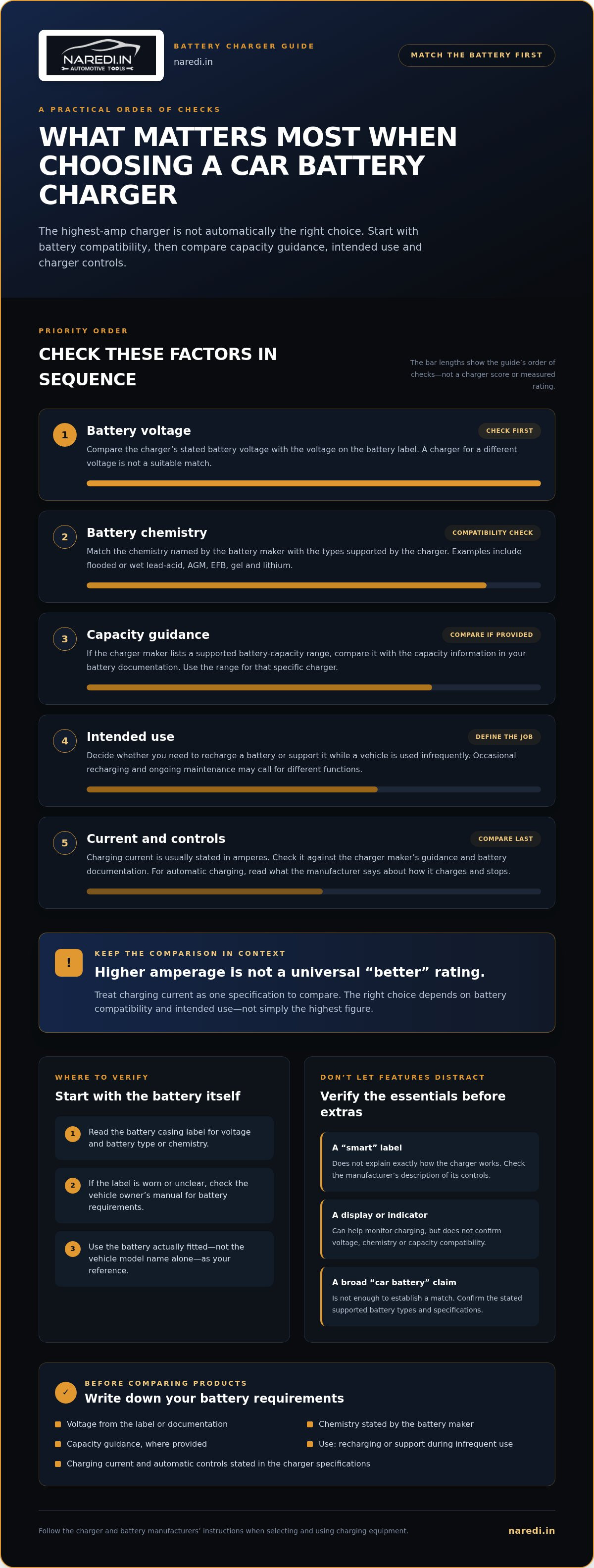
Once you’ve identified your battery, compare chargers in a set order. This keeps compatibility in focus and prevents displays or feature lists from distracting from the essential specifications. Car battery charger India listings may show several figures together, so check each against the battery and charger manufacturers’ guidance.
Check voltage and chemistry before comparing extra features. A charger must suit the battery before its other functions matter.
Match voltage, chemistry, and capacity guidance
Use this sequence to narrow your options:
- Confirm voltage. Compare the charger’s stated battery voltage with the voltage on the battery label. A charger intended for a different voltage is not a suitable match.
- Match chemistry. Check the battery manufacturer’s description, then look for that chemistry among the charger’s supported types. Don’t infer compatibility from a broad claim such as “car battery charger.”
- Compare capacity guidance. If the charger maker states a supported battery capacity range, compare it with the capacity information in your battery documentation. Use the range stated for that specific charger rather than assuming that all models with the same voltage support the same batteries.
- Define the use. Decide whether you need to recharge a battery or support it while the vehicle is not used regularly. The intended job helps determine which charging functions matter.
Assess charging current and control features
Charging current, usually shown in amperes, describes how much electrical current a charger can deliver. Treat it as a specification to compare, not a score where the highest figure automatically wins. Check the charger maker’s guidance alongside the battery documentation. The right choice depends on compatibility and intended use, not on a universal amperage.
Check how the charger controls the process. If a product is described as automatic, read what the manufacturer says about charging and stopping. A display or indicator can help you monitor the process, but it does not confirm that the charger supports your battery’s voltage, chemistry or capacity. Verify those specifications first.
Use the checklist to narrow your options
Before comparing features or product claims, note the requirements that apply to your battery:
- Battery voltage from its label or documentation.
- Battery chemistry as stated by its manufacturer.
- Capacity guidance from the battery and charger makers, where provided.
- Intended use, such as recharging or support during infrequent vehicle use.
- Charging current and automatic controls stated in the product specifications.
Compare product specifications with this checklist rather than relying on headline claims or a feature count. With your requirements in hand, you can browse naredi.in automotive tools and assess battery chargers against your needs.
Manual, automatic, and maintenance chargers: compare their intended use
Charger labels describe different ways of managing a charging task, but they don’t tell the whole story. For a car battery charger India buyers should compare the stated operating mode with their battery requirements and routine. The table summarizes the broad distinctions. Use the individual product information and manual for model-specific details.
| Charger type | User involvement | Typical stated operation |
|---|---|---|
| Manual | The user follows the charging process and instructions, including when to stop. | Charging is controlled by the user rather than described as fully automatic. |
| Automatic | The user selects and connects the charger as directed, then follows its operating instructions. | The product is described as managing charging automatically. The exact control behaviour varies by model. |
| Maintenance charging | Use and monitoring depend on the charger’s stated maintenance function and instructions. | Intended to support a battery during periods when a vehicle is not used regularly. Specific operation varies. |
What manual and automatic operation mean for a buyer
A manual charger generally requires closer user involvement. Follow the manufacturer’s directions for charging and stopping rather than assuming the unit will manage the process independently. This type may suit someone comfortable monitoring the task and following the specified procedure.
An automatic charger is described as controlling charging with less ongoing adjustment from the user. However, charging stages, cut-off behaviour and protective functions vary by product. Read the specifications to understand what the specific model does, then follow its manual for connection, operation and monitoring. The manual, not the category label, explains how to use it.
Choose a format around the charging routine
Consider how often you need to charge and who will operate the unit. For occasional charging, choose a process you can follow confidently. If a vehicle is used infrequently and battery support is part of your routine, look for a model that explicitly describes a maintenance function. Don’t assume every automatic charger is also a maintainer, or that all models support the same duration or method.
A charger replenishes a compatible battery. A jump starter serves a different purpose: it provides starting assistance when a vehicle cannot start. Don’t treat the two as interchangeable.
For any model, verify its operating modes in the product information. Features vary, so labels such as “smart,” “automatic” or “maintenance” are no substitute for checking the stated operation and instructions.
Use a car battery charger safely and avoid common buying mistakes
Safe charging starts before you connect the charger. For a car battery charger India buyers should use the vehicle manual, battery instructions and charger manual as the primary guidance for compatibility, connection and operation. General precautions help you prepare, but they don’t replace product-specific instructions.
Prepare the work area using general precautions, then follow the battery and charger manufacturers’ instructions for every product-specific step.
Prepare the battery and charging area
Read the vehicle and battery manuals before charging, and follow the charger maker’s connection sequence. Prepare a stable, dry work area. Ensure it is well ventilated where the instructions require this. Before use, inspect the battery, charger casing, leads and clamps for visible damage, loose parts or wear. Don’t proceed with damaged equipment or a damaged battery.
If you find damage, stop and seek qualified help rather than attempting a repair or improvised connection. Keep the work area clear so you can handle the charger and leads without strain. Confirm that the charger is intended for the battery and charging task before beginning. Careful setup cannot correct a compatibility mismatch.
Avoid compatibility and feature-claim mistakes
Don’t choose a charger solely by its current rating or promotional wording such as “smart” or “universal.” These labels don’t establish that a model suits your battery. Don’t assume a charger supports lithium or another chemistry unless the product documentation explicitly states compatibility with that battery type.
Safety features are model-specific too. Treat reverse-polarity protection or thermal protection as a feature only when the product specifications or manual say so. Don’t infer protection from a product category, a marketing phrase or a feature shown on another model.
Before each charging session, use this quick preparation check:
- Confirm the charger is compatible with the battery’s voltage and chemistry.
- Read the specific instructions for connection, operation and monitoring.
- Inspect the battery, leads, clamps and charger casing for damage.
- Set up in a stable, dry area, with ventilation where the instructions require it.
- Verify any safety protection in the documentation for that exact charger model.
Stop if the instructions are unclear, equipment is damaged or the battery shows signs of damage. Don’t guess at connection steps or rely on a feature claim to make an unsuitable charger safe. Check specifications and documentation before purchase, then follow the operating instructions each time.
Use these checks as you review Naredi’s automotive battery chargers and compare product information with your battery requirements.
Buy a genuine car battery charger in India from Naredi
Choosing a suitable charger is only part of the buying decision. The seller and the product information matter too. naredi.in is an automotive-tools retailer and authorized Pan-India distributor established in 2014. Its catalogue serves professionals and enthusiasts looking for automotive equipment, including battery chargers.
naredi.in describes its products as sourced directly from OEM manufacturers and 100% genuine. The website also indicates free shipping across India. These details provide useful context when buying through an India-wide automotive-equipment retailer. For compatibility and operating details, review the information for the individual charger.
What buyers can expect from naredi.in
naredi.in focuses on automotive tools and equipment, with battery chargers as part of a wider catalogue. The retailer serves both workshop users and people looking for charging equipment for personal use. Its stated authorized distributor position and direct OEM sourcing provide context about its approach to product authenticity.
Use seller details alongside the specifications, not instead of them. A genuine product still needs to match your battery and intended task. Review the charger’s stated voltage, supported battery chemistry, capacity guidance and operating modes. Don’t rely on a general category description to answer a model-specific compatibility question.
Take your charger shortlist to the product catalogue
Bring your requirements into the comparison. Note the voltage and chemistry shown in your battery documentation, any capacity guidance, and whether you need a charger for occasional recharging or a recurring battery-care routine. Compare those details with the specifications for each charger. This keeps your choice focused on compatibility rather than a headline feature or broad vehicle label.
- Use the battery’s stated voltage as a direct comparison point.
- Match the supported chemistry to the battery information.
- Compare any stated capacity range with your battery documentation.
- Check the listed operating modes against how you plan to use the charger.
For buyers comparing a car battery charger India options, this checklist makes product details easier to assess without assuming every charger suits the same battery or use case. Browse the catalogue and use each product page’s specifications to refine your shortlist.
Explore naredi.in's automotive tools and browse battery chargers with your compatibility checklist in hand.
Make your next charger choice with confidence
Before choosing a car battery charger India option, turn your research into a practical decision: keep the battery documentation close, compare the exact model details, and choose a charger whose stated role suits your intended use. This makes product comparisons more useful than scrolling through feature-heavy listings because you’ll know which specifications matter for your vehicle.
Your shortlist can stay simple. Focus on clear specifications and the instructions supplied for the model. If your requirements change, such as when you use a different battery or charging routine, reassess compatibility rather than assuming the same charger remains suitable. Keep the product information and operating instructions accessible for reference when you use the charger.
When you’re ready to compare options, browse Naredi’s automotive tools and battery chargers. Review the product information against your requirements and choose the charger that fits your needs.
Frequently Asked Questions
Can I use a car battery charger with any car battery?
No. A charger that works with one battery may be unsuitable for another, even if both are fitted to cars. Check the battery’s printed type and voltage, then look for those details in the charger’s documentation. For example, don’t infer AGM support from a description that only says “lead-acid.” If the label is unreadable, consult the vehicle manual or battery manufacturer’s information before choosing.
How do I know what size car battery charger I need?
Compare the battery’s voltage, chemistry and capacity guidance with the charger’s stated limits. “Size” can refer to more than the charger’s physical dimensions, so focus on its supported battery range and charging current. For a car battery charger India search, don’t treat a higher amp rating as an automatic upgrade. Use the battery and charger manuals to confirm that the model suits your battery and intended charging task.
Can I leave a car battery charger connected overnight?
Only if the specific charger’s instructions allow that duration and explain the required monitoring. A product described as automatic or suitable for maintenance use may still have conditions for connection and operation. Read the manual for charging-time limits, monitoring requirements and when to disconnect. Don’t use “smart” or “automatic” as a substitute for that guidance, or follow instructions from another model.
Can a car battery charger charge an AGM battery?
Yes, if the specific charger states that it supports AGM batteries and matches the battery’s voltage. Check the product documentation for AGM compatibility rather than relying on a general claim that the charger works with car batteries. If the charger has selectable modes, use only the mode identified for AGM in its instructions. The battery manufacturer’s guidance can also help you confirm the correct charging procedure.
Can I use a car battery charger to jump-start my vehicle?
Usually, a charger and a jump starter serve different purposes. A charger replenishes a battery according to its charging process, while a jump starter provides starting assistance. A depleted battery may need time to charge, so don’t expect a standard charger to start the engine immediately. If a product claims both functions, verify that capability in its specifications and follow the vehicle manual.
Is it safe to charge a car battery without removing it from the vehicle?
It depends on the vehicle and charger instructions. Some vehicle manuals specify connection points or precautions for charging while the battery remains installed. Check those directions before connecting anything, especially if the vehicle has battery-management or other electronic systems. Use only the instructed terminals and connection sequence. If the battery, wiring or charger is damaged, stop rather than attempting an in-vehicle charge.
Are car battery chargers sold in India compatible with Indian power supply?
Not automatically. Check the charger’s input-voltage and frequency ratings against the electrical supply where you plan to use it, and review the documentation for plug requirements. A product being sold in India doesn’t by itself establish that its input matches your supply. Don’t connect it if the rating is unclear or appears unsuitable. Use the manufacturer’s guidance to resolve input compatibility before operation.