

Car battery tester prices and checks for Indian drivers
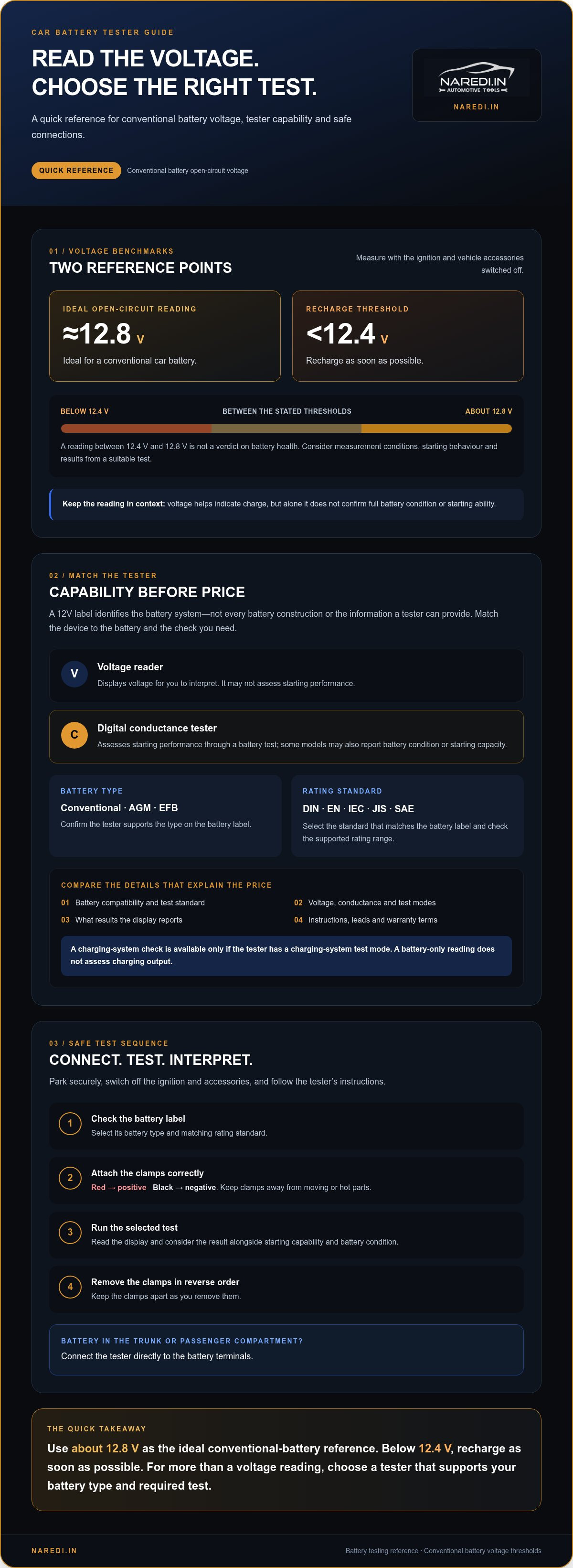
A conventional car battery ideally reads about 12.8 V at open circuit; below 12.4 V, it should be recharged as soon as possible. A car battery tester can show more than voltage, but the right choice depends on whether it supports your battery type and the checks you need.
It makes sense to compare prices first, especially when basic voltage checks and battery-health assessments serve different needs. But a low price alone won’t tell you whether a tester can assess a 12V battery, or use the correct test approach for AGM and EFB batteries.
This guide explains how to compare car battery tester options in India by capability, battery compatibility and intended use, rather than price alone. Learn how to read open-circuit voltage, connect a tester correctly and understand what its results can tell you about starting performance.
Key Takeaways
- Compare testers by battery compatibility and test functions, not price alone.
- Use about 12.8 V as the ideal open-circuit reading for a conventional battery; recharge it as soon as possible if it reads below 12.4 V.
- Match the tester’s setting to the battery type, especially for AGM and EFB batteries.
- For a battery in the trunk or passenger compartment, connect the tester to the battery terminals.
- Connect red to positive and black to negative, then interpret the reading alongside starting capability and battery condition.
Battery tester prices in India
When comparing a car battery tester in India, check its functions and battery compatibility before considering price. A basic voltage reader and a digital conductance tester do different jobs: one displays voltage, while the other assesses starting performance through a battery test. A higher price is worthwhile only if the added functions suit your vehicle and needs.
Start with the battery specification. A 12V vehicle may use a conventional flooded battery, AGM or EFB. Check that the tester supports the correct type and test standard. Cold-start current ratings can use DIN, EN, IEC, JIS or SAE. The tester’s supported rating range and selectable standard affect whether its result suits the battery label.
Compare what each display reports. A voltage-only model gives you a reading to interpret, while a more capable unit may also report battery condition or starting capacity. Look for clear instructions, an easy-to-read display and leads suited to regular handling. Compare test modes and warranty terms as well. These features help explain price differences without making the highest-priced model the automatic choice.
For a practical comparison, make a short checklist before browsing Indian listings. Note whether you need a voltage check, a conductance test, or charging-system checks. Then match each tester’s listed battery types, test standards and functions against that need. For example, a driver checking only a conventional 12V battery may not need advanced start-stop battery analysis. An AGM or EFB owner needs suitable support.
How to use a car battery tester safely? Park securely, switch off the ignition and accessories, then follow the tester’s instructions. Connect red to positive and black to negative, keeping the clamps away from moving or hot parts.
- Check the battery label and select its type and rating standard.
- Attach the red clamp to the positive terminal and the black clamp to negative.
- Run the selected test and read the displayed result.
- Remove the clamps in reverse order, keeping them apart.
Can a tester check the alternator and charging system? Yes, if it has a charging-system test mode. A battery-only tester may not provide this assessment. Compare the stated functions before buying: a battery reading alone does not assess charging output.
Price comparisons are most useful when they separate essential capability from extra features. A 12V label alone doesn’t confirm AGM or EFB compatibility. Check the battery type, current-rating standard, test modes and result information together. For open-circuit voltage, a conventional battery ideally reads about 12.8 V; below 12.4 V, it should be recharged as soon as possible. That reading helps interpret the battery’s charge, while a suitable tester can add information about its starting condition.
Open-circuit voltage thresholds
For a conventional car battery, an open-circuit reading of about 12.8 V is ideal. Below 12.4 V, recharge it as soon as possible. These values help you interpret charge level, but voltage alone doesn’t confirm the battery’s full condition or starting ability. Treat each reading as one useful measurement, not a complete diagnosis.
“Open circuit” means measuring voltage with no charging source or electrical load operating. Switch off the ignition and vehicle accessories before measuring. If a load is active, the reading reflects more than the battery’s resting voltage. Record the value and compare it with the two reference points for a conventional battery.
- About 12.8 V: the ideal open-circuit voltage for a conventional battery.
- Below 12.4 V: recharge the battery as soon as possible.
- Between those values: use the reading as a comparison point, then consider the battery’s behaviour and test results.
A reading between 12.4 V and 12.8 V isn’t covered by either stated threshold. Don’t label the battery healthy or failed from that number alone. Check the conditions of the measurement, then assess whether the vehicle starts normally and whether a suitable test reports additional battery information. For example, a low reading after the vehicle has been unused can prompt a recharge, followed by another measurement.
Follow a consistent process so you can compare readings accurately:
- Park the vehicle and switch off the ignition and accessories.
- Place the tester leads on the battery terminals, with red on positive and black on negative.
- Read the voltage and note whether it is near 12.8 V or below 12.4 V.
- If it is below 12.4 V, recharge the conventional battery as soon as possible.
- Measure again under the same conditions and compare the results.
A voltage reading is most useful when measurement conditions are consistent. If you first checked with the headlights or another electrical consumer on, switch the load off before measuring open-circuit voltage. A brief consumer load shortly before a conductivity measurement can remove surface tension and help produce correct results, but this is a separate test procedure.
For a practical next step, use a battery tester suited to your battery type and the information you need. A tester can add checks beyond voltage, while the 12.8 V and 12.4 V references remain useful for interpreting a conventional battery’s open-circuit reading.
12V vehicle battery testers
A 12V rating identifies the battery system a tester is designed to assess, but it doesn’t describe every battery’s construction. Conventional starter batteries, AGM batteries and EFB batteries can all be used in 12V vehicles. The tester must support the battery type and its test method. A device that reads voltage may not provide the same assessment as one that evaluates starting capability.
Check the battery label before selecting the tester settings. It identifies the battery type and cold-start current rating. If the tester asks for a rating standard, choose the one that matches the label. A mismatch can make the result less useful because the device compares the battery against the selected type and specification.
Battery location also changes where to connect the leads. When the battery is inside the vehicle, check the tester instructions for the appropriate connection point. Don’t use the engine-compartment jump-start contacts for that test. Direct connection measures at the battery itself and follows the specified testing location.
Before testing, park the vehicle, switch off the ignition and turn off electrical consumers. Make sure the terminals are accessible and identify the positive and negative markings. Connect the red lead to positive and the black lead to negative. Select the correct battery type and rating standard, then follow the tester’s prompts. Carefully remove the leads after the result appears.
- Read the battery label and identify its type and current rating.
- Confirm that the tester supports 12V and the battery’s construction.
- Choose the corresponding type and rating standard in the tester menu.
- Connect to the battery terminals, especially when the battery is inside the vehicle.
- Run the test and interpret the result using the tester’s displayed guidance.
Test duration can vary by battery type. A conventional starter battery may take less time to test than an AGM battery. Let the tester finish rather than treating a slower result as a fault. AGM testing may take longer because the device applies an algorithm suited to that battery construction.
For example, a 12V vehicle with an AGM battery needs a tester that supports AGM, not simply one marked for 12V batteries. A conventional starter battery calls for its matching type and rating. The key selection checks are therefore system voltage, battery construction and the current standard shown on the label.
A 12V result is only useful when the setup matches the battery. Correct terminal connection, the right menu selection and a completed test all matter. If the vehicle’s battery is difficult to access, locate its actual position before attaching leads. For batteries in the trunk or passenger compartment, use the battery terminals rather than under-hood jump-start contacts.
If the battery is in the trunk or passenger compartment, connect the tester directly to its terminals, not to the jump-start contacts in the engine compartment.
AGM and EFB battery testing
AGM and EFB batteries need a tester that supports the correct battery type because each uses a different test algorithm. A generic setting can produce a result based on the wrong method. Check the battery label, then select the matching type in the tester menu before starting.
For a start-stop battery, state of health involves more than state of charge. A charge reading shows the available charge at that moment. A health assessment also considers cold-start capability, residual capacity and charge acceptance. Together, these factors indicate the battery’s ability to deliver starting power and accept a charge.
A voltage reading alone cannot provide this full assessment. For example, an AGM battery may show a charge level without revealing its remaining capacity or starting capability. Use a tester that supports the battery type and provides a health assessment. Read that result alongside the charge reading, as the two are not interchangeable.
Follow a consistent sequence when testing an AGM or EFB battery:
- Read the battery label and identify whether it is AGM or EFB.
- Choose the matching type in the tester settings.
- Enter the battery’s cold-start current rating and its stated standard, if requested.
- Connect the tester leads as instructed and run the test to completion.
- Review the state-of-health result and charge information as separate indicators.
Do not select AGM simply because the vehicle has a start-stop system. Confirm the battery type on its label. Select EFB for an EFB battery, just as you would select AGM for an AGM battery. The test algorithm depends on this choice, so an incorrect setting can make the result less useful.
What safety risks and common testing mistakes should you know about? Reversed leads, clamps touching each other and selecting the wrong battery type are avoidable errors. Keep the clamps apart, follow the tester’s connection instructions and choose the AGM or EFB setting that matches the battery label.
Let the tester complete its full sequence before interpreting an AGM result. A conventional starter battery may take less time to test, so a longer AGM test does not itself indicate a fault. The device needs time to apply the selected algorithm and assess the battery’s condition.
For example, an EFB test may show adequate charge but poor health. Those results describe different aspects of the battery: charge acceptance, residual capacity and cold-start capability contribute to the health assessment. Use the result displayed by the tester, and repeat the test only with the same battery type and rating settings.
State of health assesses what the battery can provide beyond its charge level. Consider the factors together: cold-start capability, residual capacity and charge acceptance inform the health assessment, while state of charge is a separate measure. This distinction keeps the focus on the battery’s broader condition, not charge alone.
How does a car battery tester work?
A car battery tester connects to the battery and evaluates electrical measurements. Depending on its functions, it may display voltage or perform a conductivity measurement. Some testers use the selected battery type and cold-start rating to assess starting capability. The result is more useful when those settings match the battery label.
Before a conductivity measurement, briefly switching on a consumer such as the headlights can remove surface tension and help produce correct results. Follow the tester’s instructions for the test sequence. Keep the vehicle stationary, switch off the ignition and connect the leads securely. Connect the red cable to positive and the black cable to negative.
The tester processes the measurement and displays a result. A voltage reading describes the battery’s electrical potential at that moment. A conductivity test provides a different assessment, using the battery’s response to help evaluate its condition. The measurements are not interchangeable, so check whether the selected mode measures voltage, battery health or starting performance.
- Switch off the ignition and prepare the battery terminals.
- Connect red to positive and black to negative.
- Select the battery type and rating standard shown on its label.
- Choose the required test mode and follow the on-screen prompts.
- Wait for the result, then interpret it according to the selected test.
Starting current provides useful context. The available starting current decreases as a battery’s state of charge falls. If the result indicates reduced starting capability, consider the charge reading alongside it. A low state of charge can affect the current available for starting, so do not treat one measurement as the whole picture.
For example, a tester may display voltage and a separate assessment of battery condition. These outputs answer different questions: voltage is an electrical reading, while the condition result reflects the selected test method. For AGM and EFB batteries, select the correct type because each uses a different test algorithm. Let the tester finish before interpreting the display.
Good terminal contact matters. A loose clamp can interrupt a measurement, and reversed leads break the correct connection sequence. Keep the clamps steady and apart during testing. If an error appears, inspect the connections and selected settings before testing again. To compare results consistently, repeat the test using the same mode and setup.
Choose a device with functions suited to your checks, then compare battery testing options for the battery type and test information you need.
Naredi.in: Battery Chargers
naredi.in offers Battery Chargers and Battery Testers for drivers assessing battery condition and choosing a suitable next step. A tester helps you understand the battery reading; a charger is for when the battery needs charging. Match the charger to the battery type, including AGM or EFB, and follow its operating instructions.
When comparing equipment, focus on the information you need from the test and the battery your vehicle uses. Choose a tester to check condition, or consider a charger when charging is the task. Explore Battery Chargers and Battery Testers at naredi.in.
Make your next battery check count
Turn your test result into a practical next step. First decide whether you need to monitor battery condition, recharge the battery or support another part of your vehicle’s upkeep. A car battery tester is most useful when its functions answer your specific question, rather than when you choose by features alone.
naredi.in offers Battery Testers for checking battery condition, Battery Chargers for charging needs and Performance Additives. Decide which category suits your task, then explore the available options with that purpose in mind. The right equipment can help make future checks clearer and more consistent.
For guidance on choosing equipment for your needs, contact naredi.in for help. Take the next step with a clear purpose and choose your automotive tools with confidence.
Frequently Asked Questions
Need help choosing the right tool?
Start with the task: a voltage check, a battery condition assessment or a charging-system test. Then match the tester’s supported battery type and cold-start current standard to the vehicle’s battery label. For example, if your vehicle has an AGM battery, choose a model that supports AGM. Clear results and straightforward controls can also make routine checks easier to understand.
How do I interpret car battery voltage and health test results?
Read voltage and health as separate indicators, then consider them together. For a conventional battery, about 12.8 V is the ideal open-circuit reading; below 12.4 V, recharge it as soon as possible. A health result also considers starting ability and other battery characteristics. A car battery tester may report these separately, so don’t treat a reasonable voltage reading as proof of adequate starting current.
What is the price of a car battery tester in India?
On the Indian market, testers typically range from ₹600 to ₹658, with a median of about ₹642. Treat this as a market reference, not a price for every model. Functions, supported battery types and test modes affect what a tester offers. Compare those specifications against your vehicle’s battery and intended checks, rather than choosing solely by the lowest listed amount.
Which features should I look for, such as CCA range and battery compatibility?
Look for a cold-cranking amp range that covers the rating on your battery and support for its type, including AGM or EFB where applicable. Check that the car battery tester offers the modes you need and supports the battery’s stated rating standard, such as SAE or EN. A clear display also helps you select settings accurately and interpret results consistently.
Which car battery testers are best in India, and how do they compare?
The best choice depends on battery compatibility and the functions you need, not price alone.