

A maintainer’s value comes down to how it supports battery upkeep, not just its headline rating. The CTEK MXS 5.0 offers a maximum charging output of 5.0 A and fully automatic eight-step charging for 12V batteries. In the CTEK MXS 5.0 versus Bosch C3 car battery maintainer comparison, those maintenance features are a practical starting point for weighing the two options.
It’s sensible to look beyond charging performance when choosing a maintainer. Cable reach, included and optional accessories, and how each unit connects to the battery can all affect day-to-day convenience.
Compare battery compatibility, cable length, accessories and connection style before choosing. Match the maintainer to the battery fitted in your vehicle and how you plan to use it, rather than relying on one specification alone.
Key Takeaways
- Compare cable reach and connection options against where the battery sits and how you’ll use the maintainer.
- Factor in optional accessories when assessing the setup each charger can support.
- Match battery compatibility to your vehicle’s battery type before choosing between the two units.
- Use maintenance features and ease of connection together to decide which option best fits your routine.
Cable length and optional accessories
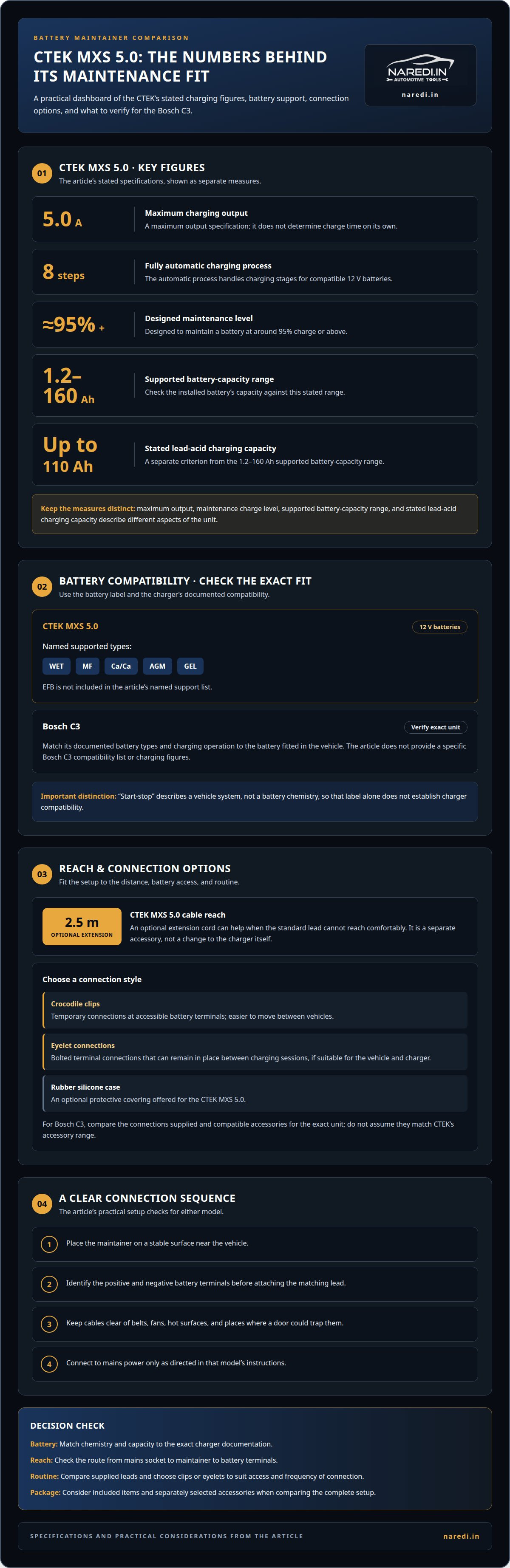
Reach depends on the distance between the mains socket, maintainer and battery terminals. The CTEK MXS 5.0 has an optional 2.5 m extension cord, which can help when the standard lead cannot reach comfortably. It is a separate accessory, not a change to the charger itself. Avoid stretching leads across walkways or placing connections where they could be pulled loose.
CTEK also offers optional crocodile clips and eyelet connections for the MXS 5.0, plus a rubber silicone case. Clips suit temporary connections at battery terminals; eyelets provide a bolted connection for a more fixed setup. The case adds a protective covering around the unit. Bosch C3 accessories should be compared by their specific function and compatibility, rather than assumed to match CTEK’s range.
For an India price comparison, consider the package contents and any separately selected accessories alongside each product’s current listing. The complete setup determines what you need to buy.
To reduce the risk of reversed connections with either model, connect positive to positive and negative to negative, then follow that model’s instructions before powering it. Stop if the battery markings or clamps are unclear. This comparison does not establish model-specific safety protections.
Warranty coverage and service access in India depend on the terms supplied for the exact model and purchase channel. Compare those documents for both maintainers, including how warranty claims are handled. The table summarises the practical cable and accessory considerations.
| Option | Cable reach | Accessory considerations |
|---|---|---|
| CTEK MXS 5.0 | Optional 2.5 m extension cord | Optional crocodile clips, eyelets and rubber silicone case |
| Bosch C3 | Assess against the battery and socket positions | Compare the supplied connections and compatible accessories |
Measure the route from the maintainer to the battery, then choose a connection style and accessories that suit how often you’ll attach it.
Battery maintenance performance
The CTEK MXS 5.0’s automatic charging and maintenance functions are central to its performance. Compare those capabilities with the Bosch C3’s stated specifications and your battery’s requirements before choosing.
CTEK MXS 5.0 battery type support
The CTEK MXS 5.0 supports 12 V WET, MF, Ca/Ca, AGM and GEL batteries. Its fully automatic eight-step charging process and maximum 5.0 A output provide a defined charging approach for compatible batteries. The stated lead-acid charging capacity is up to 110 Ah, while its supported battery-capacity range is 1.2 to 160 Ah. These limits describe different criteria, so distinguish them when checking a battery’s fit.
Bosch C3 battery type support
For the Bosch C3, match the exact unit’s stated battery compatibility to the battery fitted in the vehicle. Don’t assume support for AGM, EFB or start-stop batteries from the model name alone. The useful comparison is whether the charger’s documented battery types and charging operation suit the specific battery, rather than whether its general description sounds similar to the CTEK MXS 5.0.
The CTEK MXS 5.0 supports AGM among its named battery types, but EFB is not included in that list. Start-stop describes a vehicle system, not a battery chemistry, so it doesn’t establish compatibility on its own. The CTEK MXS 5.0 vs Bosch C3 car battery maintainer comparison should therefore begin with the battery label and the exact charger compatibility information.
For upkeep, the CTEK MXS 5.0 is designed to maintain a battery at around 95% charge or above. Its eight-step automatic process handles charging stages, while its 5.0 A maximum output is a separate specification. Neither figure alone determines the charge time for every battery. Battery condition and capacity also affect the task. In the CTEK MXS 5.0 vs Bosch C3 car battery maintainer comparison, weigh maintenance functions alongside chemistry support and capacity limits.
Before choosing a maintainer, match its stated compatibility to your battery’s chemistry and capacity. Base your decision on the battery installed in the vehicle, not on a broad start-stop label or headline charging figure.
Ease of use and included connection leads
Connection leads affect how easily a maintainer reaches the battery and stays attached. With the CTEK MXS 5.0 or Bosch C3, the practical comparison starts with the supplied lead type, terminal access, and space around the vehicle battery. A clear setup keeps the charger stable and the cables away from moving or hot parts.
Battery access can determine the most convenient connection style. Crocodile clips suit temporary connections to accessible terminals. Eyelet leads attach at the battery terminals and can remain in place between charging sessions, making repeat connections simpler. Clips are easier to move between vehicles. Choose the lead style for your vehicle, not just the charger.
Use this setup sequence for either model, while following its own instructions:
- Place the CTEK MXS 5.0 or Bosch C3 on a stable surface near the vehicle.
- Identify the battery’s positive and negative terminals before attaching the matching lead.
- Keep cables clear of belts, fans, hot surfaces, and areas where a door could trap them.
- Connect the charger to mains power only as directed in its instructions.
Terminal access can make one connection style more convenient. A battery beneath a seat or inside a compartment, for example, may be awkward to reach repeatedly with clips. A fixed eyelet lead can reduce handling if it suits the vehicle and charger connection. For an exposed battery used across different vehicles, removable clips offer more flexibility.
Before choosing between the CTEK MXS 5.0 and Bosch C3, compare the exact box contents with the battery layout and your charging routine. Confirm that the included lead reaches the connection point without tension, and that its connector matches the maintainer. A tidy cable route and accessible terminals make routine connection easier; the right choice depends on where the charger will sit and how often it will be connected.
Which car battery types do CTEK MXS 5.0 and Bosch C3 support?
Battery chemistry is a key selection criterion for both maintainers. The CTEK MXS 5.0 supports specified 12 V lead-acid types, while Bosch C3 suitability depends on matching its compatibility information to the battery in your vehicle.
The CTEK MXS 5.0 supports WET, MF, Ca/Ca, AGM and GEL 12 V batteries. These names identify battery types, so use the label on the installed battery rather than relying only on the vehicle model. Its stated chemistry support provides a direct reference when assessing a compatible 12 V lead-acid battery.
AGM batteries are used in some start-stop applications, but not every start-stop battery is AGM. EFB is a distinct battery type, and it is not among the CTEK types stated here. Check the battery’s type against the maintainer’s listed compatibility; “start-stop” is not a substitute for identifying its chemistry.
For Bosch C3, use the exact model’s battery compatibility information to assess WET, MF, Ca/Ca, AGM, GEL or EFB suitability. The model name alone doesn’t establish support for each chemistry, and start-stop use also doesn’t identify battery type. Compare the battery label with Bosch’s specified types before selecting a charging mode.
For either maintainer, compare three details: the battery’s voltage, its chemistry, and the charger’s stated compatibility. For example, a 12 V AGM battery matches a chemistry explicitly supported by the CTEK MXS 5.0. An EFB battery requires explicit EFB support from the chosen maintainer; shared 12 V voltage alone is not enough to establish compatibility.
Battery testers can help assess battery condition, while a correctly matched charger supports upkeep. Choose by the battery type first, then compare each maintainer’s stated coverage. Explore battery testing and charging options to align your equipment with your battery’s requirements.
Naredi.in
naredi.in helps you match automotive equipment to your vehicle and intended use. Once you’ve identified the battery type and maintenance needs, explore its Battery Chargers and Battery Testers for equipment suited to those tasks. Performance Additives and Jump Starters meet other automotive needs, but do not replace a compatible maintainer.
Use this comparison to identify your priorities, such as battery chemistry, lead connections and ongoing upkeep. Then explore the relevant product category with those requirements in mind. Focus on compatibility and intended use, rather than a single headline feature.
Contact naredi.in to discuss your battery equipment requirements.
Choose equipment around your next battery task
Make the decision fit the way you’ll use the maintainer, not just the comparison on paper. The CTEK MXS 5.0 vs Bosch C3 car battery maintainer choice is most useful when it leads to a setup that matches your vehicle, battery, and charging routine. Think about how often you’ll connect it and what you need your battery equipment to do over time.
If your requirements change, reassess the choice against the battery in your vehicle and the task at hand. Keeping compatibility and practicality in focus helps you avoid buying equipment that doesn’t suit your intended use. For those maintaining seasonal machinery or looking for dependable power equipment, Champion Baltics provides a wide range of workshop and power solutions.
For guidance on the next step, contact naredi.in. Make your choice with a clear view of what your battery needs, and move forward with confidence.
Frequently Asked Questions
CTEK MXS 5.0: How did it perform?
The CTEK MXS 5.0 combines automatic charging with a maintenance function for compatible 12 V batteries. Its maximum output is 5.0 A, and its eight-step process is designed to manage charging stages automatically. For a vehicle kept unused between drives, the maintenance mode is useful after charging. Performance still depends on battery condition, capacity, and compatibility, so match those factors before connecting the unit.
What are the CTEK MXS 5.0 and Bosch C3 charging current and battery capacity ranges?
The CTEK MXS 5.0 has a maximum charging output of 5.0 A and supports battery capacities from 1.2 to 160 Ah. Its stated lead-acid charging capacity is up to 110 Ah. These figures describe different limits. For the Bosch C3, compare the current and capacity figures for the exact unit with the vehicle battery, since those specifications determine whether it suits the intended charging task.
How do the CTEK MXS 5.0 and Bosch C3 charging modes and automatic maintenance features compare?
The CTEK MXS 5.0 uses fully automatic eight-step charging for 12 V batteries and maintains a battery at around 95% charge or above. For the Bosch C3 comparison, consider its stated charging modes and whether its instructions describe automatic maintenance after charging. This distinction matters if the vehicle will remain parked, rather than needing only a single charging session.
Which is better for Indian car batteries: CTEK MXS 5.0 or Bosch C3?
Neither is automatically better for every Indian car battery; choose the maintainer that matches the battery chemistry, capacity, and vehicle’s charging requirements. The CTEK MXS 5.0 has a 220-240 VAC input range and supports specified 12 V lead-acid batteries. For a Bosch C3, compare the exact unit’s specifications against the battery label and intended use before deciding.
CTEK MXS 5.0 price in India vs Bosch C3 price in India
Compare Bosch C3’s current local listing and the exact package contents, including any separately selected accessories.
CTEK MXS 5.0 and Bosch C3 safety protections and reverse-polarity risks
For either model, connect positive to positive and negative to negative, then follow that model’s instructions before powering it. This comparison does not establish model-specific safety protections.