

naredi.in brings global automotive tool brands to India.
When choosing automotive tools, look beyond the product category to consider who distributes them and how they’re sourced. Genuine tools help you choose equipment with confidence, whether you work with vehicles professionally or handle projects in your own garage.
This article explains what naredi.in does and where it is based. You’ll also learn how naredi.in's role as a distributor relates to product authenticity, and which categories it offers, including battery chargers, battery testers, jump starters, performance additives and OBD tools. That context can help you understand whether naredi.in's range aligns with the equipment you’re looking for.
Key Takeaways
- Understand how an automotive-tools retailer and distributor differs from a repair or maintenance provider.
- Learn what the company’s establishment in 2014 and Pan-India distributor role tell you about its place in the Indian market.
- See how direct sourcing from OEM manufacturers relates to product authenticity.
- Get a clearer picture of the New Delhi company profile and the tool categories that may suit your requirements.
Business type and company establishment
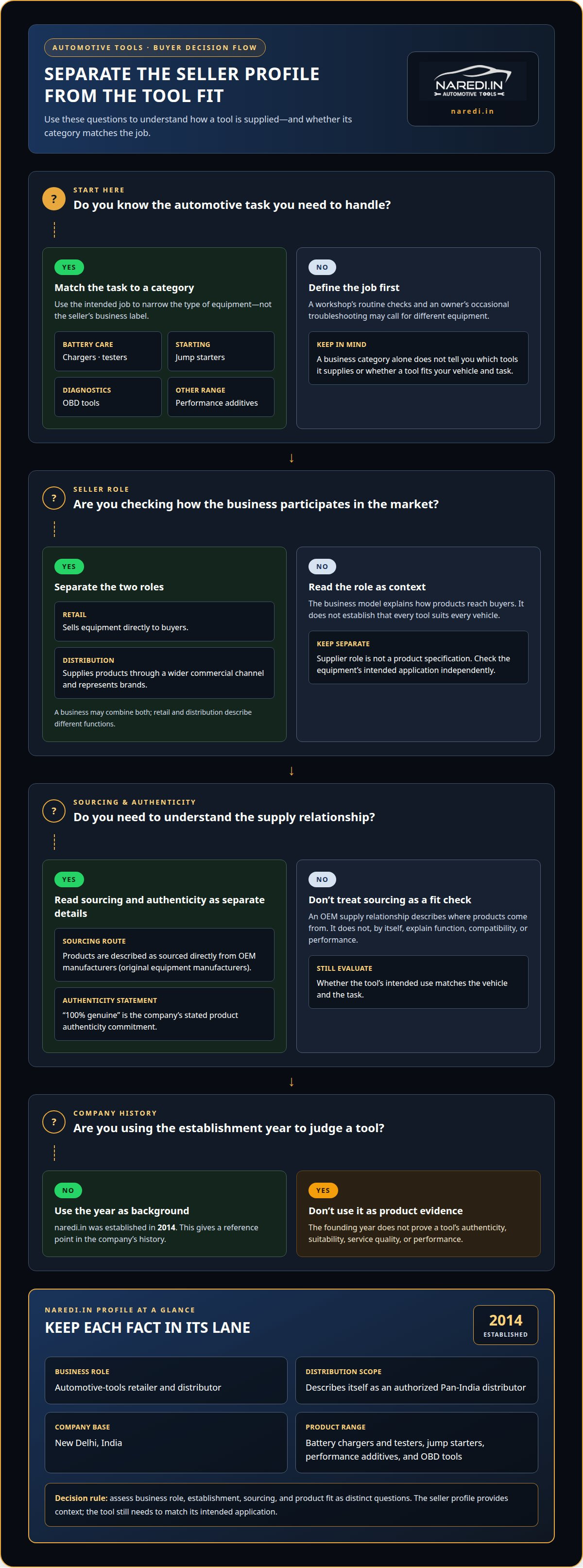
An automotive-tools business can operate as a retailer, a distributor, or both. A retailer sells equipment directly to buyers, while a distributor supplies products through a wider commercial channel. A business combining these roles can serve workshops, trade buyers, and individual vehicle owners. The distinction clarifies how products reach customers in India and what role the seller plays.
Consider a workshop sourcing diagnostic equipment. A retailer handles the direct sale, while a distributor represents a manufacturer’s products across a market. The roles can overlap, but they are not identical: retail describes the sale to a buyer, while distribution describes the supply and representation function. Understanding the business model helps clarify whether a company focuses on direct sales, brand distribution, or both.
Automotive tools serve different tasks, so a business category alone doesn’t tell you what a seller supplies. Someone looking for battery testing equipment has a different need from someone seeking vehicle diagnostics. Focus on how the seller’s product categories match the intended task. A workshop may need equipment for routine checks, while a vehicle enthusiast may want a tool for occasional troubleshooting.
Company establishment adds another useful detail: it indicates when an organisation began operating. For a buyer, that date can provide context about the company’s history, but it does not by itself prove the authenticity or suitability of a particular tool. Product sourcing, brand representation, and the equipment’s intended use remain separate considerations. A company’s founding date should therefore be read as background, not as a substitute for product-level information.
A distributor’s sourcing model also helps explain its role. Direct sourcing from an original equipment manufacturer, or OEM, describes a route from the manufacturer to the distributor. This information clarifies the supply relationship, but says nothing by itself about a tool’s function, compatibility, or performance. Knowing a seller’s distribution role, for example, doesn’t tell you whether a diagnostic tool supports a particular vehicle system.
To assess a business profile, separate these practical points:
- Business role: Determine whether it sells directly, distributes brands, or performs both functions.
- Establishment: Treat the stated founding year as company history, not a product specification.
- Sourcing: Note whether products come directly from an OEM or through another channel.
- Product fit: Match the tool category to the intended automotive task.
These details answer different questions. Business role explains how the company participates in the market, establishment provides historical context, and sourcing describes the route products take. Product fit connects a purchase to a practical need. Keeping these points distinct prevents a common mistake: assuming a company’s age or distributor status means every tool suits every vehicle.
A fleet operator choosing workshop equipment may prioritise the supplier’s distribution role and the tool’s intended application. An individual owner may focus first on the task, such as reading vehicle fault information. Both benefit from understanding the seller’s business type, then evaluating the product category separately. This keeps the decision specific instead of relying on a broad company label.
Company establishment can also help readers place a business within its own timeline. A stated year gives a clear reference point. It should not be stretched into claims about market leadership, service quality, or product performance. Those conclusions require separate evidence. A reliable profile uses the establishment date narrowly and explains the business’s actual role in plain terms.
In India, the distinction between retailer and distributor is useful when considering where automotive tools come from and how they reach buyers. Read the company profile for its stated business type, establishment, distribution role, and sourcing, then evaluate the tool itself. A charger, tester, or diagnostic device still needs to match its intended application. This approach helps trade buyers and vehicle enthusiasts assess automotive equipment more clearly.
NAREDI.IN company profile and New Delhi location
The business is based in New Delhi and operates as an automotive-tools retailer and distributor. These roles describe two parts of its market position. Retail connects products with buyers directly. Distribution represents a broader supply role for automotive tool brands. Together, they explain how the business serves customers in India without implying vehicle repair or workshop services.
Its establishment year is 2014. That date gives readers a clear point in the company’s history. It is useful context, but it does not describe a tool’s features or suitability. Buyers still need to match equipment to the vehicle and task. A workshop selecting diagnostic equipment, for example, has different requirements from an owner seeking a battery tester.
The company describes itself as an authorized Pan-India distributor. This identifies its distribution role across the Indian market. It also distinguishes the company profile from a retailer operating only at a local level. The phrase describes the stated distribution scope. It should not be read as a claim about delivery timing, local pickup, or the presence of branches in every city.
Products are sourced directly from OEM manufacturers. OEM means original equipment manufacturer. This sourcing detail describes the supply relationship, while “100% genuine” describes the company’s stated product authenticity commitment. Neither point replaces the need to select a tool for its intended use. For example, a diagnostic device and a charger serve different automotive tasks.
New Delhi provides the company’s base in India’s capital. A business location gives readers a geographic reference for the organisation. It does not, on its own, establish where each order is fulfilled or how goods reach a particular buyer. The Pan-India distributor description addresses market scope, while New Delhi identifies the company’s base. Keeping those details separate makes the profile easier to interpret.
Readers can assess the profile through these distinct details:
- Business model: Retail and distribution describe its commercial roles.
- Company history: The 2014 establishment year provides a timeline reference.
- Market scope: The authorized Pan-India distributor description states its distribution reach.
- Product sourcing: Direct OEM sourcing explains the stated supply route.
- Location: New Delhi identifies the company’s base.
These facts answer different questions. The business model explains how the company participates in the automotive-tools market. Its establishment date places the organisation in time. The distributor description indicates its stated role across India. OEM sourcing explains where products come from, and New Delhi gives a geographic anchor. None should be treated as a substitute for product specifications.
For a buyer elsewhere in India, it’s useful to distinguish the company’s base from its reach. Its base is one location, while Pan-India distribution describes its stated market role. These facts do not specify shipping arrangements or delivery schedules, but they show that the profile combines a defined base with a wider distribution scope.
When assessing genuine automotive tools, use the company profile as context, not as your only decision factor. Consider the stated distribution role and sourcing, then check whether the product category fits the task. A workshop may need equipment for repeated professional use, while an individual owner may need a tool for a specific check. In both cases, the intended application matters most.
For a closer look at the business’s automotive equipment, explore its automotive tool range. The company profile establishes who supplies the products and where it is based. Choosing the right equipment still depends on the vehicle, the intended task, and the tool category.
Naredi.in: OBD Tools
naredi.in offers OBD tools for people seeking automotive diagnostic equipment. An OBD tool connects to a vehicle’s onboard diagnostic system to access diagnostic information. The right choice depends on the vehicle and task, so identify the information you need before selecting a tool. Naredi’s OBD range serves this equipment need.
For other automotive needs, Naredi’s range also includes battery chargers, battery testers, performance additives, and jump starters. These categories serve distinct purposes, from testing a battery to providing starting support. Choose according to the task. If you’re considering an OBD tool or another category, explore Naredi’s product range and select the equipment that fits your requirement.
Choose equipment around the task ahead
Make your next decision specific: define the vehicle-related task first, then choose a suitable product category. A clear requirement helps focus your options, whether you need a battery charger, battery tester, or performance additive. Each serves a different purpose, so let the intended use guide your selection.
For diagnostics, consider an OBD tool. For battery-related needs, distinguish between charging, testing, and jump-starting rather than treating these tools as interchangeable. This practical approach keeps your choice grounded in what you need the equipment to do.
With that requirement in mind, explore the relevant categories and take the next step when you’re ready. Contact naredi.in about your needs to discuss the automotive tools that fit your application. A well-matched tool is a more useful addition to your workshop or garage, and a clear starting point helps you choose with confidence.
Frequently Asked Questions
What is naredi.in known for?
naredi.in brings global automotive tool brands to India for professionals and vehicle enthusiasts. Its range includes brands such as CTEK, Rislone, OzCharge, and Autool. A workshop seeking equipment from an international brand can explore the relevant product category, while an enthusiast can focus on tools suited to a specific vehicle-related task.
What are the latest news and events related to Naredi?
Naredi.in posts claim that a service centre cut downtime by 50% using its supplied CTEK battery chargers and advertise warranty replacements within 24 hours. A post also advertises a 3-year warranty for the Ozcharge RM 1000 jump starter.