

The right charger depends on the battery, not just the vehicle. CTEK offers battery chargers for 12V and 24V batteries, giving car, motorcycle and boat owners options for routine charging and battery maintenance. Match the charger to the battery’s voltage and type, then consider how and where you’ll use it.
A vehicle that sits unused can place different demands on its battery than one used regularly, so choosing a suitable charging setup matters. This guide explains how to compare CTEK chargers and accessories for home use, understand the options for different vehicles, and identify the features that matter in a professional workshop. You’ll get a practical overview of what each solution is for, so you can narrow your choice to the battery and maintenance task at hand.
Key Takeaways
- Choose accessories by the job: charging, checking battery condition or providing a jump-start each calls for a different tool.
- Compare charging solutions with the vehicle’s battery type and usage pattern in mind, especially when a car, motorcycle or boat sits unused.
- For a workshop, consider how charging equipment will fit into daily workflow and the range of batteries it needs to support.
- Build a safer charging routine by preparing the battery and connections carefully, then following the charger’s operating instructions.
Battery charging accessories
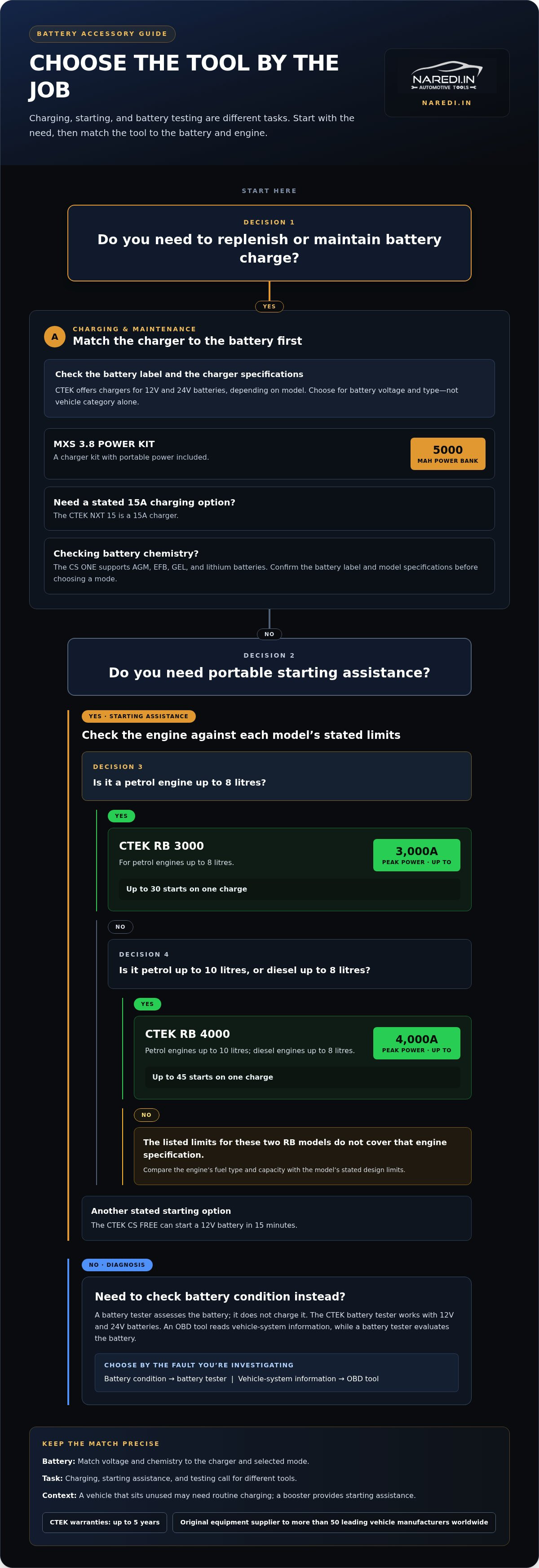
Choose an accessory by its task, not vehicle size alone. The CTEK MXS 3.8 POWER KIT includes a 5000 mAh power bank. That adds portable power alongside its charger. For home use, decide whether you need routine charging or starting assistance. A charger replenishes battery charge; a booster helps start a vehicle when its battery is depleted. These tools serve different needs, so select the function before comparing accessories.
For portable starting, compare engine fuel type and capacity with each model’s design limits. The CTEK RB 3000 suits petrol engines up to 8 litres. The RB 4000 suits petrol engines up to 10 litres and diesel engines up to 8 litres. Their peak power ratings differ too: up to 3,000A for the RB 3000, and up to 4,000A for the RB 4000. These specifications help narrow your choice.
- For portable starting: The RB 3000 provides up to 30 starts on one charge.
- For higher engine limits: The RB 4000 provides up to 45 starts on one charge.
- For a charger kit: The MXS 3.8 POWER KIT includes a 5000 mAh power bank.
Use the engine specifications and expected task together. A vehicle that sits unused may need routine charging, while a booster provides starting assistance. CTEK products have warranties of up to 5 years. The brand also supplies products as original equipment to more than 50 leading vehicle manufacturers worldwide. Treat these points as context, then match the accessory to your battery and use. For a workshop, consider whether both charging and starting support belong in its equipment setup.
Consider the CTEK NXT 15 for 15A charging; the CTEK CS FREE can start a 12V battery in 15 minutes. In CTEK’s survey, 36% of male UK drivers and 26% of female UK drivers favoured pay-per-mile charges; UK drivers aged 55 and over preferred pay-per-mile charges.
Battery charging and maintenance for cars, motorcycles and boats
Choose charging equipment by vehicle use, battery chemistry, and voltage. For Indian vehicles, match the charger to the battery label and intended task.
Choosing a Charger for Your Vehicle
A car used daily, a motorcycle stored between rides, and a boat used seasonally have different charging routines. Start with the fitted battery, then consider how often it sits unused. CTEK offers models for different battery types and tasks. Select for the battery’s requirements rather than vehicle category alone. That distinction helps avoid choosing a charger that doesn’t suit the actual battery.
Supported Battery Types and Voltages
CTEK chargers support 12V and 24V batteries, depending on model. The CS ONE supports AGM, EFB, GEL, and lithium batteries. Check the battery label and charger specifications before selecting a mode. CTEK warranty coverage reaches up to 5 years. For support in India, use the product’s warranty information and purchase documentation to guide any warranty enquiry.
Battery Testing and Diagnostics
A tester helps assess battery condition; it doesn’t charge the battery. The CTEK battery tester works with 12V and 24V batteries. Match its voltage range before testing, then consider the result alongside symptoms such as slow starting. Diagnostic tools have a separate role: an OBD tool reads vehicle-system information, while a battery tester evaluates the battery. Choose according to the fault you’re investigating.
Safe Charger Use
Before connecting a charger, confirm battery voltage and chemistry. Inspect the casing, cables, and clamps, then follow the model’s manual for connection order and charging mode. If charging doesn’t start, check power, clamp contact, selected mode, and battery compatibility. Don’t bypass warnings or use damaged leads. For model-specific operation, follow the included instructions. Compare CTEK charging options with your battery details before choosing.
Professional and workshop charging solutions
A workshop charging setup must match its workload. Separate vehicle-battery maintenance from electric-vehicle charging. A service bay may need chargers for vehicle batteries. A site serving electric vehicles may also need dedicated AC charging infrastructure. Identify the task first, then compare voltage, outlet capacity, and workflow. This prevents choosing equipment for the wrong charging job.
For electric-vehicle charging, the CHARGESTORM CONNECTED 3i provides AC charging up to 22 kW per outlet. It has a 7-inch touchscreen and is ISO 15118-ready. The CHARGESTORM CONNECTED 3e has dual 22 kW AC outlets. The CONNECTED 3 can also provide up to 22 kW per outlet. Compare outlet count and charging capacity with the intended installation. These figures describe AC charging equipment, not a vehicle-battery charger.
Connected charging can include app-based functions, but the specific model matters. The CS ONE smart charger can operate as a 12V power supply through the app’s SUPPLY mode. That provides a defined use for app control beyond charging. The app listing states that it may collect app information and performance data. It also states that data is encrypted in transit. Review the app’s functions and data details alongside the charger’s use case.
For a workshop, map equipment to each task. Use a compatible battery charger for routine vehicle-battery charging. Consider a connected EV unit when the requirement is AC vehicle charging. Then assess whether outlet capacity, touchscreen operation, or app features fit the workflow. For example, a 3i installation offers a touchscreen, while a 3e configuration offers dual outlets. ISO 15118 readiness is a stated feature of the 3i platform. Keep these specifications distinct when comparing workshop equipment. The right setup depends on the charging task, site requirements, and the equipment’s stated capabilities, not on a single headline specification.
How do you use a CTEK battery charger safely?
Start by matching the charger to the battery. Check the battery label for voltage and chemistry, then compare both with the CTEK charger manual. A 12V setting is not suitable for a 24V battery. Likewise, select a mode intended for the battery’s chemistry. Read the instructions for your exact CTEK model before connecting it, since operating steps can vary.
Prepare the vehicle and work area first. Switch off the vehicle and its electrical systems. Inspect the battery case, charger, cables, and clamps for visible damage. Don’t use damaged equipment. Keep the charging setup away from water, heat, and loose metal objects. For a boat battery, consider its location and the charger’s stated operating conditions. Stop if the battery looks damaged.
- Read the battery label and identify its voltage and chemistry.
- Confirm the charger supports those battery details.
- Inspect the CTEK charger, cables, and clamps before use.
- Connect the clamps and choose a mode as the manual directs.
- Watch the charger indicators and respond to warnings.
Don’t guess what an unfamiliar indicator means. Check the manual for your specific CTEK model. If charging doesn’t begin, follow the manual’s instructions to review the power supply, clamp contact, selected mode, and battery compatibility. Never bypass a warning or force a connector. If the charger continues to report a fault, stop the session and have the battery assessed by a qualified professional.
Before choosing equipment, compare its stated compatibility with your battery label. Browse CTEK battery chargers and select a model suited to the battery and charging task.
Naredi.in: Battery Chargers
naredi.in sells CTEK battery chargers and other automotive tools for vehicle owners and workshops. Choose a charger by battery chemistry, voltage, and intended use. A battery tester is a separate tool for assessing battery condition, while a jump starter provides starting assistance when a vehicle battery is depleted. Performance additives serve a different purpose again. Keeping these functions distinct helps you select equipment for the specific task, whether you maintain your own vehicle or support workshop operations.
Compare the battery details with the charging task before choosing. Then browse naredi.in's CTEK chargers and related automotive tools to find an option suited to your requirements. Visit naredi.in to explore the range and choose the equipment that matches your vehicle or workshop needs.
Make battery care part of your vehicle routine
Choose your next step around the vehicle’s actual use. A seasonal boat, a motorcycle between rides, and a daily-driven car each create different battery-care routines. Note the battery details and the task you want to handle before choosing equipment. That simple habit makes future maintenance decisions more focused.
Naredi offers CTEK Battery Chargers, Battery Testers, and Performance Additives for vehicle owners comparing battery-care options. Let the task guide your choice, whether you need to maintain a battery or assess its condition. Matching the product to the job is more useful than choosing by brand name alone.
Explore the CTEK range to find equipment suited to your requirements. With a clear plan for battery care, you can approach your next maintenance task with greater confidence.
Frequently Asked Questions
What is CTEK and what products does it make?
CTEK is a vehicle battery-care brand with chargers and related equipment. Its range includes chargers for maintaining or recharging batteries, portable boosters for starting assistance, and accessories such as charging kits. Some models add functions for specific tasks, such as supplying power or supporting app-based operation. Choose by the battery and intended use, rather than treating every device as interchangeable.
What are the best CTEK battery chargers and their specifications?
The right model depends on battery capacity and chemistry. The MXS 5.0 is a 12V, 5A charger for AGM, EFB, GEL, WET, and MF batteries. It supports 14-110Ah batteries, with maintenance charging up to 160Ah, and has an 8-stage automatic programme. The CT5 PowerSport is also 12V, 5A, but suits smaller 1.2-32Ah batteries, with maintenance up to 50Ah.
Where can I buy genuine CTEK products in India?
naredi.in sells CTEK products in India as an authorised distributor. Its product listings identify genuine, authorised stock sourced directly from OEM manufacturers. This gives buyers a place to compare charger specifications and select equipment for a vehicle battery or workshop task. Before ordering, match the product’s stated voltage and battery compatibility with your requirements. The store serves customers nationally across India.
Are CTEK chargers compatible with Indian cars, motorcycles, and battery types?
Yes, compatibility with Indian vehicle makes is confirmed per product, but the charger must still match the fitted battery. For example, the CS ONE supports 100-240V AC input and several battery chemistries. The MXS 5.0 and CT5 PowerSport use 220-240V AC input. Check the specific model against your vehicle’s battery voltage and chemistry, rather than assuming every charger suits every vehicle.
Are CTEK products suitable for lithium batteries and start-stop vehicles?
Some models support these battery types. The CS ONE supports lithium LiFePO4, while the MXS 5.0 supports EFB and AGM batteries commonly associated with start-stop systems. The CT5 PowerSport supports AGM, GEL, and MF batteries, but not every chemistry listed across the range. Confirm the battery label and select a charger whose specifications explicitly include that chemistry and voltage.