

Diesel Injector Cleaner: How It Works and How to Choose
Could a diesel injector cleaner help with rough running, or might the symptoms point to a different fault? Deposits can affect injector performance, but similar symptoms can have other mechanical causes. An additive may be a maintenance option, but it is not a diagnosis or a guaranteed repair.
If you’re weighing product claims or wondering whether an additive suits a modern diesel system, compare the label with your vehicle’s requirements. This guide explains what diesel injector cleaner is intended to do, what it can’t reliably fix, and how to use the product directions to make a more informed choice.
You’ll learn how to assess intended use, system compatibility, treatment ratios, and dosing instructions, and when adding cleaner may not be the right next step. The aim is to help you choose an additive for a clear purpose without expecting it to solve a fault that needs diagnosis.
Key Takeaways
- Diesel injector cleaner is intended to help address certain deposits. Treat it as targeted maintenance, not a diagnosis or repair.
- Compare products by intended use and system compatibility, and follow the product label rather than broad performance claims.
- Use the vehicle manual and product label to guide dosing and timing. There is no universal instruction for every diesel.
- Persistent or worsening symptoms may need diagnosis rather than another additive treatment.
- Naredi.in sells performance additives alongside automotive equipment, including battery chargers, testers, jump starters, and OBD tools.
What Does Diesel Injector Cleaner Do for a Diesel Engine?
A diesel injector cleaner is a fuel additive formulated to help address deposits in compatible fuel systems. Its role is limited: when used as directed, it may support cleaning, but it cannot identify the cause of a symptom or repair a damaged component.
Injectors meter and deliver fuel into the engine for combustion. Their condition matters because fuel needs to enter the cylinders in a controlled way. For a general overview of how fuel injection systems deliver fuel, see the Wikipedia explanation. Diesel systems have their own designs and operating requirements, so check compatibility for the specific vehicle.
How injector deposits can affect diesel-engine operation
Deposits around injector passages or nozzles may interfere with fuel flow or alter the intended spray pattern. Less consistent fuel delivery can affect combustion. A driver might notice rough idling, hesitant acceleration, difficult starting, or a change in engine response. These signs are clues, not proof of dirty injectors. Other fuel-system, engine, or electrical faults can cause similar symptoms.
Results vary by vehicle. Fuel quality, injector and related-component condition, and operating history can all influence how the engine behaves and whether an additive is appropriate. A symptom that begins after a change in fuel or a period of different use is useful context, but it doesn’t identify the fault by itself.
What injector cleaner can and cannot be expected to do
Treat an additive as a maintenance product, not a mechanical repair. A compatible formulation may help address certain deposits as it passes through the fuel system. The result depends on the formulation, the vehicle’s condition, and following the label. A cleaner cannot restore a worn injector, fix a leak, or resolve an unrelated engine fault.
Be cautious about broad promises involving mileage, power, smoothness, or emissions. Such claims don’t establish that a product suits your engine or that deposits are causing the problem. Check the vehicle manual and additive label before use. If the directions don’t clearly support your fuel system, don’t assume a general-purpose product is suitable.
For routine care, choose an additive whose stated purpose and compatibility match the vehicle, then follow its dose and timing instructions. Avoid repeated or concentrated treatments to force a result. Using more product doesn’t mean more effective cleaning, and exceeding label directions can create unnecessary risk.
If symptoms persist, worsen, or appear with a warning light, diagnosis is the next step, not another bottle. A vehicle assessment can help identify whether injectors or another component need attention. This keeps expectations realistic and helps avoid delaying the right repair.
How Diesel Injector Cleaner Works in the Fuel System
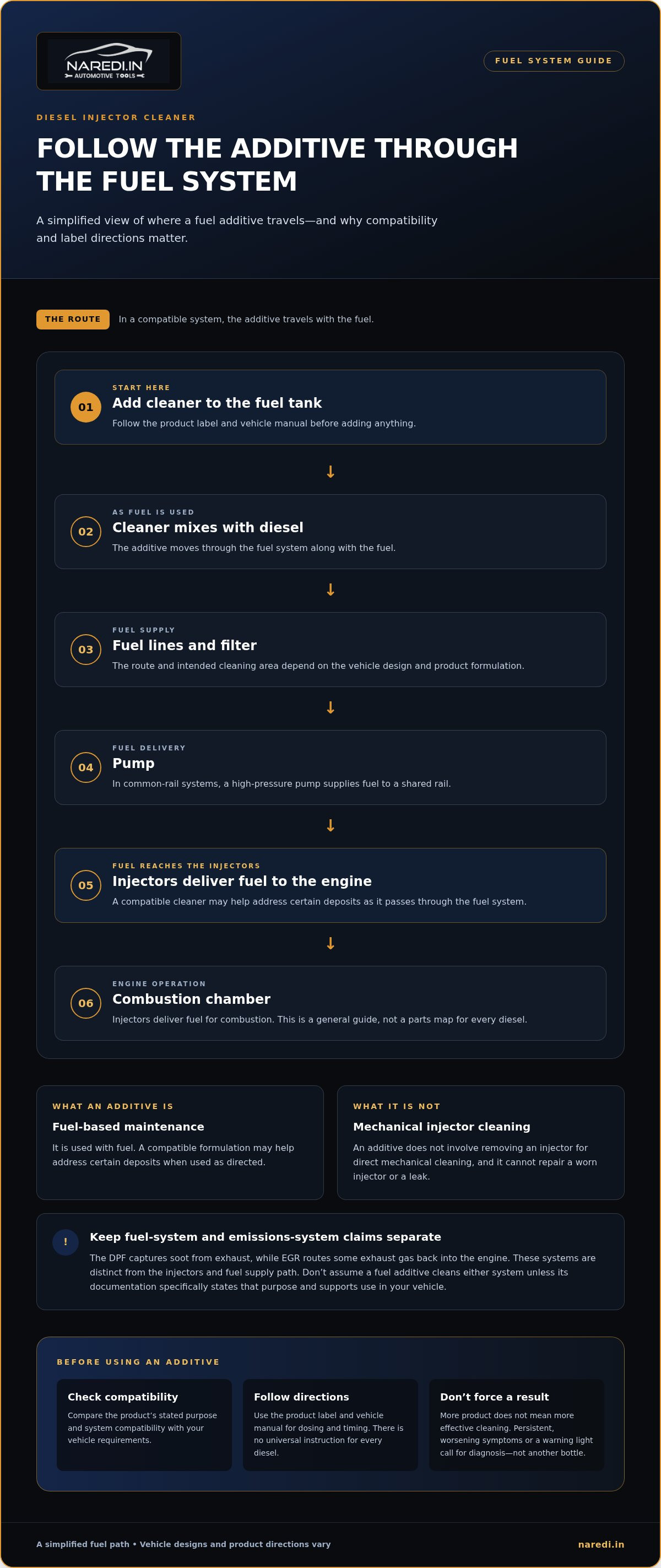
A fuel additive goes into the tank and mixes with diesel as the vehicle uses its fuel. In a compatible system, it travels with the fuel through the components that supply and deliver it. The exact route and intended cleaning area depend on the vehicle design, formulation, and product directions.
A fuel additive works through the fuel path. It is not the same as removing an injector for mechanical cleaning. An additive is used with fuel, while mechanical cleaning involves direct access to a component.
Where the additive travels after entering the fuel tank
A simplified fuel path is: tank → fuel lines and filter → pump → injectors → combustion chamber. In common-rail systems, a high-pressure pump supplies fuel to a shared rail, which distributes it to the injectors. This is a general guide, not a parts map for every diesel. System layouts vary, and a product’s reach depends on its formulation and label instructions.
Products also differ in purpose. A cleaning-focused additive is marketed to help address deposits in compatible fuel-system areas. Other fuel additives may be intended for purposes such as lubricity, ignition quality, or cold-weather fuel handling. A broad performance claim doesn’t show that a product is an injector cleaner or that it suits a particular engine. Use the stated purpose and vehicle compatibility to guide your choice.
Why modern diesel systems need vehicle-specific care
Common-rail direct injection pressurises fuel and stores it in a shared rail before electronically controlled injectors deliver it to the engine. Vehicle designs and operating requirements differ, so don’t assume a general diesel additive is suitable for every system. Check the vehicle manual and product label for compatibility and directions before adding anything to the tank.
Keep fuel-system claims separate from emissions-system claims. A diesel particulate filter (DPF) captures soot from exhaust, while exhaust gas recirculation (EGR) routes some exhaust gas back into the engine. These systems are distinct from the injectors and fuel supply path. Don’t assume a fuel additive cleans a DPF or EGR system unless the product documentation specifically states that purpose and supports use in your vehicle.
For a practical check, compare the label’s stated purpose with the component or system you’re addressing, then verify the vehicle requirements. If either is unclear, pause rather than guess. Naredi.in’s automotive performance additives are part of its wider automotive equipment range.
How to Compare Diesel Injector Cleaners Without Overreading the Claims
Start by checking product fit, not by counting the benefits in the advertisement. See whether the label names your diesel engine or fuel system as compatible. Then compare its stated purpose, dose, and treatment timing with the vehicle manual. A diesel injector cleaner that doesn’t meet the vehicle’s requirements isn’t a sound choice, whatever its advertised benefits.
Use this checklist to compare labels side by side:
| What to compare | What to look for |
|---|---|
| Intended use | Does the label specifically describe injector or fuel-system cleaning, or a different fuel-additive purpose? |
| Engine or system compatibility | Does it name the relevant diesel engine or system, and does that match the vehicle manual? |
| Dose instructions | What amount of product is specified for what quantity of fuel? Follow the label’s stated ratio. |
| Treatment timing | Does the label describe a one-time treatment or a repeated-use schedule? Don’t infer an interval it doesn’t state. |
Which label details deserve attention?
Start with compatibility, then read the directions in full. Compare the treatment amount and fuel quantity printed on the label. Products aren’t automatically interchangeable. Check warnings, storage requirements, and handling instructions too. If the manual and product directions appear to conflict, pause rather than combine or guess at instructions. The vehicle’s requirements and the additive’s stated limits matter more than marketplace summaries or promotional headlines.
How to assess performance and cleaning claims
Claims about mileage, pickup, or smoother running are product-specific, not promised results for every vehicle. Consider what each claim actually describes and whether credible, independent evidence supports it. A bold list of benefits alone doesn’t show that the product suits your engine or that a particular result will follow.
Even if a compatible additive helps address deposits, that is different from repairing a worn or damaged injector. A cleaning claim isn’t proof that the product can correct a mechanical fault. If a product promises several outcomes at once, assess each claim separately rather than assuming they all follow from its cleaning purpose.
Use a simple decision order: check compatibility first, verify the dose and timing next, then assess the claims. A product with fewer, clearly stated uses may be a better fit than one with a longer benefit list. If the label doesn’t explain a key direction or makes a claim that can’t be substantiated, don’t fill in the gaps yourself. Choose based on vehicle fit and precise instructions, not the number of promises.
How to Use Diesel Injector Cleaner Responsibly
There’s no universal dose or schedule for every diesel vehicle. Use the vehicle manual and the specific product label as your guide. Don’t use diesel injector cleaner to test or repair an unknown fault. A label-led process helps avoid assumptions about compatibility, quantity, and timing.
A label-first process for adding a cleaner
Before opening the container, read the complete directions, including compatibility notes, warnings, and handling or storage instructions. The correct amount and sequence can vary by product, so don’t borrow directions from another additive or a marketplace listing.
- Check the vehicle requirements. Consult the owner’s manual for fuel-system or additive guidance and compare it with the product label. If they appear to conflict, pause rather than guess.
- Confirm product compatibility. Make sure the label’s stated engine and fuel-system applications fit your vehicle. Don’t assume that a product suitable for one diesel system suits every diesel.
- Read the dose and fuel quantity. Use only the amount specified for the stated quantity of fuel. Don’t estimate a dose, increase it to pursue a stronger effect, or assume a larger container means a larger treatment is appropriate.
- Follow the stated sequence. The label may specify when to add the product in relation to refuelling. Follow that order, the treatment timing, and any other directions exactly.
- Use and store it as directed. Follow the product’s handling precautions and storage instructions. Don’t combine it with another additive unless the directions for both products explicitly allow that combination.
When an additive is not a substitute for diagnosis
Pay attention to what happens after use, but don’t treat the result as a definitive test of injector condition. Persistent symptoms need proper fault assessment because similar signs can have causes unrelated to deposits.
- Starting problems that continue or return
- Rough running that persists after following the product directions
- A warning light or other indication of a system fault
- Symptoms that worsen rather than settle
If you notice any of these, don’t keep adding treatments in the hope that a dose will resolve the cause. An additive may support fuel-system maintenance, but it can’t repair worn or damaged parts or diagnose another mechanical issue. Arrange an appropriate vehicle assessment rather than delaying it with repeated use.
For a compatible product, precision matters more than frequency. Choose based on the label and vehicle guidance, then use only as directed. Performance additives at naredi.in can be compared with those compatibility and instruction checks in mind.
Choosing Performance Additives from Naredi.in
Choosing a fuel additive starts with a clear purpose. You may be considering routine fuel-system care, responding to a concern, or comparing product directions. In each case, match the product’s stated use and vehicle compatibility to the owner’s manual. A confident headline isn’t a substitute for clear instructions, and more claimed benefits don’t make an additive a better fit.
Match a performance additive to the job
Read the label before selecting an additive. Consider a diesel injector cleaner for a diesel vehicle only when its stated compatibility and directions fit that vehicle. Don’t assume a product intended for petrol engines suits diesel, or that every diesel additive is intended to address injector deposits. Keep the purpose specific: the additive’s stated role should match the need you’re considering.
- For maintenance: Check whether the product describes routine use or a specific treatment, and follow its stated timing.
- For a particular concern: Compare the label’s purpose with the vehicle requirements. An additive isn’t a diagnosis or a repair for a mechanical fault.
- For product comparisons: Prioritise compatibility, dose instructions, and warnings over broad performance claims.
This distinction also helps separate additives from other automotive products. Petrol additives and diesel fuel additives aren’t interchangeable by default. Battery chargers, testers, jump starters, and OBD tools serve different purposes, so they shouldn’t be confused with fuel-system treatments.
Why product sourcing and authenticity matter
Naredi.in was established in 2014 and is an authorized Pan-India distributor. The business states that it sources products directly from OEM manufacturers and describes them as 100% genuine. These details offer context when comparing automotive equipment and performance additives, while the vehicle manual and product label remain central to choosing and using an additive responsibly.
Keep the decision practical: identify the vehicle and fuel type, match the product’s stated application, and read the full directions before use. Don’t select based only on a claim of higher mileage or smoother running, and don’t expect a fuel additive to correct persistent symptoms. Compatibility and precise use matter more than promises.
Explore automotive products at Naredi.in to compare performance additives with your vehicle requirements in mind.
Make Your Next Fuel-System Choice with Confidence
Before choosing a diesel injector cleaner, decide whether you’re considering planned care or responding to a symptom that needs assessment. That distinction keeps an additive in its proper role. If you proceed, keep the product label available and follow its directions precisely.
Note what prompted your search, when a symptom occurs, whether it changes, and what you’ve already tried. These details can help you decide whether an additive fits your purpose or whether further diagnosis is the wiser next step.
Choose based on the vehicle’s needs, not the strength of a promise. Explore automotive products at Naredi.in and compare performance additives with your vehicle requirements in mind.
Frequently Asked Questions
Can diesel injector cleaner improve fuel economy?
It may support fuel economy only if deposits are affecting fuel delivery and the product is compatible and used as directed. Improvement isn’t guaranteed. Fuel use also changes with factors such as route, load, driving style, tyre condition, and engine health. For a fair comparison, note fuel consumption across similar journeys before and after treatment. A change alone doesn’t prove the additive caused it, especially if driving conditions also changed.
Is diesel injector cleaner suitable for common-rail engines?
It may be suitable if the product label explicitly supports the vehicle’s common-rail system and the vehicle manual permits its use. Common-rail designs have specific requirements, so don’t rely on a general claim such as “for diesel engines” if the label gives narrower compatibility guidance. If the manual advises against additives, or the product directions don’t clearly cover the system, don’t assume it is suitable.
How often should you use diesel injector cleaner?
Follow the product’s stated interval, if it provides one. Don’t create a schedule based on another brand’s directions or a general online recommendation. Some products are intended for occasional treatment, while others may have different directions. Check the vehicle manual as well. If no repeat interval is stated, avoid frequent dosing by guesswork. More frequent use doesn’t establish that cleaning will be more effective.
Does diesel injector cleaner clean a diesel particulate filter?
No, don’t assume an injector cleaner cleans a diesel particulate filter (DPF). The DPF is part of the exhaust system and captures soot, while injector cleaner is added to fuel and follows the fuel system. A product may make separate claims about exhaust-system effects, but rely on its documentation rather than its name. If a DPF warning appears, follow the vehicle’s instructions and seek appropriate assessment if it remains active.
Can diesel injector cleaner fix rough idling or hard starting?
It might help only when deposits are contributing to the symptom and the product is suitable. It can’t be relied on to fix rough idling or hard starting. A weak battery, fuel-supply issue, or another engine fault can produce similar signs. If the problem continues, gets worse, or appears with a warning light, don’t keep repeating additive treatments. Arrange a proper diagnosis to identify the cause.
Can you use diesel injector cleaner in every diesel vehicle?
No. Diesel vehicles differ in fuel-system design and manufacturer guidance, so a product that suits one vehicle may not suit another. Check the owner’s manual and the cleaner’s label for the vehicle type, system compatibility, and any restrictions. Don’t use a product intended for petrol engines in a diesel vehicle unless its label specifically states that it is suitable for both fuel types and your vehicle requirements are met.
What is the difference between injector cleaner and a diesel fuel-system cleaner?
The terms can overlap, so the product label is more useful than the name alone. An injector cleaner usually identifies injector deposits as its target, while a fuel-system cleaner may describe a broader intended scope within the fuel path. Neither term proves that every component is treated or that a mechanical fault will be resolved. Compare the stated applications and compatible systems before deciding which product fits your purpose.