

A handheld automotive diagnostic scanner in India must match the vehicle’s electrical system: scanners for 12 V passenger vehicles aren’t the same as 24V heavy-duty scanners for trucks and buses. All BS6 cars sold in India have an OBD-II port, giving owners and workshops a standard connection point for diagnostics.
Compatibility is only the starting point. A handheld automotive diagnostic scanner in India may connect to a vehicle yet offer limited access to its systems. Choose a model based on the makes you work with and the diagnostic functions you need. European-car coverage and service features also vary between handheld models.
This guide explains how to assess Indian and European vehicle compatibility, compare diagnostic capabilities and understand how scanner prices in India vary by type. It also shows where handheld models fit alongside basic code readers, helping you choose a tool suited to your vehicles and workshop tasks.
Key Takeaways
- Match scanner coverage to the Indian and European vehicles you work on; a connector fit alone doesn’t establish full diagnostic compatibility.
- Compare scanner types by their connection method and intended use to narrow down which format suits your workflow.
- Prioritise diagnostic and service functions that support the tasks you need, rather than choosing by feature count alone.
- Use the model comparison to weigh coverage, capabilities and service features before selecting a handheld scanner.
Scanner compatibility with Indian and European car brands
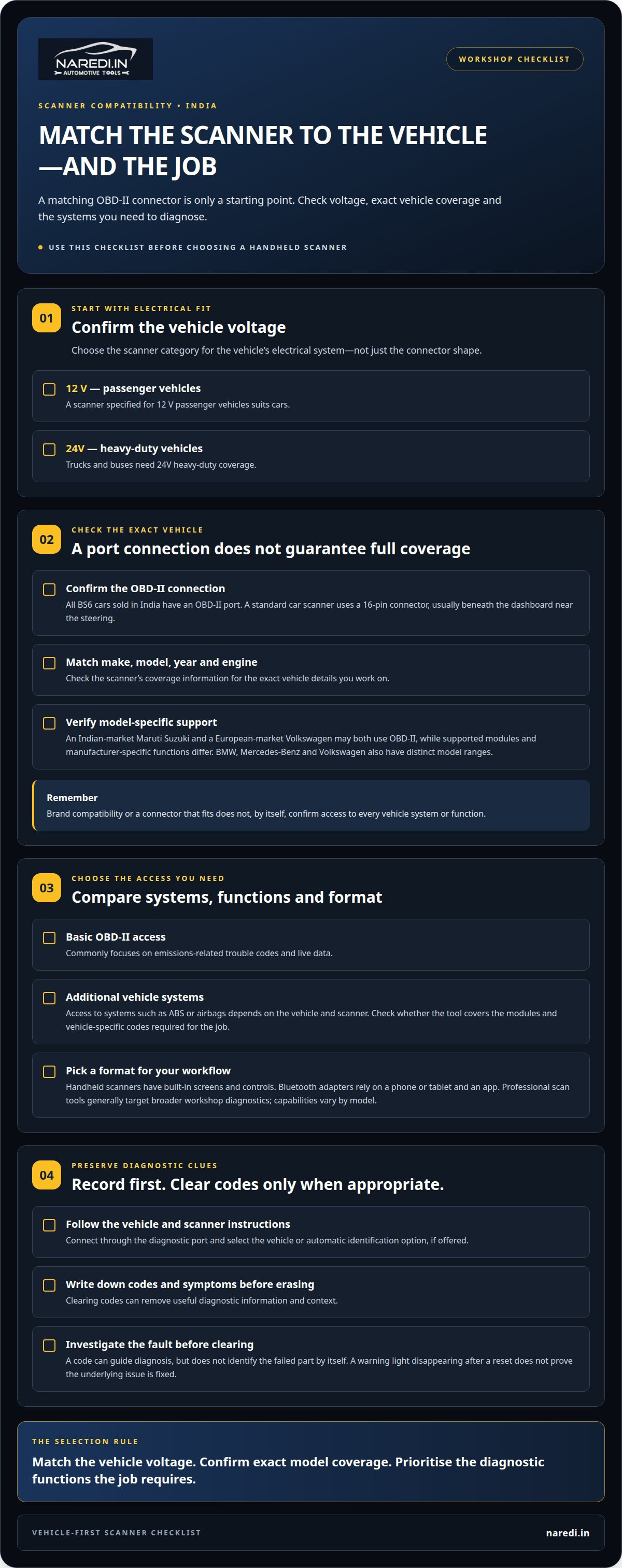
Start with the vehicle, not the scanner label. All BS6 cars sold in India have an OBD-II port. A standard car scanner connects through a 16-pin OBD-II connector, usually beneath the dashboard near the steering. That provides a physical connection, but it doesn’t guarantee access to every vehicle system or function.
Match voltage first. A scanner specified for 12 V passenger vehicles suits cars, while trucks and buses need 24V heavy-duty coverage. Then match the vehicle’s make, model, year and engine. An Indian-market Maruti Suzuki and a European-market Volkswagen may both use OBD-II, yet supported modules and manufacturer-specific functions can differ.
Check coverage against the job. Basic OBD-II access commonly focuses on emissions-related trouble codes and live data. Access to additional systems, such as ABS or airbags, depends on the vehicle and scanner. European brands such as BMW, Mercedes-Benz and Volkswagen have distinct model ranges, so a brand name alone doesn’t confirm compatibility. Look for your exact vehicle details in the scanner’s coverage information.
Handheld OBD-II scanners have built-in screens and controls. Bluetooth adapters instead rely on a phone or tablet and an app. Professional scan tools generally target broader workshop diagnostics, but capabilities vary by model. Choose according to the systems and functions you need, not just the connection type.
Clearing codes can remove diagnostic clues before you investigate a fault. An incompatible scanner may fail to communicate or provide only limited information, so record codes and symptoms before clearing anything. A warning light disappearing doesn’t prove the underlying issue is fixed.
- Confirm the vehicle uses 12 V or 24V, then choose the matching scanner category.
- Check model-specific coverage, not just Indian or European brand compatibility.
- Use the 16-pin port and preserve diagnostic codes before clearing them.
Scanner prices in India
Scanner prices depend on format, vehicle coverage and diagnostic depth. A basic code reader handles a narrower task than a handheld unit designed for broader vehicle diagnostics. Bluetooth adapters are another category, pairing with a phone or tablet instead of using a built-in screen. Compare similar tools before deciding whether a listed price offers suitable value.
For an Indian workshop, start with the vehicles and systems the scanner must support. A tool for occasional engine-code checks has different requirements from one used across several makes or vehicle systems. Broader coverage can affect price, so match specifications to actual workshop needs. Don’t pay for functions that won’t support the vehicles or work in your bay.
Review what the purchase includes. Check whether software access, updates, cables or other accessories are included or priced separately. These details affect the total cost of using a scanner, even when the upfront prices look similar. Also distinguish a one-time purchase from any recurring charge stated in the product terms. Compare those terms rather than assuming similar-looking tools have equal ongoing costs.
Build a short comparison before deciding:
- Format: handheld display, Bluetooth adapter or code reader.
- Coverage: supported makes, models and diagnostic systems.
- Included items: cables, software access and update terms.
- Use case: occasional checks, regular workshop work or broader diagnostics.
This approach prevents a low initial price from becoming the only deciding factor. A reader focused on basic engine codes, for example, may not suit a workshop that needs access to additional systems. Conversely, a broad-feature scanner may be unnecessary for a driver who only wants to read and interpret engine fault codes. Let the required functions determine the price tier.
To compare tools by category, explore OBD diagnostic tools and assess each option against your vehicle mix and intended tasks.
Special diagnostic and service functions
Functions determine whether a scanner can do more than read engine faults. Basic OBD-II access can retrieve diagnostic trouble codes and related data. Broader tools may access additional vehicle systems, live readings or service functions. These capabilities vary by scanner and vehicle, so compare the listed coverage with the tasks you need.
For protocol support, look for the specific OBD-II communication standards named in the scanner’s specifications. OBD-II compatibility alone doesn’t establish access to every manufacturer-specific code or system. Check whether the tool reads standard powertrain codes only or also covers vehicle-specific codes and modules. A code description can guide diagnosis, but it doesn’t identify the failed part by itself.
Screen and memory specifications affect everyday use. A larger display can make code descriptions and live-data readings easier to view, while menu layout affects how quickly technicians move between functions. Depending on the model, internal storage may retain reports or diagnostic records. Compare screen size, readability, storage capacity and export options in the published specifications. Don’t assume two handheld scanners store the same information.
Use a consistent sequence to read codes:
- Park safely and follow the vehicle and scanner instructions.
- Connect the tool to the vehicle’s diagnostic port.
- Choose the vehicle or automatic identification option, if offered.
- Read and record codes before selecting any erase function.
- Investigate the fault, then clear codes only when appropriate.
Clearing a code removes stored information from the scanner’s view and may erase useful diagnostic context. Record the code and symptoms first. A warning light going out after clearing doesn’t show that the cause has been repaired.
For workshop selection, prioritise functions tied to actual jobs, such as live data for observing changing readings or system access for a specific diagnostic task. Match each function to vehicle coverage, screen presentation and record-keeping needs. The most useful scanner provides the required information clearly, without relying on assumptions about protocol or module coverage.
Scanners may support the OBD-II communication standards named in their specifications. Basic OBD-II access can retrieve diagnostic trouble codes and related data. Depending on the scanner and vehicle, coverage may be limited to standard powertrain codes or extend to vehicle-specific codes and additional modules.
Handheld automotive diagnostic scanner models
There’s no single handheld scanner that suits every car and motorcycle in India. For cars, shortlist models by supported makes, vehicle systems and diagnostic functions. A Maruti Suzuki or Tata Motors vehicle in a mixed workshop fleet may need different manufacturer-specific coverage from a BMW or Mercedes-Benz. A shared OBD-II connection doesn’t mean identical module access.
For motorcycles, choose a tool that explicitly supports motorcycle diagnostics and the relevant make. Car-focused OBD-II coverage doesn’t automatically provide motorcycle compatibility. A workshop handling Hero, Honda, TVS or Bajaj motorcycles should prioritise coverage for the actual models it works on, along with any required connection hardware. Don’t treat a car scanner’s brand list as proof of motorcycle support.
Compare handheld models by practical tiers rather than marketing labels:
- Code readers: suit basic fault-code reading and clearing where supported.
- Multi-system scanners: target additional modules, such as ABS or airbag systems, on supported vehicles.
- Advanced workshop tools: may offer deeper diagnostics or service functions, depending on model coverage.
For cars and motorcycles, the best choice is the model with confirmed coverage for the vehicles and tasks in your workshop. No universal “all vehicles” label replaces make-, model- and system-level support.
In India, handheld diagnostic scanners are sold through automotive-tool retailers and authorized distributors. Warranty coverage and duration are product-specific, so use the warranty terms for the exact model rather than assuming one policy applies across scanner brands.
Before choosing a model, compare its coverage list, supported functions, screen layout, data storage and included connection hardware. A readable display helps technicians review codes at the vehicle, while saved records support later diagnosis when the model offers that feature. Match each specification to a real task, such as reading engine faults on a car or accessing supported motorcycle systems.
Explore diagnostic scanner options and compare the model coverage with your vehicle mix.
The best handheld scanner has confirmed make, model and system coverage for the vehicles and tasks in your workshop. For cars, choose among code readers, multi-system scanners or advanced workshop tools according to the functions needed. For motorcycles, verify explicit support for the relevant makes and models, including any required connection hardware.
Naredi.in
naredi.in offers automotive tools that can complement scanner use, especially when battery condition or starting reliability is also a concern. A diagnostic code reader identifies reported faults, while a battery tester evaluates battery condition. These tools answer different questions, so choose according to the task at hand.
Its range includes Battery Chargers, Battery Testers, Jump Starters and Performance Additives. A battery-related concern, for example, may call for testing or charging equipment rather than another scanner function. A scanner remains the relevant choice for reading vehicle diagnostic information; complementary products address separate automotive needs.
If you’re weighing diagnostic equipment against related automotive tools, contact naredi.in to discuss your requirements.
Make your next diagnostic decision with confidence
Choosing a handheld automotive diagnostic scanner in India can help create a more consistent diagnostic workflow. Treat the tool as part of a wider process: retain useful fault information, connect it to the vehicle’s service history and use repeat readings to guide follow-up decisions. This makes diagnostic records more useful in routine workshop work.
Consider how diagnostic tools fit alongside other automotive equipment. naredi.in also offers Battery Chargers, Battery Testers and Performance Additives for related vehicle needs. These products serve different purposes from a scanner but can support a more complete toolkit when battery testing, charging or additives are relevant to your work.
For guidance on scanner options, contact naredi.in for scanner advice. Start with the vehicles you handle and the diagnostic tasks you perform. A clear match between tool capabilities and workshop needs gives you a stronger foundation for your next decision.
Frequently Asked Questions
What types of handheld automotive diagnostic scanners are available in India?
India’s market includes basic code readers, handheld scanners with built-in screens, Bluetooth adapters that pair with a phone and professional scan tools. Their capabilities differ. A basic reader, for example, may focus on engine fault codes, while a broader tool may access additional systems or service functions. Choose the format and functions that suit your vehicle mix and diagnostic work.
What are the prices of handheld automotive diagnostic scanners in India?
Prices vary with scanner type, vehicle coverage and diagnostic features. A code reader, Bluetooth adapter and handheld tool with broader system access aren’t equivalent purchases. Software access, updates and included accessories can also affect the overall cost. Compare products with similar coverage and terms, then weigh those details against the tasks you need the scanner to perform.
Which Indian car brands and models are compatible with handheld OBD2 scanners?
Compatibility depends on the scanner’s coverage for the vehicle’s make, model, year and systems. All BS6 cars sold in India have an OBD-II port, but that connection alone doesn’t establish access to every module or manufacturer-specific function. For example, a scanner may read standard engine codes on one vehicle but provide different system access on another. Check coverage for the exact model.
Do handheld scanners in India support ABS, airbag, transmission, and service-reset functions?
Some handheld scanners support functions beyond engine diagnostics, but coverage depends on the scanner and vehicle. Don’t assume ABS, airbag or transmission access, or service resets, from an OBD-II connector alone. If a workshop needs to diagnose an ABS warning or reset a service reminder, choose a tool whose specifications explicitly support that function for the relevant vehicle.
Are there Indian regulations or vehicle-specific requirements for using OBD2 scanners?
Vehicle-specific compatibility is the practical consideration: match the scanner’s voltage category, connector and supported systems to the vehicle. Passenger cars use 12 V scanners, while trucks and buses need 24V heavy-duty coverage. All BS6 cars sold in India have an OBD-II port. These points guide tool selection; don’t treat a matching connector as proof of complete diagnostic coverage.
Which handheld OBD2 scanners are best in India for cars and motorcycles?
There’s no single handheld scanner suited to every car and motorcycle. Choose one with confirmed make-, model- and system-level coverage. For motorcycles, verify that it explicitly supports motorcycle diagnostics and the relevant make.