

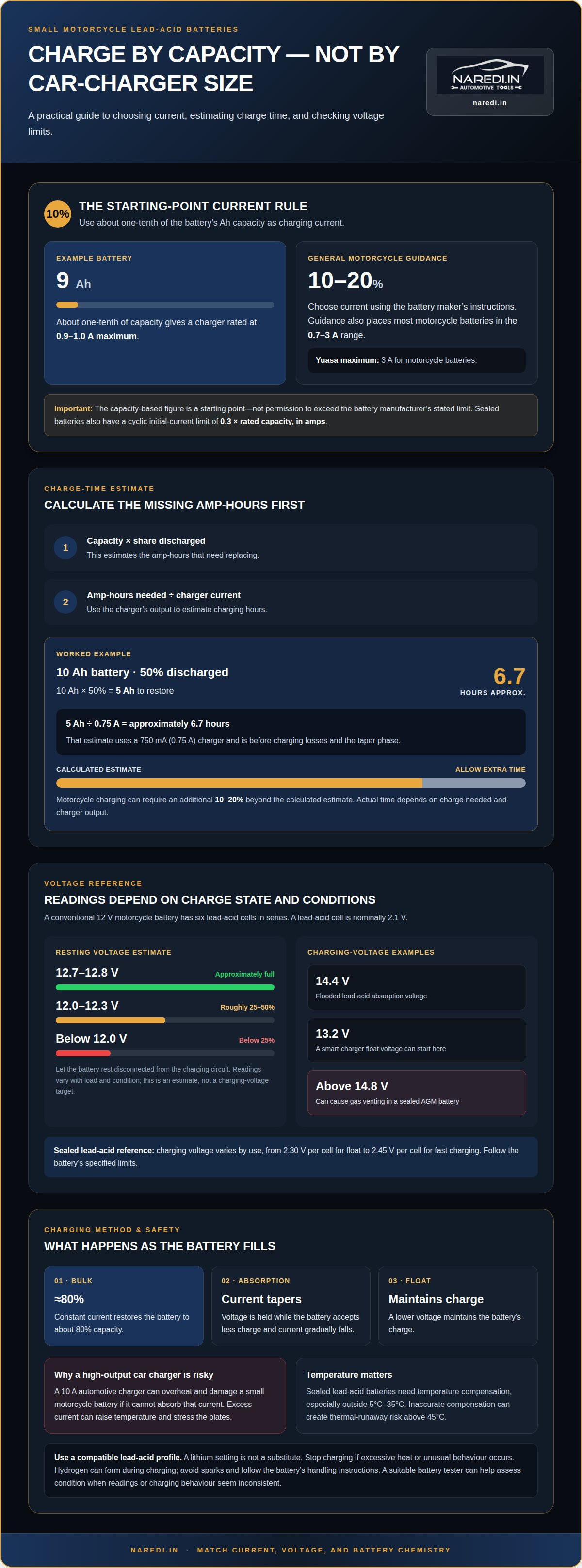
A high-output car charger can be too much for a small motorcycle battery. A safe charging amperage calculation for small motorcycle lead acid batteries starts with the battery’s amp-hour rating: use about one-tenth of that capacity as the charging current. For example, a 9 Ah battery calls for a charger rated at 0.9-1.0 A maximum.
Choosing a suitable, lower current helps reduce the risk of overheating and damage while giving you a practical way to estimate charging time. The exact time depends on how much charge the battery needs and the charger’s output.
This guide explains how to estimate a suitable current from the battery label, calculate charging time based on its state of discharge, and understand why charger voltage and charging stages matter. You’ll have a practical starting point for charging a small lead-acid motorcycle battery safely.
Key Takeaways
- Match the charger’s output to the battery’s amp-hour capacity, and follow the battery type’s voltage limits.
- Estimate charging time from the capacity that needs restoring and the charger’s current, then allow for the slower taper phase.
- A high-amperage car charger can overheat a small motorcycle battery and cause lasting damage.
- Use a suitable battery charger or tester to support careful charging and assess battery condition.
Constant-voltage, constant-current and taper charging
Use the battery’s chemistry, capacity, and voltage readings to understand how its charger should operate. A lead-acid cell has a nominal voltage of 2.1 V, but its reading changes with charge state and load.
-
Identify the Charging Method
Identify whether the charger uses constant current, constant voltage, or a staged method. Constant-current charging keeps the current steady as battery voltage rises. Constant-voltage charging keeps the voltage steady, so current gradually falls as the battery accepts less charge. This reduction in current is called the taper phase.
Many smart chargers combine these approaches in IUoU charging, a three-stage procedure. During bulk charging, constant current restores the battery to about 80% capacity. Absorption then holds voltage while current tapers. Float charging maintains charge at a lower voltage. Use a charger mode intended for the battery’s chemistry; a lithium setting is not a substitute for a lead-acid profile.
-
Check Voltage and Current Limits
Compare the battery voltage with its cell count and charging requirements. A lead-acid cell can measure 1.8 V under load at full discharge and 2.10 V open-circuit at full charge. A conventional 12 V motorcycle battery has six cells connected in series. For a 12 V lead-acid battery, a common current guideline is about 10% of its amp-hour capacity. Sealed batteries also have a cyclic initial-current limit of 0.3 times rated capacity in amps.
Use a compatible charger’s voltage limits: flooded lead-acid batteries use about 14.4 V in absorption, while smart-charger float voltage can start at 13.2 V. Sealed lead-acid charging voltage varies by use, from 2.30 V per cell for float to 2.45 V per cell for fast charging. Keep within the battery’s specified limits to prevent excess gassing. Hydrogen can form during charging, and sulfuric acid is present inside lead-acid batteries, so avoid sparks and follow the battery’s handling instructions.
For a resting-voltage estimate, let the battery sit disconnected from the charging circuit. A lead-acid or AGM battery at 12.7-12.8 V is approximately fully charged; 12.0-12.3 V indicates roughly 25-50% charge. Readings vary with load and battery condition, so use them as an estimate rather than a charging-voltage target.
Charging-time calculation using capacity, discharge depth, and charger current
A safe charging amperage calculation for small motorcycle lead acid batteries starts with the battery’s rated capacity and current state of charge. For Indian riders, follow the battery and charger manufacturer’s instructions for the specific battery chemistry and model.
-
Determine Battery Capacity and Discharge Depth
Read the battery’s Ah rating, then estimate the share of capacity discharged. Multiply those values to calculate the approximate amp-hours that need replacing. For example, a 10 Ah battery at 50% discharge needs about 5 Ah restored. State of charge determines the charge needed; temperature and battery condition also affect charging behaviour.
Estimate charging time by dividing amp-hours needed by charger output. At 750 mA, or 0.75 A, restoring 5 Ah takes approximately 6.7 hours before allowing for charging losses and the taper phase. Motorcycle charging can require an additional 10-20% beyond the calculated estimate.
-
Choose a Suitable Charger Current
Choose current using the battery maker’s instructions and capacity. General guidance places motorcycle charging current at 10-20% of rated Ah capacity, with 0.7 A to 3 A recommended for most motorcycle batteries. Yuasa recommends a maximum of 3 amps for motorcycle batteries. For a safe charging amperage calculation for small motorcycle lead acid batteries, use the capacity-based figure only within the manufacturer’s stated limit.
A 10 A automotive charger can overheat and damage a small motorcycle battery if it cannot absorb that current. Sealed lead-acid batteries need temperature compensation, especially outside 5°C to 35°C. Avoid assuming a replacement battery with a different Ah rating will charge correctly on the motorcycle: suitability depends on battery specifications and the charging system’s compatibility.
For a safe charging amperage calculation for small motorcycle lead acid batteries, consider the battery’s Ah rating, estimated discharge, and compatible charger output. A battery tester can help assess its condition if readings or charging behaviour seem inconsistent.
Risks of using a high-amperage car charger
Match the charger to the motorcycle battery, not simply to the vehicle’s 12 V system. Excess current can overheat a small lead-acid battery and cause permanent damage.
-
Recognize Overcharging Risks
Check the charger’s current and voltage settings against the battery’s type and rating before connecting it. A high-amperage automotive charger can deliver current faster than a small battery can absorb it, raising its temperature and stressing the plates. For a sealed AGM battery, charging voltage above 14.8 V can cause gas venting.
Watch for excessive heat or unusual behaviour during charging, and stop if either occurs. Sealed lead-acid batteries can face thermal-runaway risk above 45°C when temperature compensation is inaccurate. Overcharging can also increase gas production and electrolyte loss, reducing battery condition. A typical car charger is designed for larger automotive applications, so its output may not suit a motorcycle battery.
-
Compare Overcharging and Undercharging Risks
Use a charger with a lead-acid profile and a current suitable for the battery. Overcharging applies excessive voltage or current after the battery has accepted its charge, while undercharging leaves it at a low state of charge. Both can shorten battery life in different ways: excess charging creates heat and gassing, while prolonged low charge can contribute to sulfation.
Check resting voltage as one indication of charge, not as a substitute for the battery’s specifications. A lead-acid or AGM battery resting below 12.0 V is below 25% state of charge and may be deeply discharged. If left low for an extended period, lead-acid batteries may develop irreversible sulfation below approximately 12.4 V. Avoid repeatedly running the engine to compensate for a battery that remains undercharged; identify whether the charging approach is appropriate.
- Choose a charger that controls its output for the battery type, and follow its instructions. Smart charging stages reduce current as the battery approaches full charge, unlike a basic high-output device that may continue delivering unsuitable current. The right approach helps protect the battery during charging and avoid overheating or prolonged undercharging.
Charging a small motorcycle lead-acid battery
Small motorcycle batteries commonly range from 7 Ah to 30 Ah. Charge according to the battery’s chemistry and rated capacity, then manage storage to limit sulfation.
- Read the battery label and identify whether it is flooded, AGM, or gel. Match the charger’s mode to that chemistry and its current to the Ah rating. A 750 mA charger is described as suitable for motorcycle batteries between 2 Ah and 30 Ah, but the battery’s charging limits still apply.
- Switch off the charger output before connecting it. Match positive to positive and negative to negative, secure the clamps, and keep them from touching each other. Follow the charger’s connection sequence before starting the charge. When charging is complete, unplug the charger and wait a minute before removing the clamps.
- Use a maintainer for storage only when it is appropriate for the battery. Continuous float charging can contribute to grid corrosion in lead-acid starter batteries. For a seasonal motorcycle that sits idle, a smart charger can be connected in float mode for 24 hours once every two weeks. Another approach is to leave the battery open-circuit and charge it regularly, such as once a month, to help prevent sulfation.
- Account for temperature if the battery is sealed. Temperature compensation is recommended especially outside 5°C to 35°C, because charging voltage needs to adjust with temperature. A fully charged sealed battery on float charge typically draws a trickle current around 0.001 times its rated capacity. This low maintenance current is different from the charging current used to restore a discharged battery.
Choose a charger that matches the battery’s type and charging requirements. Select a suitable motorcycle battery charger for controlled charging, and use a battery tester when you need to assess battery condition.
Naredi.in
naredi.in helps you match your battery’s requirements with suitable automotive tools. Its range includes Battery Chargers and Battery Testers, as well as Performance Additives and Jump Starters. For a motorcycle battery, a charger suited to its chemistry and capacity supports controlled charging; a tester can help assess battery condition if charging does not resolve the issue. Choose equipment according to the battery specifications and the task. Contact naredi.in for guidance on choosing automotive tools.
Make Your Next Charge a Confident One
Use the battery’s label and condition to guide your charging decision. A safe charging amperage calculation for a small motorcycle lead-acid battery offers a practical starting point, while matching the charger settings to its chemistry helps determine what to do next. If you’re choosing equipment or assessing an ongoing battery issue, naredi.in offers Battery Chargers, Battery Testers, and Performance Additives for automotive needs.
Build a charging routine around the battery’s requirements rather than relying on a one-size-fits-all approach. The right tools can help you make more informed decisions and keep your motorcycle ready for its next ride. Contact naredi.in for charging advice, and move forward with confidence.
Frequently Asked Questions
How do you calculate a safe charging current for a small motorcycle lead-acid battery from its Ah rating?
Use about one-tenth of the battery’s Ah rating as a starting current: an 8 Ah battery gives a calculation of 0.8 A. Check that this result stays within the battery maker’s charging limit and your charger’s available settings. The rating indicates capacity, while the battery’s discharge level affects how much charge it needs and therefore the estimated charging time.
What charging current limits do motorcycle battery manufacturers recommend for flooded, AGM, and gel lead-acid batteries?
There isn’t one current limit that applies to every flooded, AGM, and gel battery. Use the specific battery maker’s instructions for its chemistry and capacity. A general motorcycle range is 0.7 A to 3 A, and Yuasa recommends a maximum of 3 amps for motorcycle batteries. For sealed lead-acid batteries in cyclic use, the initial current limit is 0.3 times rated Ah capacity, expressed in amps.
What is the correct charging voltage for a 12V motorcycle lead-acid battery in India?
The correct voltage depends on battery chemistry and the charger stage, not simply the fact that the motorcycle is in India. Flooded batteries use about 14.4 V during absorption. For six-cell batteries, gel charging voltage is capped at 14.2 V, while AGM charging voltage during bulk and absorption should not exceed 14.4 V. Set the charger to the battery’s chemistry-specific mode.
How long does it take to charge a small motorcycle battery at different current levels?
Charging time changes with the amount of charge missing and the charger’s output. As a reference, a 24 Ah motorcycle battery at 50% discharge takes approximately 9.6 hours with a 1.25 A charger, compared with 16 hours at 750 mA. These are estimates; charging slows as current tapers near full charge, so actual time can be longer.
What are the risks of overcharging a small lead-acid motorcycle battery?
Overcharging can heat the battery, damage its plates, and cause sealed batteries to vent gas. AGM batteries can be damaged if bulk or absorption voltage exceeds 14.4 V; gel batteries have a 14.2 V charging-voltage cap. Stop charging if the battery becomes unusually hot, and use a charger mode designed for its chemistry rather than leaving it on an unsuitable setting.
What safety precautions should be followed when charging a motorcycle lead-acid battery?
Charge in a well-ventilated area, keep flames and sparks away, and follow the charger’s connection instructions. Hydrogen can form during lead-acid charging, so keep ignition sources away from the battery. Match the positive and negative clamps to the corresponding terminals, and do not let the clamps touch. Monitor the battery while charging; excessive heat is a reason to stop and reassess the setup.