

A healthy car battery should read approximately 12.6 volts at rest. To learn how to test a car battery, switch off the engine, let the battery sit for at least an hour, then use a multimeter set to 20 volts DC. A reading below 12.4 volts means a conventional battery should be recharged as soon as possible.
A low reading can be concerning, but voltage is useful only when you know what it indicates. This guide explains how to test a car battery with a reliable measurement and interpret the result, so you can make a clearer decision about its condition.
You’ll also learn how to select the correct battery type on a tester and recognise common reasons a battery goes flat, from corrosion to charging-system problems. These steps offer practical guidance for car owners and hands-on enthusiasts in India, including how to decide whether the battery needs charging, a closer test or further attention.
Key Takeaways
- Measure a rested battery with a multimeter set to DC voltage, and use the reading to decide whether it needs charging.
- Inspect terminals for corrosion, which can interfere with power transfer; use appropriate protective gear when cleaning them.
- Select the tester’s battery type to match the battery, so it applies the correct test method.
- Consider causes such as infrequent use, electrical demand, or charging-system faults when a battery repeatedly goes flat.
What voltage should a car battery have?
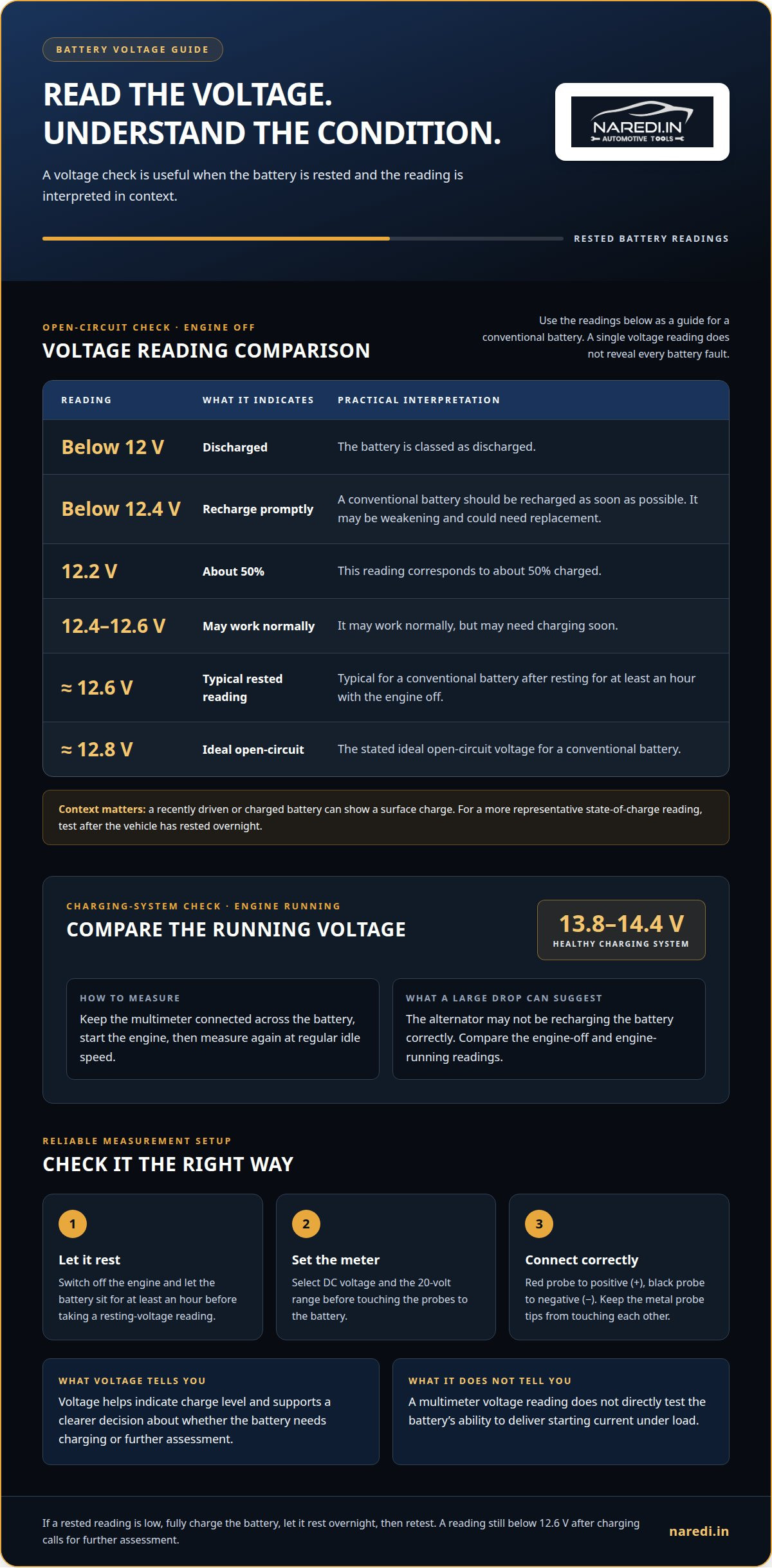
A conventional car battery typically reads approximately 12.6 volts after resting for at least an hour, with the engine switched off. A reading below 12.4 V means it should be recharged as soon as possible.
In India, test charges depend on the type of test and whether it is included in breakdown support. Workshops and battery retailers can test a battery, while roadside assistance may cover testing as part of the support included in a plan.
- Locate the battery and inspect its terminals. Open the bonnet and identify the positive and negative battery terminals, marked with “+” and “−”. Some batteries sit in the trunk or passenger compartment. In that case, connect the tester directly to the battery terminals, not the engine-compartment jump-start contacts. Switch off the engine before testing. Look for white, ashy deposits around either terminal, since corrosion can interfere with power transfer.
- Set up the multimeter. Select DC voltage and the 20-volt range before touching the probes to the battery. Connect the red probe to the positive terminal and the black probe to the negative terminal. Keep the metal probe tips from touching each other. For a resting-voltage reading, the battery should have sat for at least an hour with the engine off. A reading near 12.6 volts is typical for a conventional battery.
- Connect a battery tester correctly. Attach its red cable to the positive terminal and its black cable to the negative terminal. If the battery is in the trunk or passenger compartment, use its terminals rather than remote jump-start contacts. Follow the tester’s prompts after making the connections, and select the battery type before interpreting its result. A voltage reading alone does not reveal every battery fault.
- Clean corrosion with care. Wear gloves and safety glasses before cleaning battery terminals. Baking soda and a wire brush can remove corrosion; keep the cleaning focused on the deposits and terminal surfaces. Clean terminals help maintain power transfer and charging efficiency. Keep the battery and terminals clean as part of routine care. If the case is swollen or liquid is leaking, avoid handling it because battery liquid can be corrosive.
Interpreting battery voltage readings
Read voltage with the engine off for an open-circuit check. A conventional battery’s ideal open-circuit voltage is about 12.8 V. For a more representative state-of-charge reading, test after the vehicle has rested overnight. A recently driven or charged battery can show a surface charge, so its immediate reading may not reflect its resting condition.
- Set the multimeter to DC voltage. Select the 20-volt range, then place the red probe on the positive terminal and the black probe on the negative terminal. Read the display without starting the engine. The meter measures voltage across the battery; it doesn’t directly test the battery’s ability to deliver starting current under load.
- Use the reading as a charge guide. A conventional battery reading of 12.2 V is about 50% charged. Below 12 V, it is classed as discharged. From 12.4 V to 12.6 V, it may work normally but need charging soon. Below 12.4 V, it may be weakening and could need replacement. Recharge a conventional battery below 12.4 V promptly.
- Check the alternator’s charging voltage. With the multimeter connected across the battery, start the engine and measure again at regular idle speed. A healthy charging system should read between 13.8 and 14.4 volts. A large drop after starting can indicate that the alternator isn’t recharging the battery correctly. Compare the engine-off and engine-running readings.
- Act on patterns, not one number. If the rested reading is low, fully charge the battery and let it rest overnight before retesting. A reading still below 12.6 volts after charging calls for further assessment. If the voltage falls sharply after starting, investigate the charging system as well as the battery. Repeated low readings can indicate reduced charge retention.
Selecting the correct battery type on the tester
- Read the battery label before choosing a setting. Identify the chemistry and construction shown, such as conventional flooded, AGM, EFB, GEL or lithium. Select the matching option in the tester menu. Testers use different algorithms for different battery types, so an incorrect selection can distort the result. For a start-stop battery, use its specific type rather than treating it as a conventional starter battery.
- Match the rating standard and cold-start value. If the tester requests a cold-cranking rating, enter the value printed on the battery label. Choose the matching standard, such as EN, SAE, DIN, IEC or JIS. These standards describe cold-start current differently, so don’t enter a number from one standard under another. The battery label and tester settings should agree before the test begins.
- Use a hydrometer only where electrolyte access allows. A hydrometer measures the electrolyte’s specific gravity in a serviceable flooded battery. It can help compare cell condition, but it isn’t suitable for sealed AGM, EFB, GEL or lithium batteries. Don’t open a sealed battery to take a reading. Use a compatible electronic tester instead, with the battery type selected correctly.
- Treat an online virtual test as an estimate. Enter the requested battery details accurately, including its type and rating. Corrosion and weather can affect battery life and the accuracy of a virtual test, so its result may not match a direct measurement. Follow the tester’s instructions for preparing the battery before a conductivity test. Follow the tester’s instructions, then compare its result with a direct battery test if readings conflict.
- Choose the test method for the question. A voltage reading shows charge level, while a conductivity test assesses starting capability using the selected battery profile. For a start-stop battery, health assessment also considers cold-start capability, residual capacity and charge acceptance. Use the tester’s matching mode, then interpret its result alongside the battery’s condition and charging history.
Common causes of a dead car battery
- Look for electrical drain during parking. Lights left on, accessories, or other electrical consumers can draw charge while the engine is off. Modern cars can have up to 150 electrical consumers, increasing demand on the battery. If a battery repeatedly loses charge while parked, consider whether a device remains active or the vehicle has an electrical fault.
- Notice changes during starting. Slow cranking, a longer turn-over, or rapid clicking can indicate a weak or discharged battery. Flickering cabin lights during starting are another warning sign. A single click can point to a starter problem rather than the battery, so note the exact symptom instead of assuming every starting fault has the same cause.
- Consider battery age and heat exposure. A battery between 2 and 5 years old may need replacement as age-related sulfation reduces its performance. A swollen or bulging case can indicate excessive heat exposure and internal damage. Don’t continue using a visibly swollen battery. Liquid leaking from the case can be corrosive and presents a safety hazard.
- Check for charging-system symptoms. A battery warning icon that appears while driving can indicate a charging-system malfunction. A battery that goes flat again after charging may also point to a charging fault, rather than a one-time discharge. Compare the battery’s condition with its charging voltage before deciding the battery alone caused the problem.
- Separate discharge from failure before acting. A low charge after lights were left on differs from a battery that repeatedly fails to retain charge. Record when the problem occurs, whether the engine cranks slowly, and whether the warning icon appears. If battery removal is necessary, take care to avoid short circuits and seek professional guidance if you are unsure. A battery tester can help assess battery condition and guide the next step.
Naredi.in: Battery Testers
naredi.in is an authorized distributor of Battery Testers for checking battery condition when a voltage reading alone doesn’t explain starting problems or repeated discharge. naredi.in does not source from the grey market. Choose a tester that supports your battery’s type and rating, then use its result alongside voltage readings and symptoms. This can help distinguish a low charge from signs of reduced battery performance.
If the battery needs charging, a compatible Battery Charger can support the next step. A Jump Starter is another option when a discharged battery prevents the vehicle from starting. Choose the tool that fits the task rather than treating these products as substitutes for one another.
For a practical next step, explore the available Battery Testers and related battery equipment. Contact naredi.in for help with your battery-tool requirements.
Make your next battery check count
Knowing how to test a car battery gives you a practical starting point. The next step is choosing equipment that matches the question you need answered. Use a Battery Tester to assess battery condition, or a Battery Charger when the battery needs charging. Performance Additives are also part of Naredi’s automotive range.
Keep a record of readings and starting symptoms over time. A pattern can help distinguish an isolated discharge from a recurring battery or charging concern. If you’re deciding which battery equipment suits your needs, contact naredi.in for battery help.
With the right test and a clear record, you can approach your next battery decision with greater confidence.
Frequently Asked Questions
How to test a car battery voltage with a multimeter in India?
Set a digital multimeter to DC voltage, then connect its red probe to the positive terminal and black probe to the negative terminal. A 20-volt range suits a typical 12-volt car battery. Take the measurement with the engine off, ideally after the battery has rested. If your meter displays a minus sign, check that the probes are on the correct terminals.
What voltage should a healthy 12V car battery show at rest?
A healthy conventional 12V car battery commonly reads about 12.6 to 12.8 volts at rest. The exact reading can vary with charge and battery condition. For a useful comparison, measure after the vehicle has been parked overnight, rather than immediately after driving or charging. A reading below 12.4 volts indicates the battery should be recharged promptly and assessed again afterward.
How to perform a car battery load test at home?
A basic home check is to switch on the headlights for two minutes without starting the engine, then try starting the car. Notice whether the engine cranks sluggishly or the headlights dim substantially during cranking. Either symptom suggests the battery may not cope well with load. This check is not a substitute for a dedicated load tester, which evaluates performance under controlled demand.
How to test a car battery while the engine is cranking?
Connect a multimeter across the battery terminals before starting, keeping the probes secure and clear of moving engine parts. Ask someone to start the vehicle while you observe the display. A sharp voltage drop alongside slow cranking can indicate a weak battery, but the reading alone doesn’t identify the cause. Compare it with a rested reading and consider the starter and charging system too.
What are the signs of a weak or failing car battery?
Common warning signs include slow engine cranking, rapid clicking during starting, or cabin lights that flicker as you turn the key. A battery that repeatedly loses charge after recharging also needs attention. A single click can point to a starter issue rather than the battery. A swollen case or leaking liquid is a safety concern, so avoid handling a damaged battery.
How to test a car battery with a battery tester or hydrometer?
Connect an electronic battery tester to the positive and negative terminals, then select the battery’s chemistry and rating standard before running the test. A hydrometer checks electrolyte specific gravity and is suitable only for batteries with accessible liquid electrolyte. Don’t open a sealed battery to take a reading. Use the method appropriate to the battery design, and treat conflicting results as a reason for further testing.