

A warning light is a signal, not a diagnosis. OBD means On-Board Diagnostics: the vehicle’s built-in system for monitoring engine performance, emissions and other systems. Understanding the OBD meaning helps explain how sensors and vehicle modules detect faults, store diagnostic codes and share information with a scanner.
A code can point to a system or condition that needs attention, but it doesn’t automatically identify the failed part. That distinction matters when interpreting a warning or choosing an OBD tool.
This guide explains how OBD and OBD-II differ, what diagnostic code characters indicate, and how standards shape communication between a vehicle and a scanner. It also covers how sensors support emissions monitoring and what an OBD code can, and can’t, tell you.
Key Takeaways
- Read a diagnostic code’s characters to identify the system and fault category it points to, then treat it as a clue rather than proof of a failed part.
- Understand how standards and communication protocols affect the information a scan tool can retrieve from a vehicle.
- See why OBD-II offers a more consistent diagnostic framework than earlier on-board systems, while vehicle coverage still depends on its design and market.
- Connect sensor readings and module monitoring to emissions warnings, and understand what diagnostic tools can reveal about a vehicle’s condition.
OBD code categories and character meanings
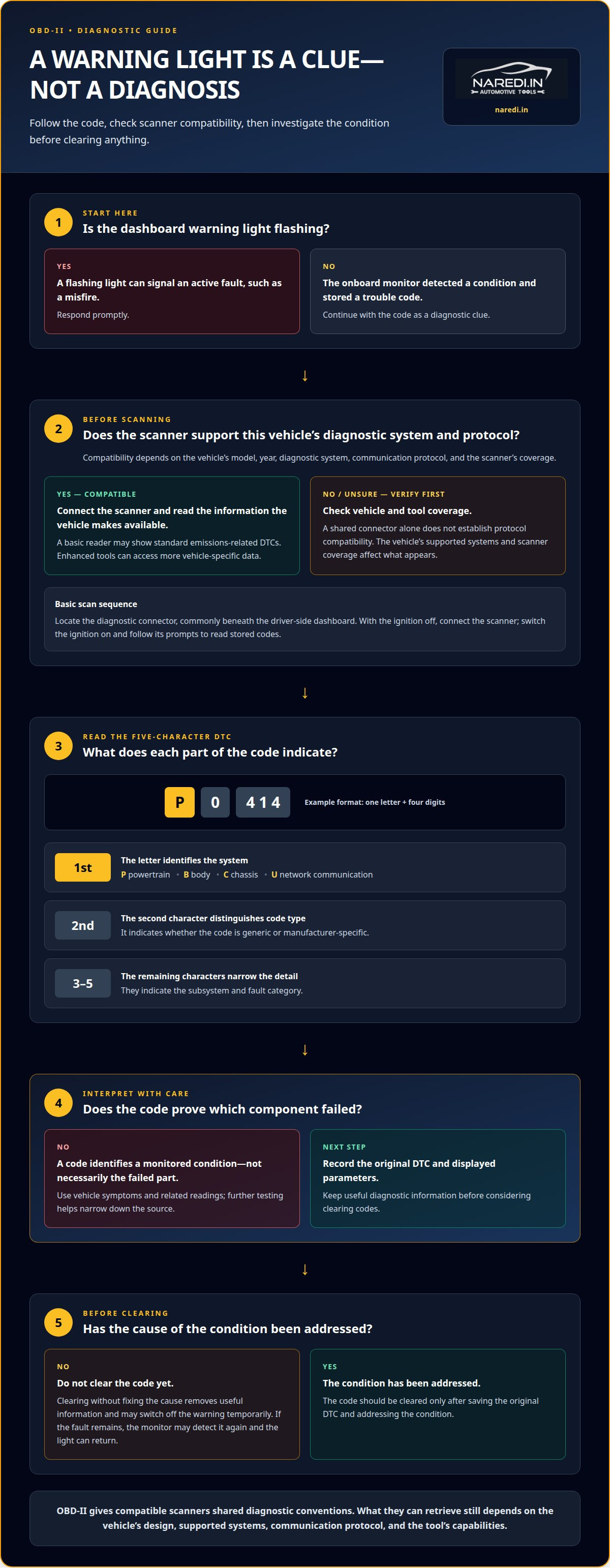
The meaning of OBD becomes practical when you read a diagnostic trouble code, or DTC. A standard OBD-II code has five characters: one letter followed by four digits. The first character identifies the system: P means powertrain, B body, C chassis, and U network communication. The second character distinguishes a generic code from a manufacturer-specific code. The remaining characters narrow down the subsystem and fault. A code identifies a monitored condition, but doesn’t prove which component failed.
An OBD warning light means the vehicle’s onboard monitor detected a condition that may need attention and stored a trouble code. A flashing light can signal an active fault, such as a misfire, so respond promptly. Use the code as a diagnostic clue, then consider the vehicle’s symptoms and related readings to understand what may be causing the warning.
To check a car with an OBD-II scanner, locate its diagnostic connector, commonly beneath the driver-side dashboard. With the ignition off, connect the scanner, then switch the ignition on and follow its prompts to read stored codes. Record the code and displayed parameters before clearing anything. For example, a P-code points to the powertrain, but further testing helps narrow down the source of the fault.
OBD-II scanner compatibility with cars in India depends on the vehicle’s model, year, diagnostic system and communication protocol. A compatible scanner can retrieve the information the vehicle makes available. A basic reader may display standard emissions-related DTCs, while enhanced tools can access more vehicle-specific data. What appears on screen depends on the reader’s coverage and the vehicle’s supported systems.
Clearing a fault code without fixing its cause removes useful diagnostic information and can switch off the warning temporarily. If the fault remains, the monitor may detect it again and the light can return. Save the original DTC and address the condition before clearing codes.
OBD2 standards and SAE-versus-ISO terminology
OBD-II relies on shared diagnostic rules, but SAE and ISO references describe different parts of that framework. SAE J1978 defines minimum operating standards for scan tools, while SAE J1979 defines diagnostic test modes. These rules help a scanner request emissions-related data consistently. They don’t mean every vehicle exposes the same manufacturer-specific information or uses the same communication protocol.
The connector specification is distinct from the communication method. SAE J1962 and ISO 15031-3 specify the OBD-II connector. For CAN communication, ISO 15765-4 uses either 250K or 500K bit rates, with CAN high on pin 6 and CAN low on pin 14. A module and scanner must support compatible signaling before diagnostics can pass between them. A shared connector alone doesn’t establish protocol compatibility.
OBD-II includes 10 standardized diagnostic modes, also called services. SAE J1979 defines these test modes, which include requests for current data and stored fault information. Parameter IDs, or PIDs, identify specific values within a mode. For example, a scanner may request a supported engine parameter and display its reading. The available PIDs depend on what the vehicle’s systems report.
Protocol names such as ISO 9141-2, ISO 14230 KWP2000 and ISO 15765-4 CAN identify different communication methods. ISO 9141-2 uses an asynchronous serial data rate of 10.4 kbit/s. KWP2000 supports 1.2 to 10.4 kbaud, while CAN uses the bit rates noted above. For an India-market vehicle, the manufacturer’s implementation determines which protocol applies. Match a scanner’s supported protocol to the vehicle for reliable diagnostics and efficiency.
Difference between OBD and OBDII
OBD means a vehicle has onboard diagnostic capability; OBD-II refers to a more standardized generation of that system. Earlier OBD systems could differ between manufacturers, so a reader designed for one vehicle might not communicate with another. OBD-I focused on emissions controls. OBD-II introduced shared diagnostic conventions, making basic emissions-related fault detection and code reading more consistent across supported vehicles.
The practical difference is the information and communication a mechanic can expect from a vehicle. With earlier OBD, manufacturers could use their own connectors, signals or code interpretations. OBD-II established common diagnostic conventions, giving compatible scanners a more consistent way to access emissions-related information. A code still identifies a detected malfunction or monitored system, not necessarily the failed part. For example, an emissions fault code may point to a system without proving which component caused the issue.
OBD-II also formalized access to diagnostic information through standardized services. A compatible scanner can use these services to request supported data from an electronic engine control module. The readings available depend on the vehicle’s design and the scanner’s capabilities. A generic reader may show standard data, while manufacturer-specific diagnostics can provide additional detail.
For vehicles in India, the OBD-II label alone doesn’t establish that every scanner will work with every model. Model year, market specification, communication support and tool coverage all affect access. Identify the vehicle and its diagnostic system, then use a compatible scanner. This distinction helps prevent an older OBD-I tool or a basic reader from being treated as a complete diagnostic solution for a later vehicle.
Engine control modules, sensors, and emissions monitoring
On-board diagnostics works through sensors and electronic control modules that monitor engine operation and emissions-related systems. A sensor reports a condition, such as oxygen levels in exhaust, to the engine control module. The module compares that input with expected operating conditions. If its monitor detects a fault, it can store a diagnostic trouble code and trigger a dashboard warning. This process can help identify a malfunction before emissions-control performance is overlooked.
In India, an OBD scan is a diagnostic check, not an emissions compliance result by itself. The applicable vehicle-testing procedure determines whether OBD testing forms part of an emissions check; a scan alone does not establish compliance.
An OBD scanner can read supported diagnostic trouble codes and vehicle parameters, including live sensor data and emissions-monitor status. It may also show whether a code is pending or stored. For example, an oxygen-sensor-related reading helps indicate what the module detected, but it doesn’t prove that the sensor itself has failed. Interpret the code alongside related readings and vehicle symptoms to understand what it means.
Some systems retain a pending code until a fault is detected again. The ECU may clear pending OBD codes if the problem isn’t detected after 40 warm-up cycles. That doesn’t repair the vehicle; it reflects the system’s monitoring process. The Society of Automotive Engineers defines diagnostic standards, while the vehicle’s own module determines which supported parameters it reports through the diagnostic connection.
Battery condition also matters to electronic diagnostics because the vehicle and scanner need electrical power during communication. A battery tester can assess battery condition, while an OBD scan reads supported vehicle data. These checks serve different purposes. For a separate battery condition check alongside diagnostic work, explore battery testers.
Naredi.in
naredi.in helps drivers and automotive professionals with vehicle needs related to electronic diagnostics. An OBD code can identify a monitored fault, while battery condition is a separate factor in vehicle operation. Battery testers assess battery condition, and battery chargers support charging. Jump starters and performance additives serve other vehicle-care needs.
Choose these product categories when your needs extend beyond reading a trouble code. They don’t replace diagnosis or repair, but can support related vehicle-care tasks. Explore naredi.in’s automotive products to find the category that fits your requirements.
Make the Next Diagnostic Decision with Confidence
A practical grasp of the meaning of OBD helps you treat diagnostic information as a starting point for informed decisions. Consider vehicle symptoms and scan results together, and don’t treat a stored code as proof that one specific part has failed. This measured approach can help you decide what information to gather next and which vehicle-care need to address.
For related automotive needs, naredi.in offers battery chargers, battery testers and performance additives. These products support different vehicle-care tasks; they don’t replace diagnosis of an unresolved fault. Choose according to the need you’re addressing, and keep diagnostic decisions separate from general maintenance.
For help discussing product needs related to your vehicle, contact naredi.in to discuss your needs. A clear next step makes it easier to move from a warning or reading toward a more informed decision.
FAQs
What is an OBD (on-board diagnostics)?
OBD stands for On-Board Diagnostics. It’s the vehicle’s built-in monitoring system, not the handheld scanner used to communicate with it. The vehicle generates diagnostic information, while a compatible reader displays the information it makes available. For example, a dashboard warning can prompt a scan, but the warning itself isn’t diagnostic equipment.
What’s the difference between an OBD and OBDII?
OBD is the general term for onboard diagnostics; OBD-II identifies a standardized generation of that technology. In practice, this distinction matters when selecting or interpreting diagnostic equipment. An OBD-II label describes support for the standard, but doesn’t guarantee access to every enhanced function. Manufacturer-specific features and the vehicle’s own implementation determine how much additional information a tool can retrieve.
Where is the OBDII port located?
Look for the diagnostic connector in the vehicle cabin, using the owner’s manual diagram if it isn’t immediately visible. Some connectors sit behind a small trim cover, so avoid pulling dashboard panels or forcing an adapter into an unfamiliar socket. Correct identification protects the connector and helps ensure the scanner is attached to the diagnostic port, not an accessory outlet.
Why Is OBD-II Written As OBD2 or OBDII?
OBD-II, OBD2 and OBDII are alternative written forms for the same term. The Roman numerals “II” and the Arabic numeral “2” both indicate the second generation. The spelling alone doesn’t identify a different diagnostic protocol or added vehicle function. You may see different versions in manuals, scanner descriptions and automotive references, so focus on the stated vehicle and tool compatibility.
Why is OBD so important?
OBD matters because its records provide a useful starting point when a vehicle shows a warning or develops a drivability symptom. Sharing the recorded information with a mechanic can make the initial discussion more specific than describing a dashboard light alone. It also helps distinguish a diagnostic clue from a confirmed component failure, supporting a more measured next step.
How Are OBD-II Codes Formed?
OBD-II codes follow a defined alphanumeric pattern, with the opening letter grouping the affected vehicle system. The following characters narrow down the code’s category and fault reference. A generic code uses a shared definition, while a manufacturer-specific code may require vehicle-specific interpretation. Treat the complete code as an identifier for further diagnosis, not as an instruction to replace parts.