

Choosing performance additives starts with identifying the vehicle system and concern you want to address. A fuel-system additive is not an engine-oil treatment, and a product label’s broad benefit claims do not tell you whether the formula suits your vehicle.
Before choosing, compare each product’s stated purpose, compatibility details and directions. This guide explains how to distinguish additive categories, assess product descriptions and avoid common selection mistakes.
We’ll compare examples across fuel-system, diesel and emissions, engine-oil, and cooling-system care, including distinct Rislone additive categories. You’ll also learn how to make a more confident purchase from naredi.in, an authorized distributor that does not source from the grey market. Naredi provides “Professional advice and support before and after your purchase” to help you assess your options.
Key Takeaways
- Choose performance additives for the specific vehicle system and intended use, rather than relying on broad performance claims.
- Match your vehicle and fuel or system details to the product directions before deciding which treatment fits.
- Compare the 177 ml injector cleaner and 500 ml complete fuel-system cleaner by their stated categories and intended uses.
- naredi.in is an authorized distributor and does not source from the grey market. Free shipping across India for our complete product range. Products include “up to 5 years warranty” and “replacement warranty - a new product replaces a defective one, no need for waiting for service and repairs.”
What Do Automotive Performance Additives Do?
Automotive performance additives are treatments formulated for particular vehicle systems or maintenance uses. The term does not describe one universal solution: a product intended for the fuel system is not automatically suitable for engine oil, the cooling system or another component. Start by identifying the system a product is formulated for, then check whether its directions and stated application fit your vehicle.
This gives you a practical way to narrow the options. Identify the system and concern first, then compare products within that category. A broad promise such as “improved performance” is less useful than a clear description of the intended application.
Which vehicle systems do automotive additives target?
Fuel-system cleaners, such as Rislone Complete Fuel System Cleaner, are formulated for fuel-system use. Engine treatments, including Rislone Engine Treatment Conditioner & Cleaner, are a separate category intended for use with engine oil. Their applications and directions differ, so do not treat the products as interchangeable.
Other treatments target specific systems, such as cooling-system products or diesel and emissions care formulas. Check that the product description names the system you want to address, then read the directions for that application.
What can an additive claim, and what should it not promise?
A product description can explain its intended benefit, but it cannot guarantee the same outcome for every vehicle. Whether a treatment is relevant depends on the vehicle, its condition and whether the formulation matches the stated application. For engine-oil treatments, understanding the role of oil additives and viscosity improvers can also help distinguish lubricant chemistry from fuel-system cleaning.
An additive is not automatically a substitute for diagnosing a mechanical fault. If a warning light, unusual noise or persistent running issue points to a problem, a treatment alone may not address its cause. Use the product only for its stated purpose and follow its directions.
How to Choose Performance Additives for Your Vehicle
Choose by the system being treated, not just by the benefit named on the packaging. Use these steps to narrow a general concern to products whose stated purpose and directions fit your vehicle:
- Identify the system. Decide whether the concern relates to the fuel system, engine oil, cooling system or another specific application.
- Define the intended use. Be specific about what you are comparing, such as injector cleaning or broader fuel-system treatment.
- Compare product labels. Check the stated purpose, formulation category, container size, vehicle and fuel compatibility, and application instructions.
Read the directions for your particular vehicle and system before use. Products in the same broad category can have different applications or instructions. If a label specifies a particular fuel or fluid, match that detail to what your vehicle uses rather than relying on the product name alone.
How should buyers compare fuel-system additives?
An injector cleaner has a more specific stated target than a complete fuel-system cleaner or a petrol treatment. Rislone Hyper Fuel Injector Cleaner and Rislone Hyper Fuel Complete Fuel System Cleaner + Petrol Treatment Performance Booster are useful category examples to compare by label. Check each product’s stated application, fuel compatibility and directions. Use those details to judge whether the product suits your intended use, rather than relying on a broad performance claim.
How should buyers compare engine and other system treatments?
For engine-oil, cooling-system, diesel or emissions treatments, compare the named target system and application directions. A general performance label does not establish that a formula suits a different system. Check the container size alongside the instructions, but do not assume a larger container or wider claim means a better match.
Once you have identified the relevant category, the performance additives collection provides a way to compare products by their stated purposes.
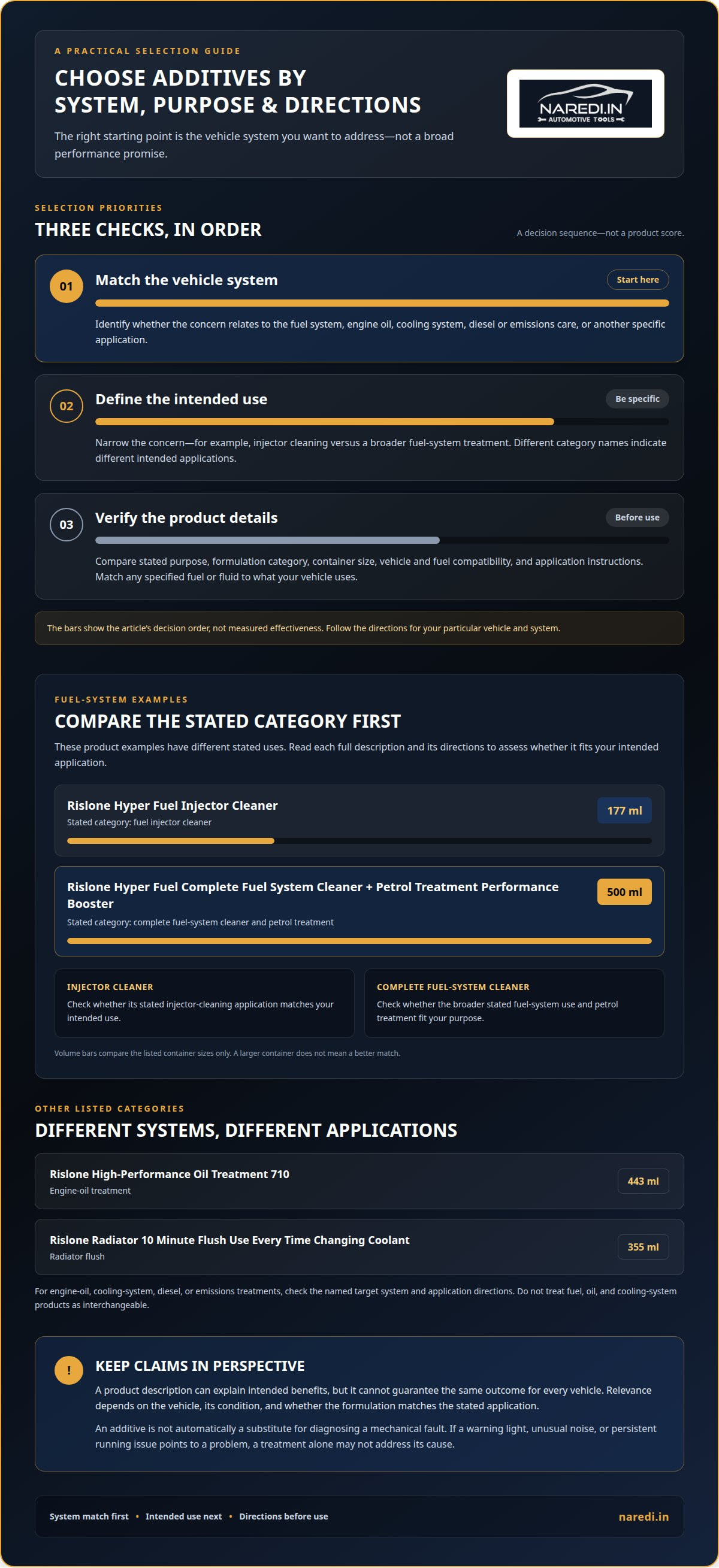
Rislone Performance Additives: Product Examples by Intended Use
These Rislone examples show why category is a more useful comparison point than treating all performance additives as interchangeable. The product names indicate different intended applications. Read the full description and directions to decide whether an option fits your intended use.
| Product name | Stated category | Container size | Comparison question |
|---|---|---|---|
| Rislone Hyper Fuel Injector Cleaner | Fuel injector cleaner | 177 ml | Are you comparing an injector cleaner for your intended use? |
| Rislone Hyper Fuel Complete Fuel System Cleaner + Petrol Treatment Performance Booster | Complete fuel-system cleaner and petrol treatment | 500 ml | Does the description match the broader fuel-system use you have in mind? |
| Rislone High-Performance Oil Treatment 710 | Engine-oil treatment | 443 ml | Is an oil treatment the category you’re looking for? |
| Rislone Radiator 10 Minute Flush Use Every Time Changing Coolant | Radiator flush | 355 ml | Does the product’s stated use align with your cooling-system task? |
Fuel-system examples: injector cleaner or complete treatment?
Rislone Hyper Fuel Injector Cleaner is labelled as an injector cleaner, while Rislone Hyper Fuel Complete Fuel System Cleaner + Petrol Treatment Performance Booster is labelled for complete fuel-system cleaning and petrol treatment. Those category names describe different scopes. Compare each product’s full description and directions with your intended use instead of assuming one is a substitute for the other.
Engine and cooling-system examples
Rislone High-Performance Oil Treatment 710 is the engine-oil treatment example. Rislone Radiator 10 Minute Flush Use Every Time Changing Coolant is the radiator-flush example. Keep comparisons within each product’s stated category and follow its directions. For broader context on engine-oil standards, see the API engine oil performance standards.
Compare product descriptions and select the category that matches your intended application. The Rislone performance additive options can be compared by their stated uses.
Buy Performance Additives from Naredi with Confidence
A suitable product is only part of a confident purchase. naredi.in is an authorized distributor and does not source from the grey market. Before ordering, match the product’s stated purpose and directions to the vehicle system and intended use you identified.
What should buyers check before ordering?
Review the product description and instructions together. First, confirm that the category fits the system you plan to treat. Then read the application directions instead of relying on a broad benefit claim or product name alone. Keep your vehicle and fuel or system details in view. This helps you make a purposeful choice without assuming that products in similar categories are interchangeable.
naredi.in provides Professional advice and support before and after your purchase. The online technical advisor is Ask Arjun, a resource for buyers assessing product information.
naredi.in warranty wording is “up to 5 years warranty” and “replacement warranty - a new product replaces a defective one, no need for waiting for service and repairs.” The delivery offer is: Free shipping across India for our complete product range.
Browse the performance additives collection
Compare the available options by product purpose, directions and vehicle details in the performance additives collection.
Choose Your Next Treatment with Confidence
Make an additive decision part of a clear maintenance routine. Note the vehicle system you are considering and the reason for the treatment, then keep the product directions accessible. This gives you a practical reference for future maintenance and ties each purchase to a specific use rather than a broad promise.
As you compare performance additives, focus on options whose stated purpose fits your intended application. Read the product information before choosing and let the directions guide how you use it. This measured approach helps you select a treatment that makes sense for your vehicle.
Ready to compare options for your next step? Browse Naredi’s performance additives and choose a product for your intended use.
Frequently Asked Questions
Are performance additives suitable for every car?
No. A treatment intended for one fuel type or vehicle system may not suit another. For example, do not assume a petrol additive is suitable for a diesel vehicle, or that a fuel-system formula belongs in the engine oil. Check the product’s stated application against your owner’s manual and vehicle details before use. If the directions do not match, choose a different product category.
Can I use a fuel injector cleaner and a complete fuel-system cleaner together?
Do not combine them unless the product instructions explicitly allow it. Two treatments can both target the fuel system and still have separate applications and directions. Read both labels, including instructions about how each product is used. If either label does not support combining treatments, use one product according to its directions rather than adding another by assumption.
Do performance additives guarantee better fuel economy or more power?
No. A product can describe an intended benefit, but it cannot guarantee better fuel economy or restored power in every vehicle. The outcome can depend on the vehicle’s condition and whether the treatment suits the stated application. Follow the product directions, and do not treat an additive as proof that an underlying issue has been resolved if symptoms persist.
How often should I use an automotive additive?
There is no universal interval. Application directions and use frequency can differ between products, so follow the specific label rather than adopting a schedule from another additive or a general online recommendation. Check the directions each time you select a product, especially if you are switching categories. Do not exceed or alter the stated instructions to try to accelerate a result.
Can an additive fix an engine or fuel-system fault?
No additive should be treated as a guaranteed repair for a mechanical fault. If a warning light stays on, a leak appears, or unusual noise or drivability symptoms continue, the cause may need qualified mechanical assessment. A treatment’s stated purpose can help you decide whether it is relevant, but it cannot establish what is causing a persistent fault or confirm that the fault is fixed.