

A smart battery maintainer for modern start stop AGM batteries should manage charging in stages rather than supply power continuously. The three stages are bulk, absorption and float: the charger replenishes the battery, controls the final part of charging, then maintains its charge. Understanding these stages helps distinguish a smart maintainer from a basic trickle charger.
Focus on charging behaviour, not just the label. Start-Stop AGM batteries need a charger with a suitable AGM mode, while EFB batteries need compatible charging support.
This guide explains the three charging stages, how maintainers differ from trickle chargers, and which AGM or EFB batteries they support. It also covers practical criteria for assessing a maintainer, so you can choose equipment suited to your battery and storage needs.
Key Takeaways
- Understand how bulk, absorption and float charging work together to recharge and maintain a battery.
- Match charger support to the battery chemistry: AGM and EFB Start-Stop batteries need compatible charging modes.
- See why automatic charge control makes a smart maintainer different from a basic trickle charger.
- Learn which practical checks help assess a maintainer’s suitability for battery type, charging needs and long-term storage.
Differences between trickle chargers and battery maintainers
A basic trickle charger replenishes charge steadily and needs monitoring, while a smart maintainer adjusts charging automatically to preserve battery charge. For a parked Start-Stop car, that difference affects how charging continues once the battery is topped up.
Charging Versus Maintaining
A battery charger replenishes a battery; a maintainer’s main purpose is to preserve its charge, not revive a dead battery. Some devices do both, but the distinction matters when choosing equipment for an AGM battery that sits unused. A maintainer can switch charging on and off as needed, while a basic trickle charger should be monitored and disconnected manually when charging is complete. Models rated at five or more amps can top off a battery more quickly when needed.
Charging and Maintenance Modes
An advanced smart charger manages charging stages, then shifts to a maintenance mode instead of supplying power continuously. During bulk charging, it replenishes the battery; smart chargers typically enter absorption charging at 80% state of charge. In absorption, the charger holds its charging voltage while current declines as the battery accepts less energy. An AGM mode tailors charging to AGM batteries, while maintenance mode helps preserve charge after charging. These modes matter because a Start-Stop AGM battery needs compatible charging, not an assumed one-size-fits-all setting.
Indian vehicle charging guidance can vary by model. Some vehicles have specific charging instructions, so use the owner’s manual to determine the manufacturer’s requirements for an aftermarket charger and any warranty-related conditions.
To connect a smart maintainer to a Start-Stop AGM battery, follow the vehicle manual’s charging guidance and select the charger’s AGM mode. Connect red to positive and black to negative, then let the smart charger manage its charging and maintenance modes automatically.
Charge an AGM battery in a well-ventilated area, since batteries can emit harmful or explosive gases. Match the red-positive and black-negative connections correctly, and follow the vehicle manual’s instructions while charging.
AGM and EFB compatibility for Start/Stop vehicles
AGM and EFB batteries serve Start/Stop systems, but their charging requirements are not automatically interchangeable. Choose a maintainer that explicitly supports the chemistry fitted to your vehicle.
Start/Stop Vehicle Compatibility
Start/Stop compatibility means the charger supports the battery type and charging requirements specified for the vehicle. AGM and EFB are different battery designs, so an AGM mode alone does not establish EFB support. Match the mode to the battery label and vehicle manual. This is particularly important when replacing a trickle charger, which may not offer chemistry-specific settings.
For example, an AGM battery calls for a charger mode that specifies AGM support; an EFB battery needs a mode that specifies EFB support. Do not select a lithium setting for either chemistry. A parked vehicle may need charge maintenance in winter, but cold conditions do not make battery types interchangeable. The charger’s supported chemistry remains the deciding factor.
Charging with the Battery Connected
You can use a maintainer with an AGM battery connected to the vehicle when the vehicle manual permits that method. Follow the manual’s instructions for connection points and the charger’s directions, since Start-Stop models may specify how charging should be connected. This keeps the charging approach aligned with the vehicle’s battery-management system.
A compatible charger used as directed is designed to charge the battery, but incorrect settings, polarity or connection points can put electronics at risk. Use the specified AGM mode and approved connection points, rather than assuming every charger is suitable. Stop if the vehicle manual prohibits charging with the battery connected.
For chemistry-specific charging choices, explore battery charging options suited to AGM and EFB use.
Consult your car’s owner’s manual before charging, as some vehicles have specific guidance. Use it to identify the permitted charging method and connection points, and keep the charger’s instructions nearby during setup. An AGM or EFB mode does not replace checking the manual. Confirm the fitted battery chemistry and follow the vehicle’s stated approach; if connected charging is prohibited, do not proceed with the battery attached.
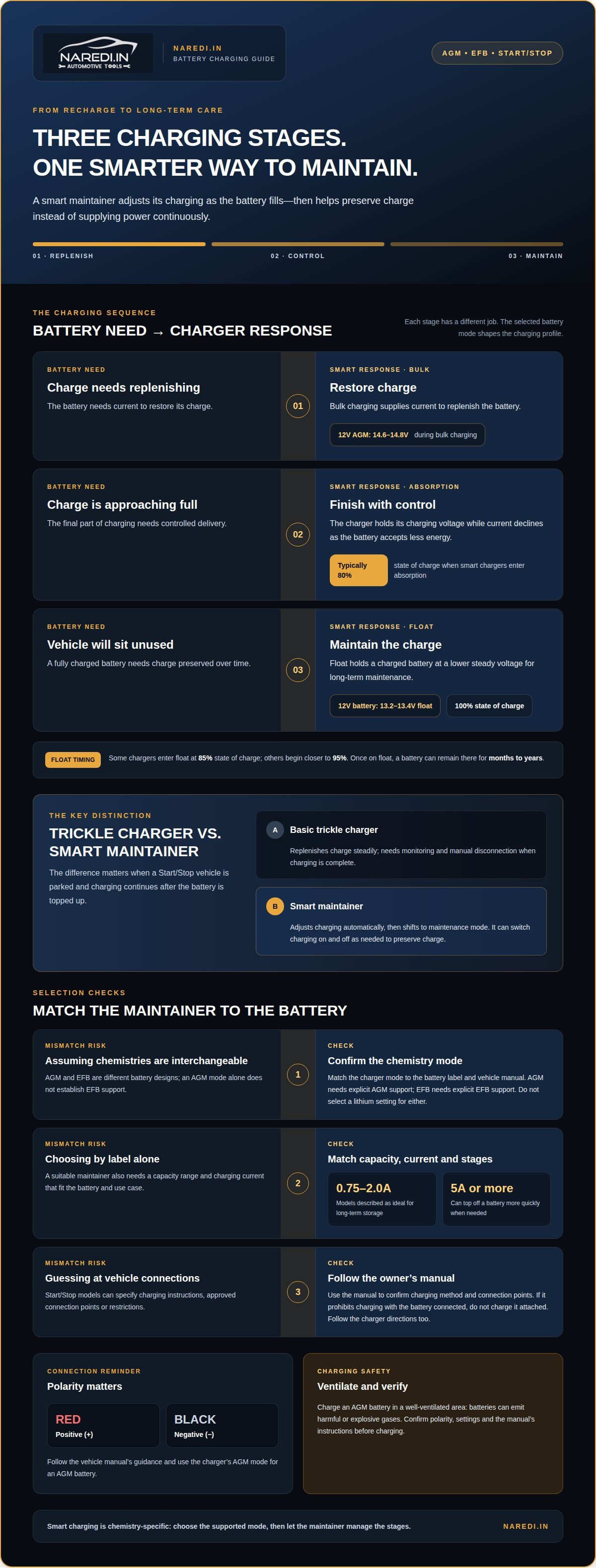
What are the 3 Stages of Smart Chargers?
A smart battery charger manages bulk, absorption and float charging, then maintains the battery at full charge. For long-term storage, the float stage helps preserve charge without continuous high-rate charging.
Bulk and Absorption
Bulk charging supplies current to restore charge, while absorption controls charging as the battery approaches full. A typical 12-volt AGM battery reaches 14.6-14.8 volts during bulk charging. The exact profile depends on the charger’s selected battery mode. AGM Start-Stop batteries require an AGM-compatible profile, not a flooded-battery setting. During absorption, the charger reduces current as the battery accepts less energy. This controlled finish supports a complete charge without treating every battery chemistry alike.
Float and Maintenance Mode
Float mode holds a charged battery at a lower steady voltage for long-term maintenance. For a 12-volt battery, the stated float voltage is 13.2-13.4 volts, and float mode maintains 100% state of charge. Some chargers enter float at 85% state of charge, while others begin closer to 95%. Once in this stage, a battery can remain on float for months to years. That makes a float-capable maintainer useful when a vehicle stays parked for extended periods.
Selecting a Smart Maintainer
Choose by battery chemistry, capacity, charging current and supported stages. Match the charger’s capacity range to the battery’s stated capacity, then select an AGM profile for an AGM Start-Stop battery. For long-term storage, models rated from 0.75 to 2.0 amps are ideal. A model rated at five or more amps can top off a battery more quickly when needed. A smart battery maintainer for modern start stop AGM batteries should provide compatible charging and float maintenance, rather than relying on a trickle setting.
AGM Start-Stop batteries typically use a 12-volt charging system, with 14.6-14.8 volts during bulk charging. Use the charger’s AGM setting and the vehicle’s specified charging guidance to select the correct profile.
How battery maintainers were tested
Compare charging behaviour against the battery type and intended use, rather than judging a maintainer by its feature list alone. For an AGM Start-Stop battery, check whether the charger offers an AGM mode, controls charging and can maintain charge after topping up.
Assess each model against the same checks:
- Compatibility: Confirm that the stated battery modes include AGM, rather than assuming a flooded setting is suitable.
- Charge control: Check whether charging progresses through bulk, absorption and float, with current declining during absorption.
- Maintenance: Determine whether the device automatically maintains charge instead of continuously trickling power.
- Protection: Review the stated safeguards against reverse connection and overcharging, and follow the supplied instructions.
These checks help distinguish useful performance from marketing language. A reverse-polarity safeguard addresses an incorrectly connected clamp, but does not replace careful connection. Automatic charge control matters because a basic trickle charger requires monitoring and manual disconnection once charging is complete. A maintainer preserves charge; it is not intended to revive a dead battery.
For a fair comparison, use the same fully charged AGM battery and follow each charger’s specified setup. Observe whether it selects the correct mode, completes charging and settles into maintenance without unexpected interruptions. Then assess whether the indicator clearly shows charge status and whether the instructions explain connection and disconnection. Do not claim a model passed a test unless those checks were actually performed.
Compare AGM-compatible maintainers by their documented safety protections, charging and maintenance features, and purchase price in INR. Without like-for-like test results and current price data, naming a “best” model or ranking value would be misleading. If an engine will not start, a maintainer is not a substitute for a jump starter.
Use these criteria to narrow the choice, then explore AGM-compatible battery chargers for a charging solution that matches your battery.
Naredi.in: Jump Starters
naredi.in offers Jump Starters for situations where a discharged battery leaves your car unable to start. A jump starter addresses the immediate need to start the vehicle; it does not replace a smart battery maintainer for modern start stop agm batteries to preserve charge during storage. For ongoing battery care, Battery Chargers serve a different purpose, while Battery Testers help assess battery condition.
Choose the right tool for the problem: use a maintainer to maintain charge, and consider a jump starter when a discharged battery prevents the engine from starting. For help choosing between these options, contact naredi.in.
Make your next battery-care decision with confidence
A smart battery maintainer for modern Start-Stop AGM batteries should suit the vehicle and how you use it. Before choosing equipment, note the battery chemistry, the vehicle’s charging guidance, and whether your priority is routine battery care or responding to a starting problem. This gives you a clear basis for selecting the right type of tool.
Keep the decision practical. A charging concern points to a charger, while uncertainty about battery condition makes testing relevant. Naredi offers Battery Chargers, Battery Testers and Performance Additives, alongside Jump Starters. Choose according to the task rather than expecting one product type to address every battery concern.
With the right information about your vehicle and battery, you can make a more considered choice. For help with your next step, contact naredi.in for battery help and move forward with confidence.
Frequently Asked Questions
Which battery maintainers support AGM batteries and modern start-stop vehicles?
Choose a 12V charger that explicitly supports the battery chemistry fitted to your vehicle. CTEK MXS 5.0, MXS 7.0, MXS 10 and MXS 3.8 chargers are listed as compatible with AGM and EFB batteries. The MXS 7.0 also supports Lead-Acid and WET batteries. Match the charger’s stated compatibility to your battery and vehicle guidance before connecting it.
How often should an AGM start-stop battery be maintained during long parking?
During extended parking, use a compatible maintainer’s float mode continuously if the vehicle’s charging guidance permits it. Float-capable chargers can maintain a battery for months to years, while models rated from 0.75 to 2.0 amps are suited to long-term storage. There’s no single interval that fits every car: the battery’s condition, vehicle settings and parking duration affect how quickly charge falls.
How do popular AGM-compatible maintainers compare for safety, features, and price?
Compare documented protection against reverse connection and overcharging, AGM charging modes, automatic bulk, absorption and float control, and maintenance features, alongside purchase prices in INR. Without like-for-like test results and current price data, ranking models as the best or best value would be misleading.