

A fault code is a clue, not a repair. A vehicle diagnostic tool reads codes and sensor data through a car’s diagnostic port, but it doesn’t fix the underlying fault. Modern cars commonly use a 16-pin OBD connector, and scanner capability depends on the systems and functions it can access.
Choosing a scanner can be confusing: an OBD2 code is information the scanner retrieves, not the device itself. A vehicle diagnostic tool may also support different diagnostic functions and service resets depending on its capabilities. The right choice depends on what you need to read or do with your vehicle.
This guide explains how scanners work, how to interpret OBD2 codes, and which service resets different tools may support. It also explores scanner prices in India and the factors that influence cost, helping you compare vehicle diagnostic tools by their capabilities and intended use.
Key Takeaways
- Learn why a scanner is the device that retrieves information, while an OBD2 code is one message it reports.
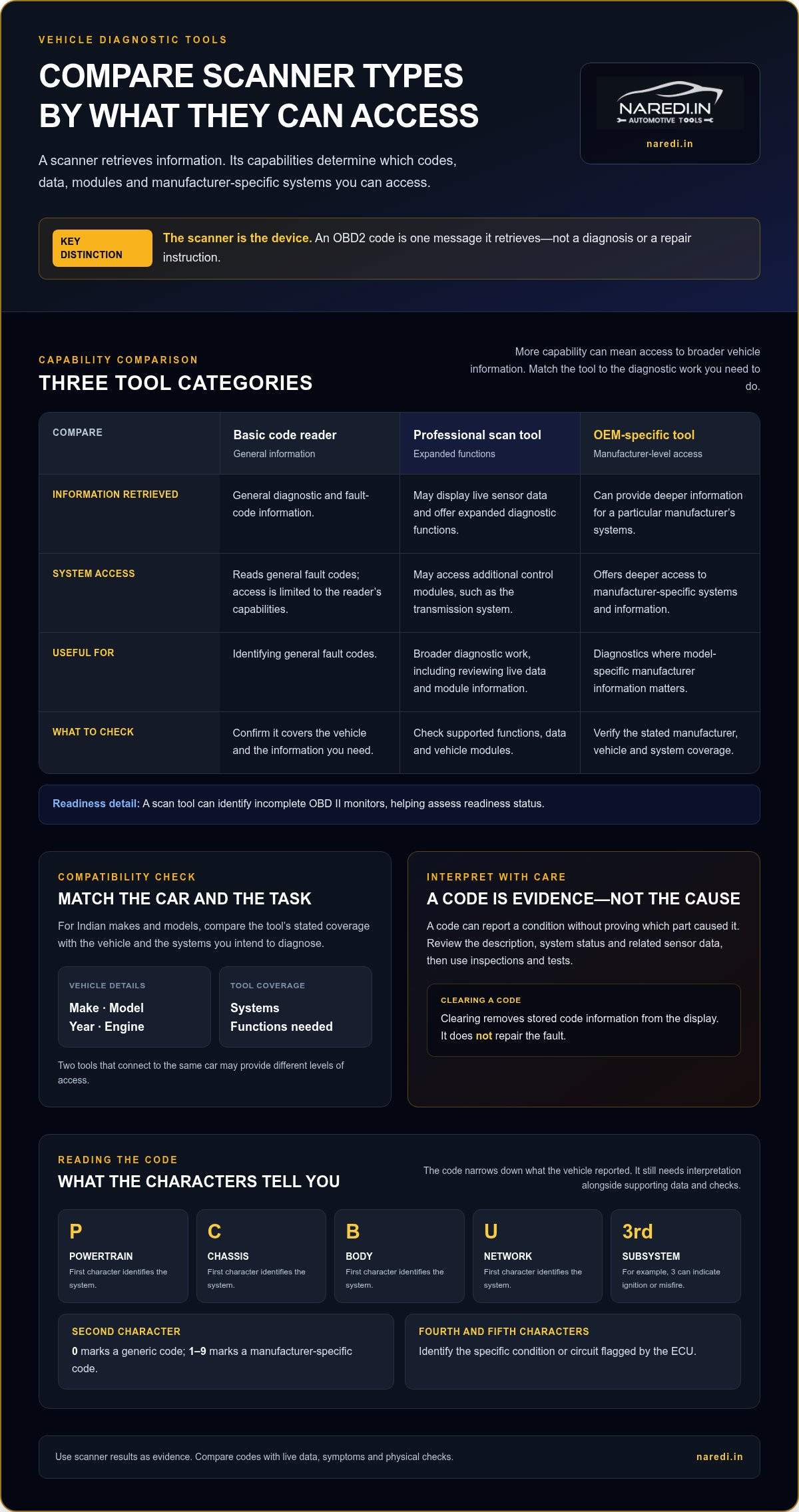
- Compare basic code readers, professional scan tools, and manufacturer-specific tools by the depth of vehicle access they provide.
- See how diagnostic functions and service resets vary, and why a reset doesn’t replace diagnosing the underlying fault.
- Understand how a vehicle’s data network carries information between control modules and the scanner.
- Explore what affects diagnostic tool prices in India and how to match capability to your intended use.
Differences between diagnostic scanners and OBD2 codes
A scanner is the device; an OBD2 code is one message it retrieves. Knowing the difference helps you use scanner results as evidence, not as a diagnosis by themselves.
Scanner Roles and OBD2 Codes
An automotive diagnostic scanner connects to vehicle systems and retrieves information, including OBD2 trouble codes. The code is a standardized message within that information, not a tool or a repair instruction. For example, codes beginning with P relate to powertrain systems, while C, B, and U indicate chassis, body, and network systems. This distinction helps technicians interpret results accurately.
Most modern cars use a 16-pin diagnostic connector, commonly beneath the driver’s-side dashboard. The scanner plugs into this port to communicate with the vehicle’s onboard computer systems. Depending on the device, it may retrieve stored or pending codes, system status, live data, and sensor readings. The port provides access to information; it doesn’t mean every scanner can access every control module.
Code characters narrow down what the vehicle has reported. The first character identifies the system: P, C, B, or U. The second character separates generic codes, marked 0, from manufacturer-specific codes, marked 1-9. The third character identifies a subsystem; 3, for example, can indicate ignition or misfire. The fourth and fifth characters identify the specific condition or circuit flagged by the ECU.
Scanner Connectivity and Operating Systems
Scanners connect through the vehicle’s diagnostic port, but their user interfaces vary. A standalone scanner has its own screen and controls; a compatible OBD or OBD2 connector can also send data to a mobile phone running manufacturer software. The phone, connector, and software must work together to display the retrieved information. This matters when choosing a setup you can operate and understand.
Connecting the vehicle is only the first step in a useful diagnostic workflow. Review the code description, system status, and related sensor data, then compare those findings with the vehicle’s symptoms. A code can identify a reported condition without proving which part caused it. Use inspections and tests to narrow down the cause, rather than treating a code as a direct instruction to replace a part.
Reading and Clearing Fault Codes
To read codes, connect the scanner to the 16-pin port, follow its prompts, and select the code-reading function. Record the code and its status before clearing anything. To clear codes, use the scanner’s clear function after reviewing the results. Clearing removes stored code information from the display, but it doesn’t repair the fault that triggered it.
After clearing a code, scan again and compare the results with the original record. If the same code returns, it remains useful evidence for further inspection and testing. Don’t replace a part based only on a trouble code. Consider the code, live sensor data, and physical checks together to distinguish a reported symptom from its underlying cause.
What are car diagnostic tools?
Car diagnostic tools range from basic code readers to advanced scanners that access broader vehicle systems. For an OBD2 tool, prioritize the data and functions you need; for Indian cars, match its stated vehicle and system coverage to your make, model, year, and engine.
Types of Automotive Diagnostic Tools
Automotive diagnostic tools vary in how much vehicle information they retrieve, so match the tool’s capabilities to the task. A basic code reader retrieves general diagnostic information, while a professional scan tool offers expanded functions. An OEM-specific tool provides deeper access to a particular manufacturer’s systems, which can matter for model-specific diagnostics.
For a workshop, the right tool category depends on its diagnostic workload. A basic reader can identify general fault codes; an advanced scanner may display live sensor data or access additional modules, such as the transmission system. OEM-specific software can provide deeper manufacturer-level information. A scan tool can also identify incomplete OBD II monitors, helping assess readiness status, according to the California Air Resources Board.
Diagnostic Tool Features and Benefits
Useful features include code reading, live data display, access to relevant control modules, and clear descriptions of retrieved information. These functions help technicians compare a reported fault with sensor readings, such as engine temperature, rather than rely on a code alone. Choose a tool based on the tasks you need to perform, so you don’t pay for capabilities that won’t support your work.
Some diagnostic tools serve a specialized purpose. TPMS tools monitor tyre pressure and alert when it rises or falls by 25% or more from the manufacturer’s recommended inflation level. That function differs from engine-code reading. Identify whether you need general fault information, broader system access, or tyre-pressure monitoring before comparing device features.
Compatibility with Indian Car Models
Compatibility means the scanner can communicate with the vehicle and access the systems you intend to diagnose. For Indian makes and models, compare the tool’s stated vehicle coverage with the car’s make, model, year, and engine. Then check that it supports the functions you need. This is more useful than choosing by brand name alone.
Two tools that connect to the same vehicle may offer different levels of access. One may read general codes, while another supports additional modules or manufacturer-specific information. For example, a reader suited to engine faults may not provide the transmission data a workshop needs. Match the scanner’s coverage to the diagnostic task.
A compatible OBD tool can help retrieve vehicle information for diagnosis, but scanner data still needs interpretation. Read the code, review supporting sensor data, and use inspections or tests to identify the underlying fault before deciding on a repair.
Diagnostic functions and service resets
Diagnostic functions identify reported faults, while service resets clear or relearn selected vehicle settings. Match the scanner’s functions to the job, then repeat the diagnostic test after a repair to check whether the fault remains.
Reset and Relearn Functions
Service resets update selected maintenance records or vehicle settings, while relearns help a control module adapt after certain work. The distinction matters because a code reader that reads engine faults may not perform the reset a task requires.
Depending on the vehicle and device coverage, service functions can include resetting a maintenance reminder or supporting an electronic parking-brake service mode. Relearn functions can include procedures such as throttle adaptation. These are distinct operations, not universal features. Before relying on a scanner, check its function list for the specific vehicle and task.
Choose a diagnostic tool by starting with the symptom and system involved. An engine warning on a diesel vehicle calls for relevant engine-system access; a transmission concern needs transmission data. A universal reader can serve basic code checks, while model-specific functions require suitable vehicle coverage and software.
A useful workflow keeps the original reading, repair findings, and post-repair scan together. Record the fault and live sensor data before work, complete the repair, then scan again. The second test helps show whether the reported issue has cleared or needs further investigation.
Risks of Clearing Trouble Codes
Clearing a diagnostic trouble code removes stored information; it doesn’t fix the underlying fault. An erased code can remove useful evidence before technicians compare it with symptoms, sensor readings, or inspection results.
For example, clearing an engine code before recording its description and status can make the initial diagnostic picture harder to reconstruct. The warning may return if the condition persists. Don’t replace a part based only on a code, and don’t treat a cleared display as proof of a repair.
Some scan tools also show which OBD II readiness monitors haven’t completed. Clearing codes can affect the available monitor-status information until the vehicle completes the relevant checks. Review the scanner’s status data and keep a record before clearing, especially when someone else will continue the diagnosis.
After repairs, repeat the test and compare the result with the original reading. If the same fault appears again, technicians can use its status, related sensor data, and physical tests to continue diagnosis. A code describes a reported condition, not a guaranteed cause, so repair decisions should follow the evidence.
CAN bus and vehicle data networks
A vehicle’s CAN bus, or Controller Area Network, carries information between electronic control modules. A diagnostic scanner uses the vehicle’s diagnostic connection to retrieve information from onboard systems. This network helps explain why a scanner can display data from multiple systems, yet may not access every module or function.
Each control module manages a specific area, such as engine operation or transmission control. Sensors provide readings that modules use to monitor vehicle conditions. For example, an engine control module can use sensor data to assess engine operation, while another module handles a different system. The CAN bus lets modules exchange messages without requiring a separate direct connection for every reading.
When a scanner requests information, the vehicle’s network carries relevant messages back through the diagnostic connection. The scanner organizes these messages into codes, system status, or live readings. A fault involving one system may also affect communication with another module. In that situation, a technician considers network information alongside vehicle symptoms and inspection results.
Network access depends on the scanner’s supported functions and the vehicle’s systems. A basic reader may retrieve general engine information, while a more capable diagnostic scanner may communicate with additional modules. In a workshop, this distinction matters: a tool that reads engine faults may not show data from the transmission or other control units. Match the device’s coverage to the system being checked.
Electric vehicles also use electronic control modules to monitor vehicle systems. Depending on the vehicle and scanner, available data may relate to battery condition or charging-system operation. These checks are not interchangeable: a displayed reading is diagnostic information, not proof of a failed battery or component. Technicians compare scanner results with appropriate tests before drawing conclusions.
For example, if a dashboard warning appears alongside a communication fault, the code identifies a reported condition. It doesn’t establish whether the cause lies in a module, wiring, or another issue. Reviewing related codes and live readings can help narrow the investigation. A diagnostic scanner retrieves and presents information; it doesn’t repair the network or confirm a root cause by itself.
Use network data as part of a structured diagnostic process. Record the reported codes and module status, compare related sensor readings, then inspect and test the affected system. After a repair, repeat the diagnostic test to see whether the fault remains. This makes CAN bus information more useful than treating a single scanner message as a complete diagnosis.
Vehicle diagnostic tool prices in India
In India, the cost of a vehicle diagnostic tool depends mainly on the functions and vehicle coverage you need. A basic reader for general engine codes serves a narrower purpose than a workshop scanner that accesses multiple modules, displays live data, and supports broader testing. Compare capability with your intended use, not the device label alone.
For a personal vehicle, start with the task. If you mainly need to read general engine trouble codes, a basic code reader may be enough. If you need transmission information, live sensor readings, or access beyond the engine system, look for a tool that explicitly supports those functions for your vehicle. Greater system access expands what the tool can do.
Workshop requirements differ. A mechanic may need one scanner to diagnose multiple vehicles, review several modules, and produce reports that support testing. Deeper manufacturer-specific coverage can support tasks that general code reading cannot. Consider the range of vehicles, modules, and functions the scanner supports, as well as whether its software provides useful descriptions and readable results.
Before comparing prices, make a short feature list:
- Identify whether you need engine-only code reading or access to other modules.
- Decide whether live data and report functions are needed for your testing workflow.
- Match supported vehicle coverage to the make, model, year, and engine you work on.
- Check whether the scanner supports the specific diagnostic functions you expect to use.
These comparisons explain why two devices with similar-looking screens can serve different users. A tool designed for basic code retrieval has a narrower role than one that reads more systems and presents more diagnostic information. For a vehicle owner, unused advanced features add little practical value. For a workshop, broader access may matter across varied diagnostic jobs.
BS6 status alone doesn’t determine whether a scanner works with a vehicle. Compatibility depends on whether the tool supports that vehicle’s diagnostic communication and the systems you need to access. Check vehicle coverage and function support together, rather than relying on the emissions label as the only selection criterion.
Keep your final decision tied to the diagnostic scope. A general reader suits basic engine-code checks; broader testing requires the corresponding module and live-data support. Reports can help organize findings for a mechanic, but scanner information still needs interpretation alongside inspections and tests. Choose the functions that address your actual work.
Compare OBD tools for vehicle diagnostics by their supported systems and functions to narrow your options for the job.
Naredi.in: Battery Chargers
naredi.in offers Battery Chargers for drivers who need battery-charging equipment, a separate need from reading vehicle fault codes with an OBD scanner. A diagnostic scan provides vehicle information, while a charger addresses battery charging. Keeping these functions distinct helps you choose the right equipment for the task.
If you’re concerned about a battery reading, Battery Testers can help assess battery condition. Jump Starters and Performance Additives are also available for their respective automotive needs. These products complement diagnostic knowledge, but they don’t replace fault-code interpretation, inspection, or testing when a vehicle warning appears.
Visit naredi.in to explore its automotive tools and products.
Choose your next diagnostic step
Choose your next tool based on the diagnostic work you need to do. A vehicle diagnostic tool should match your vehicle coverage and information needs, while battery equipment serves a different purpose. Keeping those needs distinct helps you build a practical automotive toolkit without treating one device as a substitute for another.
naredi.in offers OBD Tools for vehicle diagnostics, alongside Battery Chargers, Battery Testers, and Performance Additives. Consider which category fits your next task, whether you need to read vehicle information or address a separate battery-related need.
Contact naredi.in about diagnostic tools to explore the available options, and take your next step with a clearer sense of the equipment your work calls for.
Frequently Asked Questions
What is an OBD2 Port?
An OBD2 port is the vehicle’s diagnostic socket for connecting a compatible scanner. Modern cars commonly have a 16-pin connector, often beneath the driver’s-side dashboard. Look along the lower dashboard for the socket and match the scanner plug before connecting it. The port provides access to vehicle information, but the data available depends on the scanner and the systems it supports.
How does a car diagnostic scanner work?
A vehicle diagnostic tool connects to a car’s diagnostic port and retrieves information from electronic systems. It can display trouble codes, system status, or sensor readings on its screen or through a compatible phone app. If an engine warning appears, record the code and note the symptoms. Those details help guide further checks, but the scan alone doesn’t identify every failed part.
How much do vehicle diagnostic scanners cost in India?
In India, scanners typically cost between ₹11,000 and ₹65,000 per piece, with a median of about ₹38,000. Cost varies with vehicle coverage, module access, live-data display, and supported functions. Compare the tool’s capabilities with the work you expect to do. A basic code reader and a workshop scanner serve different needs, so the lowest price may not provide the required diagnostic coverage.
What is the difference between a basic OBD2 scanner and a professional diagnostic tool?
A basic scanner focuses on general diagnostic information, while a professional tool may offer broader system access and more detailed readings. A vehicle diagnostic tool for basic engine-code checks serves a different purpose from one used to examine additional modules. Compare the coverage and functions your vehicle and diagnostic tasks require, rather than choosing by the device’s label alone.
Can a vehicle diagnostic tool reset service lights, ABS, airbags, and transmission codes?
Some scanners support service resets or access to ABS, airbag, and transmission systems, but functions vary by device and vehicle. Review the supported functions for the specific make, model, and system. Clearing a code doesn’t repair its cause. Save the original information, and treat safety-system warnings as diagnostic evidence, not as issues resolved simply because a scanner can clear a message.
Are Bluetooth OBD2 adapters safe and reliable to use with smartphone apps?
Bluetooth adapters send vehicle data to compatible smartphone apps, and their reliability depends on the adapter, app, phone, and vehicle working together. Check that the app clearly displays codes and readings for your vehicle. Use your phone while parked, and keep the adapter and cable clear of the driver’s controls. An adapter provides connectivity, but doesn’t guarantee full system access or accurate interpretation of every result.
Which vehicle diagnostic tools are best in India for cars and motorcycles?
For cars, choose a tool whose stated coverage matches the vehicle’s make, model, year, engine, and the systems you need to diagnose. Basic code readers handle general codes, professional scan tools offer expanded functions, and OEM-specific tools provide deeper access to a particular manufacturer’s systems.