

A workshop charger should do more than recharge a battery. A workshop may benefit from a unit that supports both battery charging and power-supply tasks, depending on the work involved.
It’s reasonable to want one unit to handle both charging and a steady supply of power during workshop tasks. The PRO25S is designed for both roles, so the important distinction is when its charging function is appropriate and when its power-supply mode is the better fit.
This guide explains how the PRO25S supports and charges workshop batteries, what its power-supply mode can do, and what to expect from its size and UK plug. You’ll also get a clear view of the model’s main specifications and the practical points that matter when considering it for a workshop in India.
Key Takeaways
- Match the charger to the battery chemistry and capacity, and distinguish the PRO25S NA specifications from other regional versions.
- Understand how its automatic charging cycle supports workshop battery charging and maintenance.
- See how power-supply mode can help maintain vehicle settings and support electrical testing.
- Assess the unit’s dimensions, weight and plug format against your workshop setup in India.
What’s the CTEK PRO25S like?
The PRO25S is a workshop charger whose compatibility depends on battery chemistry, capacity and regional version. Check those specifications against the battery before choosing a charging mode.
Battery Chemistry and Capacity Compatibility
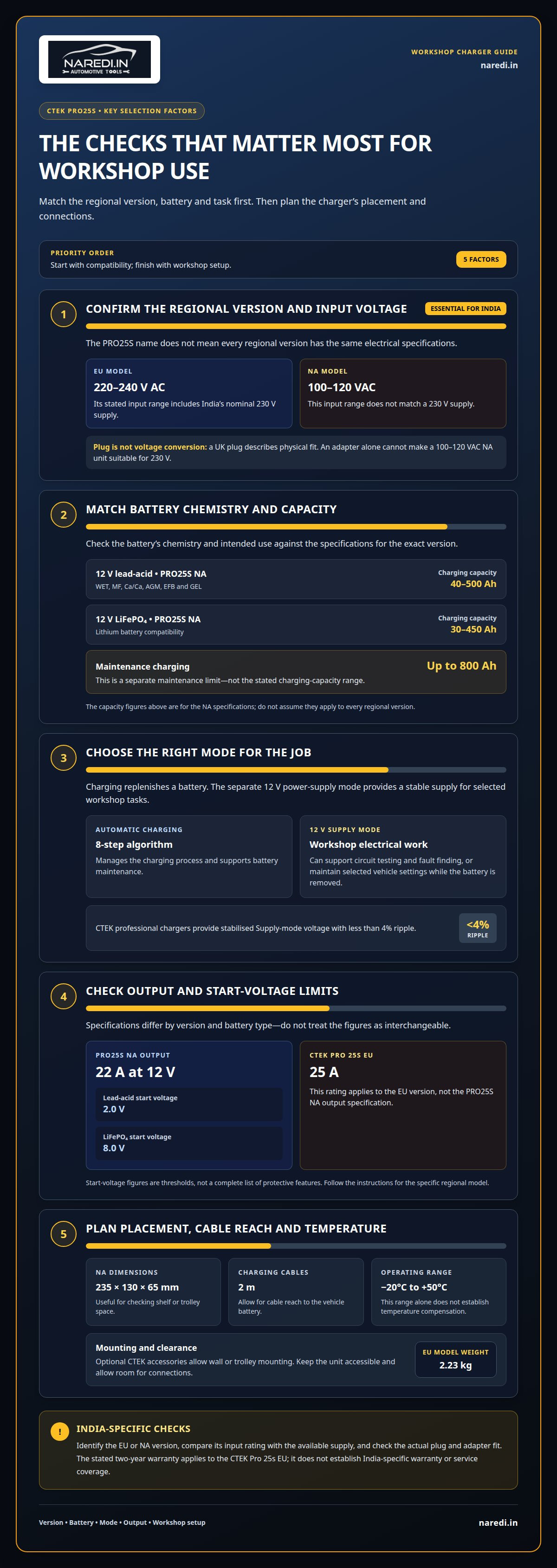
The PRO25S supports 12V lead-acid batteries, including WET, MF, Ca/Ca, AGM, EFB and GEL types. For the PRO25S NA, the stated lead-acid capacity range is 40-500 Ah. Its stated LiFePO₄ compatibility is for 12V batteries, with a 30-450 Ah capacity range on the NA version.
These ranges apply to the NA model specifications; they shouldn’t be treated as universal across regional versions. Maintenance charging is also listed for batteries up to 800 Ah, a separate use from the stated capacity ranges for charging. Match the battery’s chemistry and intended use to the relevant specification before selecting the unit.
Safety Features and Protections
For safe operation, treat chemistry and voltage compatibility as essential checks. The PRO25S NA lists a 2.0V start voltage for lead-acid batteries and an 8.0V start voltage for LiFePO₄ batteries, so the applicable threshold depends on battery type.
These figures describe start-voltage limits, not a complete list of protective features. Don’t assume the unit includes reverse-polarity or spark protection from the model name alone. Follow the instructions for the specific regional model and its connection procedure.
Limitations and User Concerns
Check that the charger’s voltage matches the battery before use. Capacity limits also differ by chemistry and use: the NA charging ranges are not interchangeable with its maintenance-charging limit. A product-wide pattern of common user complaints can’t be inferred from these specifications alone.
For India, the available warranty fact is specific to the CTEK Pro 25s EU: it has a two-year warranty. That EU warranty term doesn’t establish an India-specific warranty or service arrangement, so it should not be presented as coverage for every PRO25S sold in India.
Workshop battery support and charging
The PRO25S combines automatic charging with workshop battery maintenance. Its current output and charging features vary by version, so identify the model before applying specifications.
Temperature-Compensated Charging
Temperature-compensated charging adjusts charging parameters in response to battery temperature. The PRO25S operating range is -20°C to +50°C, but an operating-temperature range alone doesn’t establish temperature compensation. Treat these as separate specifications, and don’t infer a temperature-adjusting function from the operating limits.
25A Charging and Maintenance
The CTEK Pro 25s EU is rated at 25 amperes. The PRO25S NA output is 22 A at 12 V, so these figures apply to different versions. Its fully automatic 8-step charging algorithm manages the charging process, while maintenance charging supports batteries up to 800 Ah. That maintenance limit is distinct from the battery capacity ranges for charging.
For LiFePO₄ use, the PRO25S supports 12V lithium batteries. The NA version lists a 30-450 Ah capacity range and an 8.0 V start voltage for LiFePO₄ batteries. That start threshold matters when a lithium battery is deeply discharged; it differs from the NA lead-acid start voltage.
The charging cables are 2 m long, which determines how far the unit can sit from a connected battery. Optional CTEK accessories allow wall or trolley mounting. Consider cable reach and mounting position together when arranging a workshop bay. They affect where the charger can be placed during charging or maintenance, without changing the battery’s chemistry or capacity requirements.
Dimensions, weight and UK plug
The PRO25S dimensions and weight vary by regional version. Check the specifications for the specific PRO25S version before planning its placement. The CTEK Pro 25s EU weighs 2.23 kilograms. These figures distinguish compact physical size from the space needed for its cables and power connection.
For a garage setup, use the 235 × 130 × 65 mm NA measurements to assess shelf or trolley space. Allow room for the unit’s connections and the 2 m charging cables described for the PRO25S. A mounting position also needs to keep the charger accessible while cables reach the vehicle battery. Optional CTEK accessories allow wall or trolley mounting.
For the mains supply, version matters more than the PRO25S name alone. The EU model’s input voltage is 220-240 V AC, a range that includes India’s nominal 230 V supply. The PRO25S NA is listed with 100-120 VAC input, which does not match 230 V. Don’t treat the NA and EU electrical specifications as interchangeable.
A UK plug describes the plug’s physical format, not the charger’s input-voltage range. A UK-plug EU unit may have the appropriate voltage range for a 230 V supply, but the plug must also fit the socket. A plug adapter changes physical fit; it does not convert voltage. For that reason, an adapter alone cannot make a 100-120 VAC NA unit suitable for 230 V.
Before selecting a unit for an Indian workshop, identify whether it is the EU or NA version, then compare its input rating with the available supply. Check the actual plug supplied with that unit and whether it connects securely through the required adapter. Keep the distinction clear: the EU specification covers 220-240 V AC, while the NA specification covers 100-120 VAC.
Workshop battery support and power supply
The PRO25S has a separate 12V power-supply mode for workshop electrical work. This is distinct from its automatic battery-charging function: one replenishes a battery, while the other provides a stable supply for selected vehicle tasks.
During circuit testing and fault finding, supply mode can power vehicle systems while a technician investigates an electrical issue. CTEK professional chargers provide stabilised Supply-mode voltage with less than 4% ripple. That low ripple is relevant to diagnostic work, where a steady supply helps avoid introducing unnecessary voltage variation during testing.
The mode can also preserve vehicle settings when the battery is removed. A constant 12V supply keeps selected electrical systems powered during that work, rather than leaving them without power. This is useful when settings need to remain intact, but it doesn’t replace correct workshop procedures or make battery removal itself part of the charger’s function.
Choose the operating mode according to the task. For a discharged battery, use the appropriate charging programme and compatible battery settings. For circuit testing, fault finding or maintaining vehicle settings during battery removal, use the 12V supply mode. Keeping those jobs distinct helps prevent treating a power supply as a charging programme, or expecting charging mode to provide the same support to vehicle electronics.
The practical takeaway is that the PRO25S serves two workshop roles: battery charging and 12V electrical support. Its Supply mode is relevant when diagnostics or settings preservation require a steady supply, while its charging function serves batteries. For other electrical requirements, such as a 24V system, this 12V mode isn’t the specified match. Select equipment according to the vehicle system and the task.
For workshop charging equipment suited to battery care, explore battery charger options.
Naredi.in
naredi.in helps Indian automotive users explore equipment for battery charging, testing and related needs. If the PRO25S specifications suit your workshop, use the chemistry, capacity and power-supply requirements discussed above to guide your equipment choice.
Naredi’s range includes Battery Chargers, Battery Testers, Performance Additives and Jump Starters. A battery tester helps assess a battery’s condition; a charger replenishes it. Choose equipment for the task at hand, whether that is charging, checking battery condition or preparing for a jump-start.
Contact naredi.in to discuss automotive tools for your requirements.
Choose equipment around the work ahead
A workshop’s next step is to match equipment to the jobs it handles, not just to one charger specification. A ctek pro25s workshop battery support power supply setup may suit some tasks, while battery testing or jump-starting calls for different equipment. Keep the vehicle’s electrical requirements and the intended task central to that decision.
naredi.in offers Battery Chargers, Battery Testers and Performance Additives, alongside Jump Starters and OBD Tools. These products support different workshop needs, from charging and checking batteries to vehicle diagnostics. Identify the tasks your workshop handles, then choose equipment accordingly.
Contact naredi.in to discuss your setup and take the next step with a clear view of your workshop’s requirements.
Frequently Asked Questions
What is it?
The CTEK PRO25S is a 12V automotive battery charger with a separate power-supply mode. It supports charging compatible batteries and supplying power for selected workshop tasks, such as vehicle electrical diagnostics. For example, a technician can use the supply function when a vehicle needs stable power during fault finding. Its suitability depends on the battery, vehicle system and specific task.
What is the CTEK PRO25S workshop battery support power supply?
It is a charger that can also provide a steady 12V supply for workshop work. In Supply mode, it can support electrical circuit testing, fault finding and preserving vehicle settings while a battery is removed. That makes it relevant when the job requires power to vehicle systems rather than charging a disconnected battery. It doesn’t replace the diagnostic tool or the correct workshop procedure.
What are the CTEK PRO25S specifications, charging current, voltage, and supported battery types?
The PRO25S is for 12V batteries, but current and input voltage depend on the regional version. The EU model is rated at 25 amperes, while the PRO25S NA output is 22 A at 12 V. Supported lead-acid types include WET, MF, Ca/Ca, AGM, EFB and GEL; 12V LiFePO₄ support is also listed. Match the precise version to your requirements.
Can the CTEK PRO25S provide stable power for vehicle diagnostics and ECU programming?
Its 12V Supply mode is intended for electrical circuit testing and fault finding. CTEK professional chargers provide stabilised Supply-mode voltage with less than 4% ripple for vehicle diagnostics. That specification supports diagnostic use, but it doesn’t establish compatibility with every ECU programming procedure. Programming equipment and vehicle instructions determine the required supply conditions, so treat diagnostics and programming as distinct workshop tasks.
How do you set up the CTEK PRO25S as a battery support supply?
Use the Supply mode for vehicle support, rather than a battery-charging programme. First, identify the exact PRO25S version and follow its instructions for connecting the unit to the vehicle and mains supply. Select the 12V Supply mode as directed, then begin the workshop task. Keep the intended use aligned with the vehicle system and the requirements of the diagnostic procedure.
How does the CTEK PRO25S compare with the CTEK PRO25 SE and other workshop power supplies?
The PRO25S has 2 m cables, while the PRO25SE has 6 m heavy-duty cables for greater workshop-bay reach. Other options include the PRO60, with 60A output and selectable 12.6-14.8V, and the MXTS 40 for 12V or 24V charging.