

Automotive Diagnostic Tools in India: Prices and Specifications
More than 7,000 Code Readers & Scan Tools results give Indian buyers a wide field to compare. The right automotive diagnostic tools in India depend on the vehicle systems you need to access and the depth of information you expect from a scan. A basic code reader and a professional scanner serve different diagnostic needs.
It’s worth looking beyond the purchase price: vehicle coverage, live data, system diagnostics, and warranty terms all affect whether a tool suits your workshop or personal use. A scanner’s functions and compatibility determine what information it can retrieve, and how useful that information is for diagnosis.
This guide explains the main types of automotive diagnostic scanners, what affects their prices in India, and which specifications to compare. You’ll learn what live data and system-level diagnostics can reveal, how to assess warranty terms, and how OBD tools fit alongside other automotive equipment. The goal is to help you match a tool to the vehicles and diagnostic work you handle.
Key Takeaways
- Match a scanner’s vehicle and system coverage to the diagnostic work you need to perform.
- Compare market prices by tool type and capability, rather than treating every scanner as an equivalent option.
- Check supply voltage, live-data access, system diagnostics, and warranty terms against your intended use.
- For heavy-duty construction vehicles, account for diagnostic tools designed to operate at 12-24 volts.
- Use live data and system-level functions to narrow down what a fault code alone cannot explain.
Automotive diagnostic scanners and tools
Diagnostic tools range from basic code readers to scanners with broader vehicle-system access. In India, match the tool’s functions to the vehicle and fault you need to investigate.
OBD2 Readers and Professional Scanners
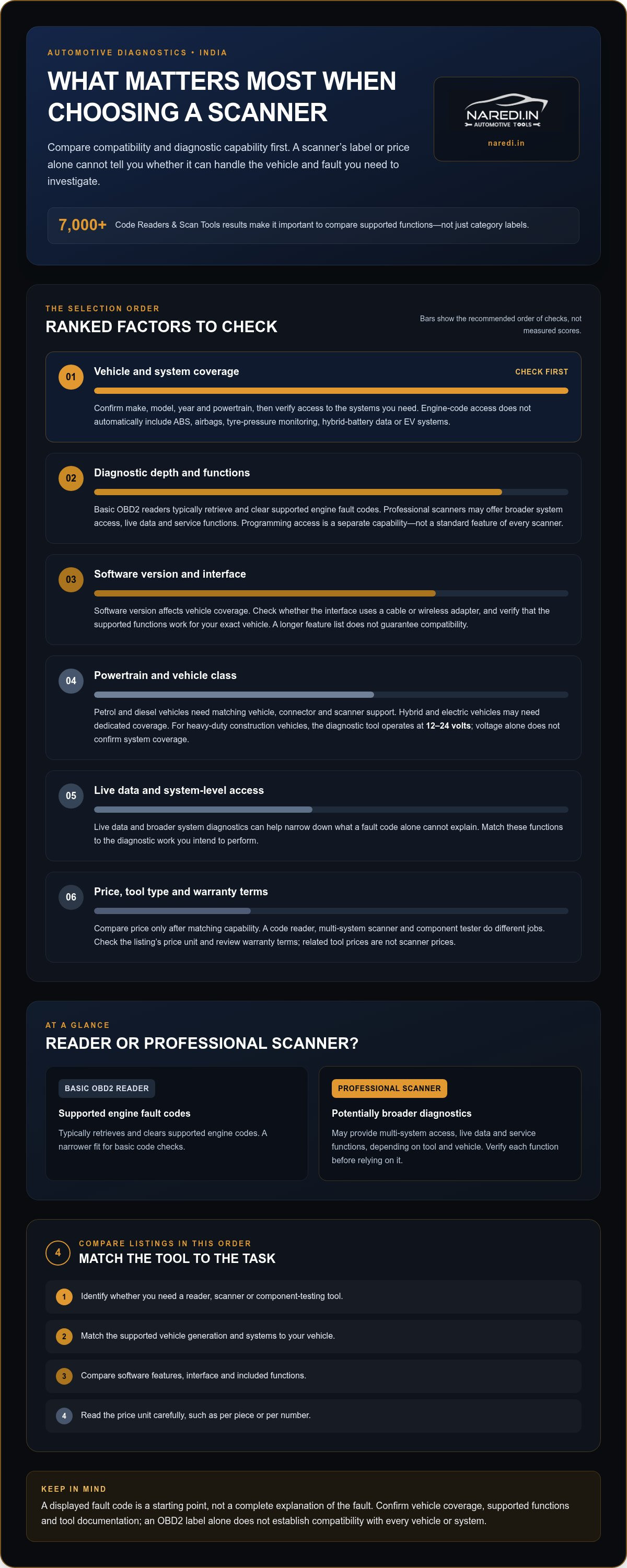
Basic OBD2 readers typically retrieve and clear supported engine fault codes. Professional diagnostic scanners can provide broader system access, live data, and service functions, depending on the tool and vehicle. The difference is useful: a code reader may identify an engine fault, while a compatible professional scanner may also inspect systems such as ABS or airbags.
Before choosing, compare supported vehicle makes, systems, and functions. Programming access is a separate capability, not a standard feature of every scanner. A diagnostic interface may connect through a cable or wireless adapter, and the software version affects vehicle coverage. Don’t assume that a longer feature list means every function works on your vehicle.
Vehicle Type Compatibility
Petrol and diesel vehicles can use OBD2 readers when the vehicle, connector, and scanner support the same diagnostic functions. Hybrid and electric vehicles may require tools with dedicated coverage for their additional systems. No single OBD2 label establishes compatibility across every powertrain, make, model, or system.
Identify the vehicle’s make, model, year, and powertrain before comparing scanner coverage. Then check support for the systems you need, such as engine management or tyre-pressure monitoring. A tool that reads engine codes may not access hybrid-battery data or electric-vehicle systems. These distinctions help narrow your choice of automotive diagnostic tools in India to the right use case.
Risks of Cheap or Incompatible Tools
A low-cost or incompatible scanner may return incomplete information, fail to communicate, or provide unclear code descriptions that complicate diagnosis. Limited vehicle coverage can also prevent access to the system behind a warning light. Treat a displayed code as a starting point, not a complete explanation of the fault.
Use a simple process: confirm vehicle coverage, read the scanner’s supported functions, and match them to the issue. Avoid programming functions unless the tool supports the vehicle and you understand the procedure. A failed connection or incorrect operation can interrupt diagnosis and make troubleshooting harder.
Listings show more than 7,000 Code Readers & Scan Tools results, so category labels alone won’t identify the right tool. Compare the scanner’s interface, supported systems, software version, and intended vehicle types. For example, verify tire pressure system access separately from basic engine-code reading. Some tools are designed for code reading, while others support additional diagnostic operations.
Truck scanning requires attention to vehicle class and electrical compatibility. A heavy-duty construction vehicle diagnostic tool operates at 12-24 volts. That specification matters when comparing equipment for truck diagnostics, but voltage alone doesn’t establish vehicle coverage. Also assess the supported truck systems and diagnostic functions before using a scanner.
For India, distinguish a tool’s compliance documentation from its diagnostic coverage. An OBD2 label alone doesn’t establish regulatory certification or access to every vehicle system. Review the documentation for the tool’s intended function and the vehicle coverage it provides.
Automotive diagnostic tool prices in India
Prices for diagnostic equipment in India vary by tool type and function. A code reader, multi-system scanner, and component tester do different jobs, so their prices aren’t directly comparable. When choosing a scanner, compare vehicle coverage, software functions, and supported systems before considering price. A lower-cost reader may suit basic code checks, while broader diagnostics require different capabilities.
Listings for related diagnostic equipment show how prices vary across tool categories, highlighting the diversity available for mechanics and garages seeking reliable automotive diagnostic tools India options.
These figures apply to the named tool types and units shown, not to scanners generally. A circuit tester checks electrical circuits, while a sensor tester focuses on sensor signals. A Break Out Box provides access to vehicle wiring during diagnosis, and a BDM frame set serves a different diagnostic setup. Compare each tool’s function before using its listed price as a reference.
For scanners, price reflects vehicle coverage and diagnostic depth. A reader that retrieves engine codes has a narrower role than equipment that accesses several vehicle systems. Software support, data display, and functions such as key programming also shape a tool’s intended use. Electric vehicles and newer vehicle generations may require specific coverage. Check support for the exact make, model, and system against the task.
Before comparing two listings, use this practical sequence:
- Identify whether you need a reader, scanner, or component-testing tool.
- Match its supported vehicle generation and systems to your vehicle.
- Compare software features, interface, and included functions.
- Read the price unit carefully, such as per piece or per number.
This avoids mistaking a per-unit sensor-tester listing for a scanner price. It also separates the purchase cost from the capability needed for the job. Don’t assume programming or electric-vehicle support is standard across all scanners.
For an onboard diagnostics reader, browse the available OBD diagnostic tools and compare their intended use with your vehicle and diagnostic requirements. A useful price comparison begins with function, then checks compatibility and software support. That approach keeps the listed amount tied to what the tool can actually do.
Diagnostic tool specifications and warranty
A scanner’s specification sheet shows which vehicle systems it can access and how it connects. Compare supported functions, vehicle coverage, display, interface, and warranty terms before choosing a tool for workshop use.
Mechanics should prioritise vehicle compatibility, engine and other system coverage, live-data monitoring, and clear fault-code descriptions. Bluetooth can simplify connection to a compatible device, but it doesn’t establish diagnostic coverage by itself.
Check these specifications against the work you handle:
- Vehicle coverage: Match supported makes, models, and vehicle systems to the vehicles in your workshop.
- Diagnostic functions: Separate code reading from live-data monitoring, system tests, and service functions.
- Connection interface: Compare the scanner’s connector, cable, or Bluetooth connection with your intended setup.
- Display and reports: Look for readable codes and data values that help you compare results during diagnosis.
- Software: Review supported vehicle coverage and software version information relevant to your diagnostic tasks.
A specification must fit the vehicle’s electrical requirements, too. The Smart Can Solution 2 is specified for a 12 V supply voltage. That figure describes its supply voltage; it doesn’t, by itself, establish coverage for every vehicle or system. Check the tool’s stated functions alongside the vehicle’s requirements.
For warranty comparisons, read the written terms for coverage, duration, exclusions, and the process for handling a fault. These details explain what support applies if the scanner develops a hardware or software issue. Keep the purchase record and warranty document together. Don’t assume a warranty covers accidental damage, software access, or every component unless the terms say so.
Software support matters because a scanner’s vehicle coverage and functions depend on the software available. Check how the stated version supports your vehicle and whether it includes the functions you need. Bluetooth convenience won’t provide access to unsupported engine data. A clear display can show readings, but interpretation still depends on the diagnostic context and the vehicle’s condition.
Use a simple comparison process. First, list the vehicles and systems you diagnose. Next, match those needs to the scanner’s coverage and functions. Then compare its interface, software version, warranty terms, and display. For example, a workshop focused on engine faults may prioritise engine-code access and live monitoring, while broader work calls for access to other relevant systems. This helps you choose automotive diagnostic tools in India by capability, not feature labels alone.
Live data and system diagnostics
A scan tool can show more than stored fault codes. Live data displays supported signals while the vehicle is operating, helping technicians observe how a system responds. For example, an engine-sensor reading can be compared at idle and during acceleration. The reading provides diagnostic context, but it doesn’t identify a failed part by itself.
Live data is most useful when linked to a clear symptom. If the driver reports uneven engine response, select relevant engine parameters and observe them under the conditions described. Compare related values rather than relying on a single sensor. A faulty reading may result from the sensor, its wiring, or another system condition, so review the surrounding evidence before drawing a conclusion.
Use this sequence to make the scan more informative:
- Record the reported symptom and when it appears.
- Scan the vehicle systems supported by the tool.
- Review stored codes before selecting relevant live data.
- Observe the data stream under the conditions linked to the symptom.
- Compare related sensor readings and inspect the relevant hardware.
This connects scan results to the vehicle’s actual behaviour. For example, an engine code and a changing sensor value provide different clues. A code identifies a detected condition; live data shows how the monitored parameter behaves during observation.
System diagnostics extend beyond the engine. Depending on the vehicle and scanner coverage, a scan may access systems such as ABS, airbags, transmission, or tyre-pressure monitoring. Available modules and functions vary between models. A tool that reads engine codes may not communicate with other systems, so select the relevant system from the scanner menu and confirm that it returns vehicle data.
Advanced functions may include system tests or service operations, but availability depends on the scan tool and vehicle. Don’t assume every tool can command a component or change a setting. Distinguish between viewing data and performing an active test. Before using an advanced function, understand what it commands and which hardware it affects.
Interpretation matters as much as scanning. A value that changes during a test may be responding normally, or it may indicate a fault when compared with related readings and symptoms. Review the units, labels, and selected vehicle system. If the scanner supports graphing, a graph can make changes easier to follow than a single displayed value.
For practical diagnosis, save or note the initial codes and observations before clearing anything. Re-scan after the relevant inspection or repair to see whether the same code returns. A scan tool provides evidence for troubleshooting; sound conclusions come from combining codes, live data, symptoms, and inspection of the related system.
Automotive diagnostic tools
A diagnostic tool is useful when it answers a defined question. Start with the symptom, then choose a test that can investigate it. For example, a warning light may call for an initial code reading. Intermittent stalling may require observing live readings during the reported condition. This keeps the scan focused on evidence rather than feature labels.
Before buying, map your usual work to the tool’s functions. A home user who reads engine codes has different needs from a workshop diagnosing several vehicle systems. Vehicle coverage should match the makes and models you work on. Check whether the scanner connects to the systems you need and presents readings clearly.
Use this decision sequence to compare options:
- Define the task: Choose code reading, live monitoring, system testing, or another stated function.
- Match the vehicle: Compare coverage for its make, model, year, and powertrain.
- Check connection: Confirm the connector or wireless method suits your diagnostic setup.
- Review the display: Look for readable codes, units, and data labels.
- Consider the operator: Choose controls and menus that suit your experience and workflow.
A tyre-pressure warning is a practical example: an engine-code reader may not access tyre-pressure data. The required system coverage matters more than a broad product label. Similarly, a scanner with testing functions may help investigate a supported system, but functions vary by vehicle and tool. Match the intended test to the available function.
Intelligent features are useful only when they improve the diagnostic process. A guided menu can help an operator find a system, while a data graph can make changing readings easier to follow. Neither replaces interpretation. Compare the result with the symptom, inspect related components, and use a relevant test before deciding what the reading means.
For a workshop, consider how the tool fits repeated tasks. A clear connection process and organised menu can reduce unnecessary steps during routine scans. For personal use, straightforward code descriptions may matter more than advanced controls. Choosing automotive diagnostic tools in India means balancing vehicle coverage, useful functions, and ease of use against the work you actually do.
Use the same criteria when reviewing OBD diagnostic tools: match coverage and functions to your vehicle and intended testing. This makes the choice more precise than selecting by a feature count alone.
Naredi.in: Battery Chargers
naredi.in is a practical next step when diagnostics point to a battery-related need rather than a vehicle fault requiring further testing. OBD tools read supported vehicle data; a battery charger has a different purpose: charging a battery. Keeping these roles distinct helps you choose equipment for the task.
Explore naredi.in’s range of Battery Chargers, Battery Testers, Jump Starters, and Performance Additives to find a category suited to your automotive needs. A battery tester can help assess a battery, while a charger is intended to charge one. These products complement diagnostic work without replacing a scan or system test.
Visit naredi.in to explore its automotive tools and products.
Make the Next Diagnostic Choice with Confidence
Use your diagnostic findings to define the next check. Let the vehicle, system, and task guide your choice, rather than a feature label. This practical approach helps you assess automotive diagnostic tools in India and focus on equipment suited to the work ahead.
For your next step, compare automotive diagnostic tools in India by the vehicle systems and functions you need. naredi.in offers OBD Tools, along with Battery Chargers, Battery Testers, and Performance Additives for other automotive needs. Each category serves a different purpose, so choose according to the task.
Contact naredi.in about diagnostic tools to explore OBD options for your requirements. A clearly defined diagnostic need makes it easier to choose automotive diagnostic tools in India with purpose.
Frequently Asked Questions
What types of automotive diagnostic tools are available in India?
India’s diagnostic tool options include OBD2 code readers, multi-system scanners, circuit testers, sensor testers, and breakout boxes. A reader retrieves supported fault codes, while a scanner may access additional vehicle systems. Circuit and sensor testers help investigate electrical signals directly. Choose by the diagnostic task: retrieving a code, monitoring data, or testing a component requires different functions.
What are the best car diagnostic scanners in India in 2026?
The best scanner depends on the vehicles and systems you need to diagnose. For example, the Autool CS520 supports petrol and diesel vehicles, including AdBlue BS6, and lists engine, ABS, SRS, transmission, and body systems. Compare its coverage with your vehicle and intended tasks. Other options, such as Konnwei and BlueDriver models, should be assessed by their individual supported functions.
How much do automotive diagnostic tools cost in India?
There isn’t one price for every diagnostic tool. Costs differ between a basic code reader, a multi-system scanner, and a separate testing instrument. Vehicle coverage, supported systems, software functions, and included accessories also affect comparisons. When shopping for automotive diagnostic tools in India, identify the functions you need first, then compare prices for tools with matching coverage.
Which OBD2 scanners support Indian car brands and models?
Compatibility varies by product. Supported Indian makes include Maruti, Tata, Hyundai, Honda, Mahindra, Royal Enfield, Bajaj, and KTM, but coverage differs between scanners. Match the tool’s stated support to the exact vehicle make, model, year, and powertrain. For example, don’t assume a scanner that communicates with one petrol model will also access every system on a diesel or hybrid model.
How do you use an OBD2 scanner to diagnose a car fault?
Park safely, locate the vehicle’s diagnostic connector, and connect the scanner as instructed. Switch on the ignition when prompted, select the vehicle profile, and read the stored fault code. Record it before clearing anything. Then compare it with the reported symptom and inspect relevant live readings. Clear codes only after addressing the fault, then scan again to see whether it returns.
Which diagnostic tools work with petrol, diesel, hybrid, and electric vehicles in India?
Petrol and diesel vehicles can use OBD2 readers when the vehicle, connector, and scanner support the same functions. Hybrid and electric vehicles may need tools with dedicated coverage for their additional systems; check support for the specific make, model, and systems.
Are there Indian regulations or certification requirements for automotive diagnostic tools?
Check the tool’s compliance documentation for its intended function; an OBD2 label alone does not establish regulatory certification.
Where can I buy automotive diagnostic tools in India, and what warranty is offered?
Browse available OBD diagnostic tool listings in India. Check the written warranty terms for coverage, duration, exclusions, and the process for handling a fault.