

A basic battery charging formula can estimate charging time, but it can’t tell you exactly when a battery will be full. The calculation is simple: divide the amp-hours of charge to add by the charger’s current in amps. In practice, the result is only a starting point.
Voltage does not appear in this basic calculation. Capacity and current must use compatible units, while voltage matters when checking charger compatibility and calculating power. Knowing which figures to use helps avoid a common mistake: treating a battery’s full rated capacity as the amount it needs to recharge.
This guide explains the battery charging formula and how to use it. You’ll see worked examples, learn how to calculate charging current and power, and understand why actual charging time may differ from the estimate.
Battery chemistry, state of charge, temperature and charging efficiency all affect the result. These factors help explain why a charger’s output rating does not necessarily mean the battery receives that current throughout the charging cycle.
Key Takeaways
- Use the battery charging formula with the capacity to add, not automatically the battery’s full rated capacity.
- Divide amp-hours by charging current in amps to get an ideal estimate in hours.
- Follow the worked automotive battery example to see each step from capacity to estimated charging time.
- Account for charging stages and battery chemistry when interpreting the result.
- Use voltage, chemistry requirements and charger output to guide safe charging. The estimate is not a battery health test.
What Does a Battery Charging Formula Calculate?
A battery charging formula estimates how long a charger may take to add a required amount of charge. The basic calculation compares the charge to add, measured in amp-hours (Ah), with the charging current, measured in amperes (A):
Estimated charging time in hours ≈ amp-hours to add ÷ charging current in amps
For example, if you need to add 12 Ah and the charger’s relevant output is 4 A, the ideal estimate is 12 ÷ 4, or 3 hours. This is a calculation, not a countdown. It does not measure battery health or guarantee when charging will finish. The current and charging conditions can change during the process.
The battery charging formula turns two specifications into a useful starting estimate. Keep the units matched: divide amp-hours by amps to estimate hours. Voltage matters for charging, but it is not a direct input in this basic time equation. For a broader explanation of charging systems and their factors, see Battery Charger Principles.
What do Ah, A and volts mean in a charging calculation?
Amp-hours (Ah) describe battery capacity, or the amount of charge it can store. Amperes (A) describe current, the rate at which electrical charge flows. Volts (V) describe electrical potential. Each unit tells you something different, so don’t divide a voltage figure by a capacity figure to estimate charging time.
For instance, a battery label might show 60 Ah, while a charger label lists a maximum output of 6 A. The first is capacity; the second is a current rating. The battery’s voltage is a separate value that helps identify a compatible charger. Read each figure with its unit rather than treating the numbers as interchangeable.
When is the simple battery charging formula useful?
Use the formula for a first estimate when you know how many amp-hours need to be added and have a relevant charging-current figure. If a battery is partly discharged, estimate only the capacity needed to restore its charge. Don’t automatically use its full rated capacity. The result can help you plan, but it remains an idealised estimate.
Charging current can vary during a charging cycle, and the battery’s chemistry and charging profile affect how it accepts charge. A charger’s stated current should not be assumed to flow continuously until charging is complete. Treat the result as a planning guide, then follow the battery and charger instructions for the actual charging process.
The basic formula estimates ideal charging time by dividing the amp-hours to add by the charging current in amps. It provides a starting point, not a measurement of battery condition or a guaranteed completion time.
How to Use the Battery Charging Formula Correctly
Build the estimate from the charge the battery still needs, not just the number printed on its label. The battery charging formula is most useful when you use matching units, a realistic current figure and a clear assumption about the battery’s present state of charge.
- Find the rated capacity. Read the battery capacity in amp-hours (Ah) from its label or documentation.
- Determine the capacity to add. For a partly discharged battery, estimate the unfilled portion of its rated capacity instead of treating the battery as empty.
- Identify the charging current. Use the charger’s relevant output in amperes (A), not its voltage or a different current rating.
- Divide capacity by current. The result is an ideal estimate in hours. Keep Ah in the numerator and A in the denominator.
How do you calculate the charge still needed?
If you know both the rated capacity and state of charge, calculate the unfilled proportion as 1 minus the state-of-charge fraction. Multiply that proportion by the rated capacity to estimate the amp-hours to add. Treat the state-of-charge figure as an estimate unless it comes from a suitable measurement method. An assumed percentage can make the time estimate less reliable.
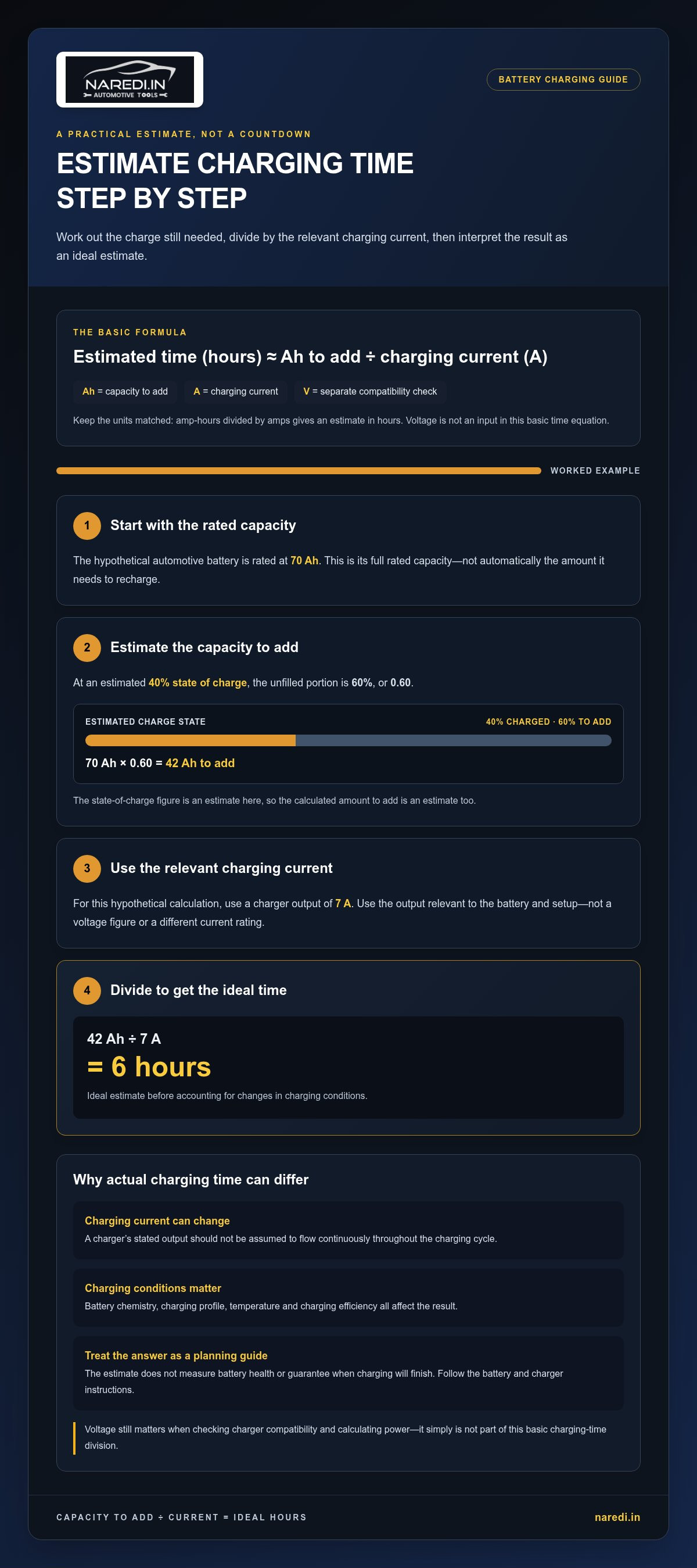
Hypothetical example: Suppose an automotive battery is rated at 70 Ah and is estimated to be 40% charged. The unfilled proportion is 100% − 40% = 60%, or 0.60. The estimated capacity to add is 70 Ah × 0.60 = 42 Ah. These figures illustrate the calculation and do not describe a particular battery or charger.
How do you calculate charging time from capacity and current?
Now use the 42 Ah to add and a hypothetical charger output of 7 A: 42 Ah ÷ 7 A = 6 hours. This is the ideal result before accounting for changes in charging conditions. Check that the current value represents the output relevant to your battery and charging setup.
Ah divided by A gives hours because amperes represent amp-hours delivered per hour. In the example, 7 A for one hour would ideally add 7 Ah, so 42 Ah requires six hours at that steady rate.
Keep the ideal answer separate from any efficiency adjustment. Don’t add a generic percentage to the time just because charging equipment and batteries are not perfectly efficient. An adjustment requires a suitable, reliable efficiency figure for the specific charging conditions. If an applicable charge-efficiency factor, η, is available and the assumptions support its use, an adjusted estimate may be calculated as ideal time ÷ η. Charging behaviour can vary, so this remains an estimate, not a precise finish time.
After calculating the estimate, compare the current you used with the output information for battery chargers. Consider charger output alongside the battery’s requirements rather than choosing a current based on the time estimate alone.
Why the Formula's Result Can Differ from Actual Charging Time
The battery charging formula assumes a steady current, but charging is rarely that simple from start to finish. A charger’s rated current describes its output capability under specified conditions. It does not mean the battery will receive that current continuously. The battery accepts current according to its condition and charging requirements, and the charger may adjust its output as charging progresses.
Several variables can widen the gap between an ideal calculation and the time shown by a charger or measured in use:
- Charging stage: Current may reduce as the battery approaches full charge, extending the final part of the process.
- Battery acceptance: Depending on its state and limits, a battery may accept less current than the charger can supply.
- Charging profile: The charger controls current and voltage according to its design and selected settings.
- Operating conditions: Temperature and battery condition can affect charging behaviour.
How do battery chemistry and charging stages affect the estimate?
Lead-acid and lithium-based batteries use different charging profiles. The same capacity and charger-current figures therefore do not necessarily produce the same real charging duration. Depending on the battery chemistry and charger, charging may slow near completion. Follow the battery and charger manufacturers’ instructions for chemistry-specific settings and limits. A current rating alone does not describe the complete charging process.
The charger’s rated output and the current accepted by the battery are related, but they are not interchangeable. A charger’s stated current does not prove that the battery receives it throughout charging. The charging system may regulate output, and the battery may accept less as its charge level rises. Use a correction factor only when the battery or charger specifications provide a suitable basis for it. Avoid applying a universal percentage to every setup.
When should voltage and watt-hours be used instead?
An energy calculation can help when the charge required is expressed in watt-hours (Wh) and the relevant charging power is known in watts (W). The basic relationship is power in watts = voltage in volts × current in amps. Estimated time in hours is then watt-hours to add divided by charging power. This remains an ideal estimate if power changes during charging.
For a hypothetical example, suppose the charging side operates at 24 V and supplies 3 A. Its calculated power is 24 × 3 = 72 W. If 144 Wh must be added, the ideal energy-based estimate is 144 ÷ 72 = 2 hours. Actual duration may be longer if the system does not deliver that power continuously.
Use voltage and energy figures that describe compatible parts of the charging system. Don’t combine a battery’s nominal voltage with a charger’s current rating if those values do not represent the same operating conditions. Check the battery and charger documentation for the relevant voltage, output and charging profile before relying on an energy estimate.
Worked Example: Estimate Battery Charging Time Step by Step
Here’s a hypothetical automotive battery example showing how the calculation works. The figures are illustrative, not specifications for a particular battery or charger. Always follow the battery and charger manufacturers’ instructions, including their limits on voltage, chemistry and charging current.
How do you work through a car-battery charging example?
Assume a battery has a rated capacity of 60 Ah and is estimated to be half charged. The estimated capacity to add is 60 Ah × 0.50, or 30 Ah. Now assume a compatible charger supplies 5 A under the relevant conditions. Substitute those values into the formula:
Estimated time = capacity to add ÷ charging current
30 Ah ÷ 5 A = 6 hours
The ideal estimate is six hours. This assumes a steady 5 A current and does not include changes in charging behaviour. The battery’s actual state of charge may also differ from the assumed 50%, changing how much capacity needs to be added.
The table shows how the ideal estimate changes when the capacity to add stays at 30 Ah but the hypothetical current varies:
| Capacity to add | Hypothetical current | Ideal estimated time |
|---|---|---|
| 30 Ah | 3 A | 10 hours |
| 30 Ah | 5 A | 6 hours |
| 30 Ah | 10 A | 3 hours |
These figures are arithmetic comparisons, not recommendations to use any of the listed currents. The battery’s permitted charging current and the charger’s compatible output take precedence. A higher current produces a shorter ideal estimate, but it must be suitable for the battery and charging system.
How should you interpret the calculated result?
Use the answer to plan, not to predict an exact finish time. A charger may not deliver its rated current continuously, and current can taper as charging nears completion. If the battery’s actual state of charge is lower than assumed, it may need more charge than the example allows for. Both factors can extend elapsed time beyond the ideal result.
The formula gives an ideal time at a stated current; real charging time depends on how much charge the battery needs and how the charger delivers it. Don’t apply a universal extra-time percentage. Any adjustment requires relevant battery and charger specifications.
Use the calculation to understand the relationship between charge needed and charger output, then explore battery chargers that can be matched to the battery’s requirements.
Apply the Battery Charging Formula Safely and Choose the Next Step
A charging-time estimate is useful only when the charging setup is suitable for the battery. Before starting, match the charger’s voltage and supported battery chemistry with the battery manufacturer’s requirements. Check the charger’s output against the permitted charging limits, too. A correct calculation cannot make an incompatible charger safe to use, and an estimated finish time does not confirm that a battery is safe or serviceable.
What should you check before starting a charging cycle?
Read the battery and charger instructions before connecting them. Follow their guidance on connection order, ventilation, charging limits and any chemistry-specific settings. Use the charger only with a battery type and voltage it supports. These checks come before the time estimate: the calculation helps with planning, while the manufacturers’ instructions govern the charging process.
- Voltage: Confirm that the charger is intended for the battery’s voltage.
- Chemistry: Select only a charging setting supported by the battery type and charger.
- Output: Keep the charger’s current within the battery manufacturer’s stated limits.
- Condition: Don’t start or continue charging if the battery is damaged or behaves abnormally. Stop and follow the manufacturer’s guidance.
Abnormal behaviour can include unexpected heat, swelling, leakage or an unusual smell. Don’t rely on a calculated duration to judge whether charging should continue. If you notice a problem, stop the process and use the battery manufacturer’s instructions to determine the appropriate next step. A time estimate is not a substitute for assessing battery condition.
How can a charger’s specifications support a better estimate?
Compare the charger’s stated current with the current used in your calculation. If the figures differ, recalculate using a suitable output value, while remembering that rated current may not be delivered continuously. Then check voltage compatibility, supported chemistry and charging limits. A battery charger supplies the charging current, but its specifications must fit the battery.
Use this short check before relying on your estimate:
- Confirm the battery capacity still to be added and the assumptions behind it.
- Read the charger’s output and supported battery details from its specifications.
- Compare those details with the battery manufacturer’s requirements.
The battery charging formula can help you compare charging current with the charge needed, but it cannot verify equipment compatibility or battery condition. Once you’ve identified the specifications that matter, browse battery chargers for your charging needs and compare their stated details with your battery requirements.
Put Your Charging Estimate to Practical Use
Use the battery charging formula as a planning reference, then compare its estimate with the charging process under your actual conditions. Keeping a simple record of the battery, charger output and elapsed time can help you make more informed estimates for similar charging tasks later. Treat each result as context, not as a substitute for the battery’s requirements or a check of its condition.
Next, compare the charger’s stated specifications with the battery details used in your calculation. This makes the estimate more relevant and helps you focus on equipment suited to the task. naredi.in is an authorized Pan-India distributor established in 2014, with products sourced directly from OEM manufacturers and described as 100% genuine.
Browse battery chargers and compare their specifications with your battery’s requirements. Use the details to choose equipment that fits your charging needs.
Frequently Asked Questions
What is the formula for calculating battery charging time?
Divide the amp-hours you need to add by the charging current in amps: estimated time in hours ≈ Ah to add ÷ A. For example, adding 18 Ah at a steady 6 A gives an ideal estimate of 3 hours. This battery charging formula is a planning tool, not a promise of the charger’s finish time. Use the capacity still needed, not automatically the battery’s full rated capacity.
How do I calculate how long it takes to charge a 12V car battery?
A 12V rating alone doesn’t tell you the charging time. You also need the battery’s capacity, the charge it needs and the compatible charger’s current. For a hypothetical example, if a 48 Ah battery needs 12 Ah added and a suitable charger supplies 4 A, the ideal estimate is 12 ÷ 4 = 3 hours. Check the battery and charger instructions before charging.
Can I use voltage in the battery charging time formula?
Voltage is not a direct input in the basic amp-hour calculation, which uses capacity and current. It is essential for checking whether the charger is suitable for the battery. If you’re calculating from energy instead, divide watt-hours to add by charging power in watts, with power calculated as volts × amps. Ensure those voltage, current and energy figures refer to compatible operating conditions.
How much current should I use to calculate battery charging time?
Use the charger’s stated current output that applies to the battery and charging mode, while staying within the battery manufacturer’s charging limits. Don’t select a current simply to produce a shorter estimate. For example, if a charger has different output settings, base your calculation on the setting actually used, provided it is suitable for the battery’s voltage and chemistry.
Why does the actual charging time differ from the formula?
The calculation assumes that the chosen current continues steadily, but the charger may adjust its output as charging progresses. The battery may also accept less current than the charger can supply. Its present state, temperature, condition and charging profile can affect elapsed time. A low or uncertain starting charge can also mean the battery needs more capacity added than your estimate assumes.
Is the same charging formula suitable for lead-acid and lithium batteries?
The basic arithmetic can estimate ideal time for either type if you know the capacity to add and a relevant current value. However, lead-acid and lithium-based batteries use different charging profiles and may respond differently as charging proceeds. The formula does not account for those differences by itself. Follow the battery and charger manufacturers’ chemistry-specific instructions, settings and limits.
Can a battery charging formula tell me whether my battery is healthy?
No. A time estimate describes a possible charging duration; it does not assess battery health, capacity retention or safe condition. A battery that takes longer than expected may have several causes, and the calculation alone cannot identify which one applies. If you’re concerned about its condition, use an appropriate battery tester or have the battery assessed using a suitable testing method.