

A higher peak-current rating doesn’t automatically make a jump starter the right choice for your vehicle. When comparing a portable jump starter in India, start with your vehicle’s voltage, engine type and size, then check whether the product’s specifications support that fit. This guide helps you look past headline numbers and focus on what matters.
Emergency starting, battery charging and battery diagnosis are different jobs, even when products include extra features. You’ll learn which specifications to compare, how to match a jump starter to your vehicle, and when a charger or tester is more suitable. The aim is a confident choice, not a longer list of features.
naredi.in offers battery tools for different needs, including the OzCharge RM 1000, a 1000A supercapacitor jump starter with no battery, as well as battery chargers and testers. By the end, you’ll have a practical way to assess product information and choose equipment for emergency starting, charging or battery checks.
Key Takeaways
- Choose a portable jump starter in India by matching its stated voltage, vehicle type and engine limits to your vehicle, not by peak current alone.
- Separate emergency starting from routine battery charging and diagnosis so you select the right kind of tool for the job.
- Compare compatibility and current ratings first. Treat lights and device charging as optional extras.
- Understand how the OzCharge RM 1000, CTEK MXS 5.0 charger and Konnwei KW210 tester serve different battery needs.
What a Portable Jump Starter in India Does, and When You Need One
A portable jump starter is a compact power source designed to provide temporary starting assistance when a vehicle battery cannot supply enough power to start the engine. It can be useful when you’re away from a charging point and need an emergency starting option. When choosing a portable jump starter in India, match the product to your vehicle’s electrical requirements and intended use. Don’t choose on the basis of a prominent current figure or a bundle of extra functions alone.
Both compatibility and the reason the vehicle won’t start matter. A jump starter may help with a low battery, but it can’t guarantee a start in every situation. Another fault may be responsible, or the battery may be unable to support starting. Check the product documentation for the vehicles and operating limits a model is intended for, then compare those details with your vehicle manual.
What problem does a portable jump starter solve?
A jump starter addresses an immediate problem: the vehicle battery isn’t providing enough power for the engine to start. The device supplies starting assistance for that situation. It’s an emergency tool, not a way to identify why the battery became weak or maintain it over time. For background on automotive battery types and function, consider how the battery supports the vehicle’s electrical system as well as starting.
Results depend on the vehicle, the product’s stated compatibility and the battery’s condition. A jump starter isn’t a universal fix for a damaged or deeply discharged battery, or for another vehicle problem. Follow the product instructions and use the device only within its documented limits.
Is a jump starter different from a charger or tester?
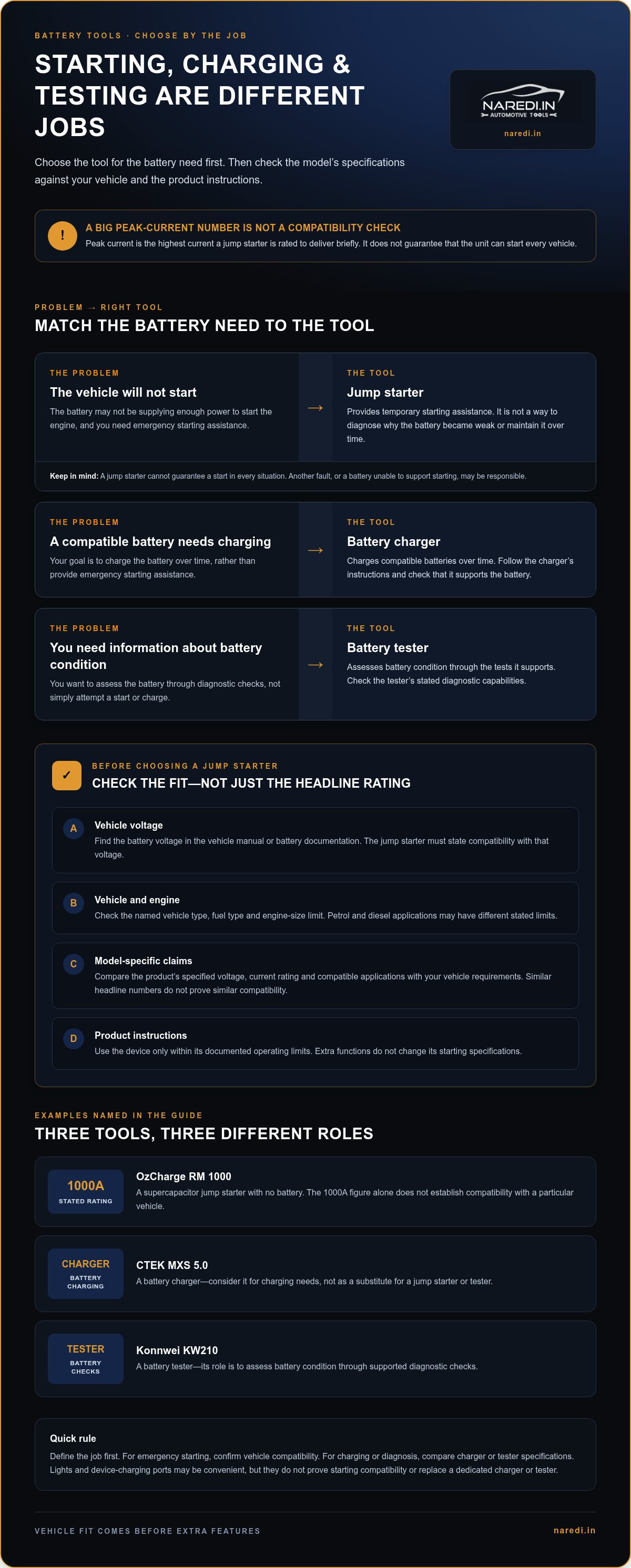
Yes. These tools address different battery needs. A jump starter provides starting assistance; a charger charges compatible batteries over time; and a tester assesses battery condition through the tests it supports. Don’t assume one tool performs all three roles just because its listing mentions additional functions.
- Choose a jump starter when your priority is emergency starting assistance and the product is specified for your vehicle.
- Choose a charger when you need to charge a compatible battery over time, following the charger’s instructions.
- Choose a tester when you need information about battery condition through the tester’s supported diagnostic checks.
Define the job before comparing models. If you need help with an unexpected no-start, focus on starting compatibility. If you want to charge a battery routinely or investigate its condition, compare charger or tester specifications instead. Lights or device-charging ports may be convenient, but they don’t establish vehicle compatibility or replace a dedicated charger or tester.
How Portable Jump Starter Ratings Relate to Vehicle Compatibility
A large current number can catch your eye, but it doesn’t confirm that a jump starter suits your vehicle. When comparing a portable jump starter in India, check the product’s stated voltage, vehicle type and engine limits against your vehicle documentation. Read the full specification, not only the product title or peak-current figure. Compatibility depends on the combination of these details, not a single rating.
Peak current is the highest current a jump starter is rated to deliver briefly, not a guarantee that it can start every vehicle. Treat it as one specification to compare. Product ratings and compatibility claims may be presented differently, so rely on the documentation for the exact model rather than assuming that products with similar headline numbers perform alike.
What does a jump starter’s current rating tell you?
The current rating describes a stated aspect of the device’s output. On its own, it doesn’t account for your vehicle’s electrical requirements or establish that the product is suitable for a particular engine. Check the jump starter documentation for its rating and listed applications, then compare those details with your owner’s manual or battery information. Resources such as Battery Council International standards offer broader context on battery terminology, but don’t replace model-specific compatibility instructions.
Why voltage and vehicle type matter
Start with the battery voltage in your vehicle documentation. The jump starter must state compatibility with that voltage. Then check whether the manufacturer names your vehicle type and gives an engine-size limit that covers your engine. Petrol and diesel applications may have different stated limits, so don’t assume that a rating for one applies to the other. A high peak-current figure is not proof of compatibility.
Use this quick comparison before choosing:
- Vehicle voltage: Find the battery voltage in the vehicle manual or battery documentation.
- Vehicle and engine: Note the vehicle type, fuel type and engine size relevant to the manufacturer’s stated limits.
- Jump starter claims: Compare those requirements with the model’s specified voltage, current rating and compatible applications.
- Instructions: Follow the product documentation for operating limits and use. Extra functions don’t change the starting specifications.
If a listing gives only a peak-current number, it leaves important questions unanswered. Look for clear, model-specific compatibility information and compare it with your vehicle documentation. This makes it easier to assess product claims consistently, whether you’re reviewing one device or comparing several. Once you know which specifications matter, browse naredi.in automotive tools with a clearer sense of what to look for.
Compare Portable Jump Starters by the Features That Affect Use
Once you know what your vehicle requires, compare models in a consistent order. Listings for portable jump starters in India may place current ratings beside lights, USB ports or bundled tools. These extras can be useful, but they don’t establish whether a starter fits your vehicle. First record the compatibility and operating details in each product’s documentation. Then compare portability and functions you’ll actually use.
Checklist: compare compatibility first, then ratings, portability and useful extras.
| What to compare | What to record | How it helps |
|---|---|---|
| Compatibility | Stated voltage, vehicle type and engine limits | Shows whether the maker identifies your vehicle as a suitable application. |
| Stated current | The current rating and how the manufacturer describes it | Allows you to compare published ratings without treating one number as proof of fit. |
| Portability | Documented dimensions, weight and storage requirements | Helps you judge whether the device is practical to carry and store in your vehicle. |
| Additional functions | Only the features named in the product documentation | Separates useful extras from assumptions based on product photos or category norms. |
Which features are essential, and which are optional?
Compatibility and clear operating instructions are essential. A torch, display, USB output or bundled tool is an extra, and its presence and function can vary by model. Don’t assume a feature exists because similar products offer it. Check the exact model documentation and consider whether the feature matters for your use. Convenience shouldn’t outweigh a mismatch with your vehicle or unclear instructions.
Use the product listing and manual as evidence, not the product category as a shortcut. For example, naredi.in lists the OzCharge RM 1000 as a 1000A supercapacitor jump starter with no battery. Those details describe its stated design and current rating, but they don’t establish vehicle compatibility or other functions. Check the product documentation for those details.
How do battery-based and supercapacitor models differ?
Battery-based and supercapacitor models are two design categories. Don’t generalise an individual product’s operating characteristics from its category name alone. Use its documentation to compare how it operates, what its specifications mean and how it should be used. The OzCharge RM 1000 is described as using supercapacitor technology and having no battery. Don’t infer unlisted claims about its lifespan, charging, storage or performance from that description.
Make a short comparison for each model: record its stated compatibility, current rating, portability details and documented extras. Leave a field blank if the product information doesn’t provide it. This keeps your comparison grounded in verifiable details and helps separate useful features from persuasive headlines.
Choose the Right Portable Jump Starter for Your Vehicle and Use
A sound choice starts with the job you need the tool to do. Use this process to assess a portable jump starter in India without letting peak-current figures, bundled extras or product appearance make the decision for you. Keep your vehicle documentation and the exact product instructions nearby as you compare.
- Define the need. Is your priority emergency starting assistance, routine charging of a compatible battery or diagnosing battery condition? Each task calls for a different tool, so settle this before comparing models.
- Check vehicle compatibility. Record the battery voltage, vehicle type and relevant engine details from your vehicle documentation. Compare them with the precise voltage compatibility and vehicle or engine limits stated for the jump starter model.
- Compare functions last. Once the vehicle fit is clear, consider portability and documented extras. A light or device-charging function may be convenient, but it can’t make an incompatible model suitable.
A practical compatibility checklist before purchase
Use the exact product listing and instructions, not assumptions based on a similar-looking model. Check the stated voltage, vehicle application and engine limits against your vehicle records. Then review the instructions for connection steps, operating conditions and restrictions. If the documentation doesn’t establish a suitable match, don’t treat a high current rating or extra feature as a substitute for clear compatibility information.
- Record the battery voltage and vehicle type from your vehicle documentation.
- Compare these details with the exact model’s stated limits and applications.
- Read the product instructions for connection, use and restrictions.
Avoid choosing the wrong battery tool
Match the tool to the task. A jump starter provides emergency starting assistance. A charger is for charging compatible batteries, while a tester assesses battery condition through its supported tests. These are distinct functions, and one tool shouldn’t be assumed to replace another. For ongoing charging needs, a car battery charger India buying guide can help you focus on charger-specific requirements rather than jump-starting ratings.
Keep your shortlist grounded in documented facts. Don’t choose a model solely for a large peak-current number, attractive design or bundle of extras if its vehicle compatibility remains unclear. A careful match gives you a more useful basis for deciding than a headline specification alone.
Compare automotive tools against your requirements at naredi.in’s automotive tools, using each option’s stated purpose and specifications.
Explore naredi.in’s Jump Starter and Related Battery Tools
The right battery tool depends on the job. A jump starter supports emergency starting, a charger replenishes a compatible battery over time, and a tester helps assess battery condition. A portable jump starter India comparison should begin with the task, then consider the product’s stated specifications. naredi.in offers tools for starting, charging and diagnosis, making it easier to distinguish an emergency-starting option from equipment for other battery needs.
A confirmed portable jump starter option
The OzCharge RM 1000 is a 1000A supercapacitor jump starter with no battery. These specifications identify its stated design and rating, but don’t establish whether it suits a particular vehicle or explain every operating requirement. Read the product documentation for vehicle compatibility, operating instructions and restrictions. Assess fit using those details rather than relying on the current rating alone.
When a charger or tester is the better tool
If your need is routine charging rather than emergency starting, the CTEK MXS 5.0 is listed as a 12V, 5A charger for AGM, EFB and GEL batteries. A charger serves a different purpose from a jump starter: it charges a compatible battery over time according to its instructions. Its voltage and stated battery types are useful starting points for deciding whether its listed application aligns with your requirements.
For battery-condition checks, the Konnwei KW210 is listed as a 12V tester for AGM, EFB and GEL batteries. A tester is for diagnosis, not emergency starting or charging. Use the tests and battery applications in its product information to judge whether it suits the assessment you need. Don’t assume a jump starter can diagnose battery condition, or that a tester can charge or start a vehicle.
Keep the distinction clear:
- Emergency starting: Compare jump-starter specifications and vehicle fit.
- Charging: Match the charger’s stated voltage and battery types to your charging requirement.
- Diagnosis: Review the tester’s listed battery applications and supported tests.
naredi.in was established in 2014 and describes itself as an authorised Pan-India distributor, with products sourced directly from OEM manufacturers. For a confident selection, focus on the documented purpose and specifications of the specific tool, not just its name or headline rating.
Browse naredi.in’s automotive tools and compare options by the job you need done: emergency starting, battery charging or battery testing.
Make Your Next Battery-Tool Choice with Confidence
Before you buy, make a brief decision record. Note the vehicle details you used, the exact model you’re considering and the product-documentation claims that support its intended use. That way, your portable jump starter India choice is based on information you can refer to later, not just a headline rating or a memory of a product listing.
Keep the vehicle manual and the selected tool’s instructions accessible. If someone else may use the equipment, make sure they can find the operating guidance and understand the stated limits. Organising that information helps make future decisions clearer and supports use according to the product documentation.
When you’re ready, browse naredi.in’s automotive tools and choose the option that fits your vehicle and intended task.
Frequently Asked Questions
Can a portable jump starter start a vehicle with a completely dead battery?
It may provide starting assistance, but a start isn’t guaranteed if the battery is completely discharged, damaged or affected by another fault. “Dead” can describe different conditions, and a jump starter can’t diagnose the cause by itself. Follow the device instructions and don’t continue attempts beyond its stated operating guidance. If the vehicle still won’t start, the battery or another part of the starting system may need assessment.
Is a portable jump starter suitable for both petrol and diesel vehicles?
Some models state compatibility with both, but suitability depends on the exact product and vehicle. A petrol car and a diesel vehicle may have different starting requirements, so check the manufacturer’s listed engine limits for each fuel type. Don’t assume that a model specified for a petrol engine of a given size also covers a diesel engine of the same size. Follow the product documentation.
How do I know whether a jump starter is compatible with my car?
Compare your car’s battery voltage and engine details in its manual with the exact jump starter’s stated applications and limits. Check that the documentation names the relevant vehicle type and covers the engine size. When comparing portable jump starters in India, don’t rely on a product title or a similar model’s specifications. Use the instructions for the exact device before connecting it.
What does the peak-current rating on a jump starter mean?
Peak current is the product’s stated maximum current output for a brief period. It offers one point of comparison, but doesn’t tell you by itself whether the device suits your vehicle or guarantee a start. Read the rating alongside the manufacturer’s vehicle and engine compatibility information. If two models use different rating details, compare their documentation carefully instead of treating the larger headline number as automatically better.
How often should I recharge a portable jump starter?
Follow the recharge schedule in the manufacturer’s manual, since the recommended interval depends on the product design. Recharge after use if the instructions call for it, and check the device’s charge status before storing it for an extended period. If the model provides a charge indicator, use it as described in its documentation. Don’t apply a battery-based model’s charging routine to a different design without checking its instructions.
Can a portable jump starter charge a car battery?
A jump starter is generally intended to assist with starting, not to recharge a car battery through a routine charging cycle. A device may include other outputs or functions, but those don’t establish that it can charge the vehicle battery. Check the manual for the exact model. If your aim is to replenish a compatible battery over time, choose a charger specified for that battery and follow its directions.
Can I use a car jump starter for a motorcycle?
Only if the jump starter’s documentation explicitly supports your motorcycle’s battery voltage and application. A car-compatible label alone doesn’t establish motorcycle compatibility. Check the motorcycle manual and the jump starter instructions for connection requirements and limits. Don’t improvise connections or assume that a device is suitable because it can start a car. Choose a tool documented for your vehicle type.