

A higher amp rating alone doesn’t make a battery maintainer safer or a better fit. To compare CTEK vs OzCharge battery maintainer features and reliability, first match the charger to your battery and use case, then assess its safety features and support.
It’s reasonable to want a maintainer that keeps a vehicle battery ready without guesswork. The right choice depends on the specific model, battery chemistry and capacity, charging current, and built-in protections, not the brand name alone.
This comparison explains how to assess battery compatibility, amperage, safety features, owner feedback, and customer support. Use these criteria to narrow your options for a vehicle or stored battery and identify which model specifications matter most.
Key Takeaways
- Match a maintainer to the battery’s chemistry and voltage first; brand alone won’t establish compatibility.
- Choose charging current around the battery and how you use it, distinguishing long-term storage from faster top-ups.
- Compare safety protections and connection guidance as carefully as charging features before selecting a unit.
- Use owner feedback to understand real-world experience, then explore battery chargers or testers when you need a practical next step.
Choosing a charger compatible with the battery type
Start with battery voltage and chemistry, then compare the charger’s supported capacity and charging current. A multi-step charging programme describes how charging progresses; on its own, it doesn’t prove the charger will extend battery life.
CTEK Charger Options
CTEK offers models for different batteries and charging needs. The MXS 5.0 suits many motorcycle and car batteries, including lead-acid, AGM and gel types, with settings of 0.8 A and 5 A. The MXS 10 provides 10 A, while the Multi US 7002 supports flooded, AGM and gel batteries through an eight-step charging curve. The CS ONE listing identifies a 12 V charger for AGM, EFB, gel and lithium batteries.
For India, the provided price is ₹29,900 per piece for the CTEK CS ONE. Suitability for an Indian vehicle depends on matching the charger’s voltage and battery chemistry to the vehicle’s battery. The MXS 5.0 includes automatic temperature compensation, a relevant feature when charging conditions vary. For connector types, cables, clamps and included accessories, treat each exact model’s package as its own specification rather than assuming brands use identical fittings.
OzCharge Maintainer Options
With OzCharge, as with CTEK, a brand or model name alone doesn’t establish compatibility. Match the charger’s stated voltage, chemistry support, and current to the battery in your vehicle. This applies to motorcycles and cars in India. Suitability for local conditions also depends on the charger’s temperature guidance and operating limits.
| Option | Battery compatibility | Charging detail | India price |
|---|---|---|---|
| CTEK MXS 5.0 | Lead-acid, AGM and gel | 0.8 A or 5 A settings | Not included here |
| CTEK MXS 10 | Check against battery chemistry | 10 A capability | Not included here |
| CTEK CS ONE | AGM, EFB, gel and lithium | 12 V charger | ₹29,900 per piece |
| OzCharge | Match the exact model to the battery | Check model specifications | Not included here |
Choose a model that matches the battery’s voltage and chemistry, then select the current and connections suited to how you’ll use it.
Owner experience and customer support
Owner reports add practical context, but one account cannot establish a brand-wide reliability rate. A CTEK MXS 5.0 owner reported that the charger began showing problems after three years, while still describing ownership of more than five years when writing the review. That timeline suggests the unit remained in use after the first reported fault, but it doesn’t show how typical that experience is.
The reported problems were specific: the MXS 5.0 switch sometimes needed five to ten presses to register once, and its cables could fall about 50 cm short of the owner’s preferred reach. These details matter in daily use. A switch fault affects mode selection, while short cables can limit where the charger sits beside a vehicle. Neither detail alone tells you how another unit will perform.
When comparing CTEK and OzCharge owner feedback, look for recurring issues tied to specific models rather than relying on a single rating. Separate comments about the charger from complaints about setup, battery condition, or access to the connections. If an engine turns over slowly, remember that a maintainer review describes the charger experience, not the cause of the starting problem.
Customer support is best judged through practical ownership information: clear operating instructions, troubleshooting steps, warranty conditions, and a defined process for handling faults. These factors can matter as much as long-term performance if a switch or cable develops a problem. Compare support terms for the exact model, not just the CTEK or OzCharge name. For a compatible charging option, browse battery chargers suited to your vehicle’s requirements.
The reviewer’s CTEK MXS 5.0 began showing problems after 3 years of use, and the reviewer had owned it for more than 5 years when writing the review. This places the reported fault within a longer ownership period, but provides no further detail about its cause or whether it persisted.
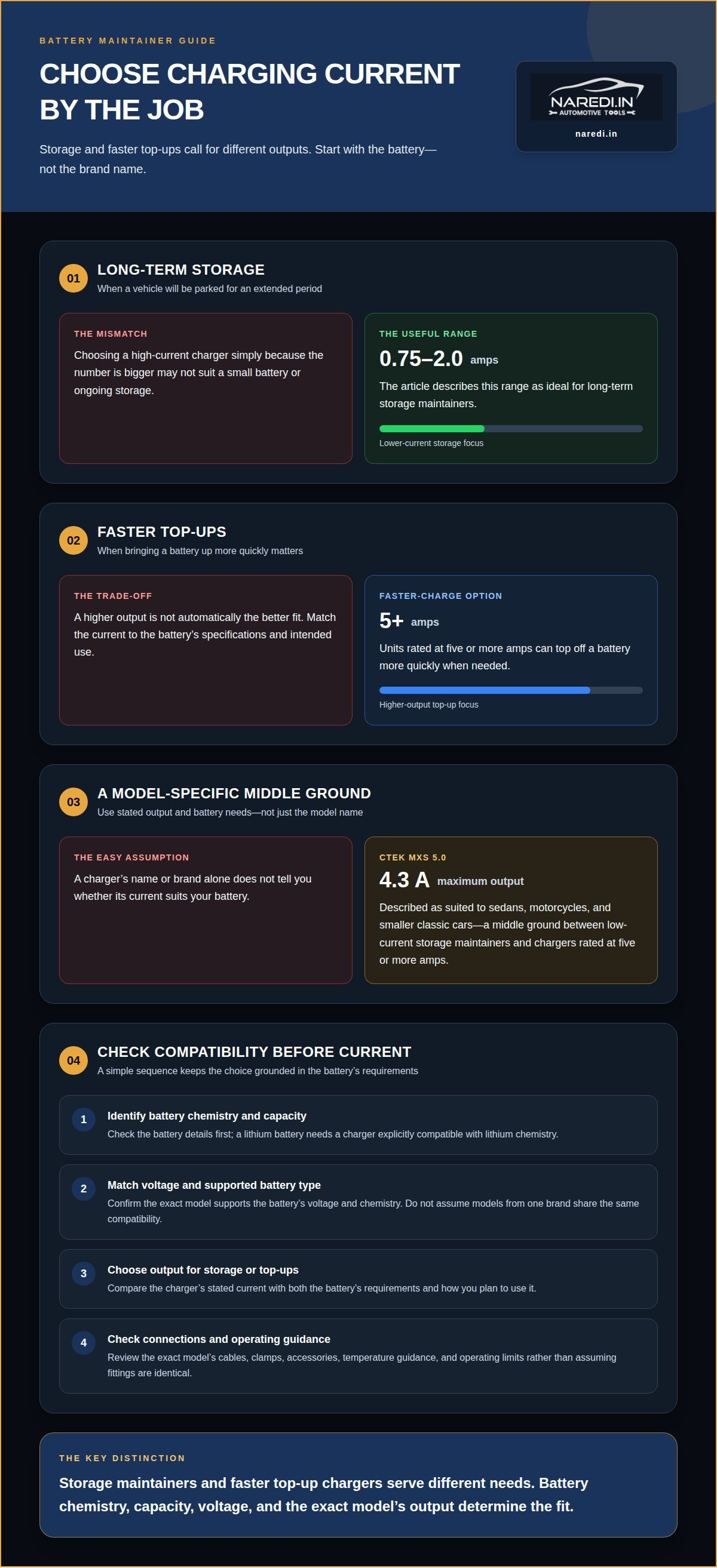
Battery-maintainer amperage selection
Amperage affects how a maintainer suits storage and charging needs. For long-term storage, maintainers rated from 0.75 to 2.0 amps are described as ideal. Units rated at five or more amps can top off a battery more quickly when needed. These are different use cases, not a simple ranking: choose around the battery and how it will be used.
Start with the vehicle battery’s chemistry and capacity, then compare the charger’s supported range and output. Higher current isn’t automatically right for a small battery or long-term storage. A lower-current maintainer may suit a parked vehicle, while a higher-output charger may be useful when faster top-ups matter. The battery specifications should guide your choice.
The CTEK MXS 5.0 has a maximum output of 4.3 amps and is suited to sedans, motorcycles, and smaller classic cars. That makes it a middle ground between low-current storage maintainers and chargers rated at five or more amps. Its model name shouldn’t replace checking the stated output and the battery’s requirements. A lithium battery also needs a charger explicitly compatible with lithium chemistry.
For OzCharge, compare the specific maintainer’s output with its supported battery capacity and chemistry. Don’t assume two models from the same brand have the same current or support the same battery types. Apply the same check to CTEK chargers. The intended vehicle class can help narrow the options, but output and battery compatibility should determine your final choice.
A battery tester can help assess battery condition, but it can’t determine the right charging current on its own. First identify the battery chemistry and capacity, then choose a compatible charger and an output suited to storage or faster top-ups. This grounds your amperage choice in the battery’s needs, not brand preference.
For a quicker top-off, five or more amps is an option, but the battery’s needs still determine whether that output is suitable.
Battery-maintainer safety features
Compare safety features at the model level, not just by brand. Check the instructions for the specific CTEK or OzCharge model to confirm whether it has reverse-polarity and spark protection. Don’t assume a feature listed for one charger applies to another. A useful CTEK vs OzCharge battery maintainer features and reliability comparison distinguishes documented safeguards from general brand claims.
Check what the charger indicates when a connection or charging condition is unsuitable. Clear status lights or fault messages can help you spot a problem before treating the battery as ready to start the vehicle. Compare the information each model provides and follow its instructions if an alert appears. A completed charging cycle doesn’t prove the battery or starting system is healthy.
Battery condition is important when making safe charging decisions. A battery tester offers a separate assessment; a maintainer charges or maintains the battery within its stated operating limits. If the battery shows visible damage or behaves unexpectedly, stop using the charger and follow the product instructions. A maintainer can’t replace diagnosis of a vehicle fault.
When comparing CTEK and OzCharge, consider safeguards, how clear the operating guidance is, and what information the charger shows during charging. Compare specific models rather than assuming both brands use identical protections. Focus on the exact unit, its stated safeguards, and how clearly it communicates its operating status.
For a practical safety review, check the charger’s connection guidance, warning indicators, and stated protections before use. Keep the unit and its leads in good condition, and operate it only within its stated limits.
Explore battery testers to assess battery condition as part of a careful charging decision.
Naredi.in
naredi.in helps you turn a CTEK versus OzCharge comparison into a practical equipment choice for your vehicle and battery. Use battery type, voltage, and required charging current to narrow the options, then consider whether you also need to assess battery condition or address a separate performance concern.
naredi.in's range includes Battery Chargers and Battery Testers, as well as Performance Additives and Jump Starters. A tester can help you assess battery condition, while your charger should match the battery's stated requirements. Focus on the equipment that fits your needs rather than brand preference alone.
For help choosing automotive equipment, contact naredi.in.
Choose the next step with confidence
Comparing CTEK and OzCharge battery maintainer features and reliability is most useful when it leads to a choice that suits your vehicle and how you use it. Before deciding, consider whether you need dependable storage charging, straightforward operation, or support for a particular battery setup. Choose the model that meets those needs rather than relying on brand preference alone.
naredi.in offers Battery Chargers, Battery Testers, and Performance Additives for automotive needs. If you’re weighing equipment options or want help identifying a suitable next step, Contact naredi.in for help. A clear understanding of your requirements makes the conversation more useful and helps you move forward with greater confidence.
Frequently Asked Questions
What safety features do comparable CTEK and OzCharge models include, such as reverse-polarity and spark protection?
Reverse-polarity and spark protection are model-specific, so check the exact charger instructions instead of assuming both brands include these features. Before connecting either unit, follow its guidance for the battery and connection setup. Clamp sequence and shutdown procedure are practical safety details, but they don’t confirm whether a charger has reverse-polarity or spark protection.
What do long-term owner reviews and reliability tests report about CTEK versus OzCharge maintainers?
Owner reviews reflect individual experiences, not a controlled reliability comparison between CTEK and OzCharge. A report about one CTEK model can’t show how it performs against an OzCharge equivalent or represent every unit. For a fair assessment, compare similar use, batteries, and operating conditions, and distinguish owner feedback from repeatable tests of matched models.
Which CTEK and OzCharge battery maintainer models are available in India, and what are their prices?
The CTEK CS ONE is listed for India at ₹29,900 per piece.
How do CTEK and OzCharge charging stages, maintenance modes, and desulfation features compare?
The CTEK Multi US 7002 has an eight-step charging curve and a recondition mode intended to restore stratified batteries. The CTEK MXS 5.0 has a reconditioning mode for deeply discharged batteries; compare each exact OzCharge model’s stated charging programme.
How do CTEK and OzCharge maintainers compare in charging current, charging time, and energy efficiency?
The CTEK MXS 5.0 offers 0.8 A and 5 A settings, with a maximum output of 4.3 A; the MXS 10 provides 10 A. Maintainers rated at 0.75-2.0 A suit long-term storage, while units rated at five or more amps can top off a battery quicker; the CT5 TIME TO GO displays a charging countdown.