

A century-old name still needs a clear explanation. Rislone says it has engineered automotive aftermarket performance chemicals since 1921. Understanding the brand’s history helps put its engine treatments and additives in context, but the right choice depends on the engine’s condition and the concern you’re addressing.
It’s reasonable to compare treatments carefully: additives aren’t a substitute for diagnosing a mechanical fault, and different formulas serve different purposes. This article explains Rislone’s product history, how its engine treatments and additives are used, and how they relate to wear, heat, friction, and vibration.
Use this practical framework to understand what Rislone products are intended to do and where they fit in vehicle care. You’ll also learn what an additive can and cannot address, helping you compare options before choosing a treatment.
Key Takeaways
- Compare an engine treatment with the specific concern you’re addressing, such as friction, heat, wear, or vibration.
- Use the product label to guide application and dosage, since instructions can differ between formulas.
- Assess engine type and emissions equipment before selecting an additive, and distinguish maintenance support from diagnosing a mechanical fault.
- For battery maintenance needs, explore naredi.in’s Battery Chargers, alongside its Performance Additives and other automotive tools.
Automotive chemical product history
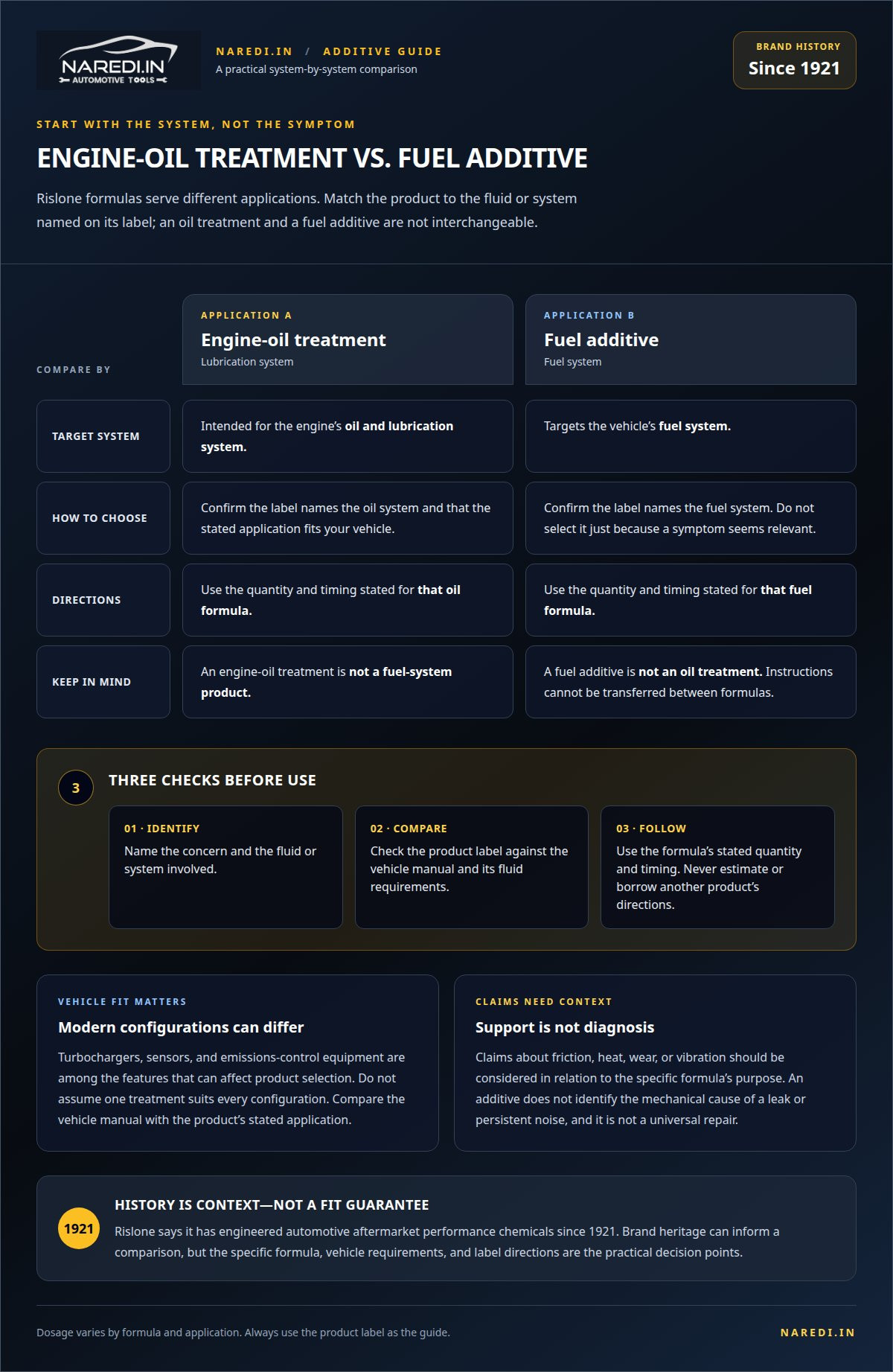
Rislone says it has engineered automotive aftermarket performance chemicals since 1921. That history spans major changes in engines, fuels, lubricants, and emissions equipment. It gives drivers context when comparing treatments, but age alone doesn’t show whether a particular formula suits a specific vehicle. The product’s intended system and label directions are more useful decision points. Consider the vehicle’s requirements alongside the particular Rislone product, rather than relying on the brand’s heritage as proof of fit.
Automotive additives serve different applications. An engine-oil treatment is intended for the lubrication system, while a fuel additive targets a different system. They aren’t interchangeable. First identify the system involved, then read the label for the stated application and any limits. Compare Rislone formulas by purpose, not just by the symptom you hope to address.
Engine design also affects product selection. Modern vehicles may include turbochargers, sensors, and emissions-control equipment, so don’t assume one treatment suits every configuration. Compare the vehicle manual with the product’s stated application. If you’re considering an additive for noise, vibration, or oil consumption, separate its intended role from diagnosing the mechanical cause. Rislone’s history can inform your comparison, but the specific formula must match the vehicle and concern.
Rislone products are available in India through an authorised Pan-India distribution channel. Listed Rislone products carry a one-year warranty against manufacturing defects. For purchase or warranty questions, retain the invoice and product packaging, then refer to the terms supplied with that product. Import considerations depend on the purchase channel and applicable product documentation; use authorised distribution rather than assuming every imported item has the same warranty coverage.
Use the 1921 history as background, then make a practical comparison. Identify the fluid or system involved, match it to the product’s stated application, and follow the directions. For example, an engine-oil treatment shouldn’t be selected solely to address a cooling-system symptom. This keeps the decision focused on the vehicle, the concern, and the particular formula.
Engine treatments and additives
Rislone says its performance additives have helped drivers and racing teams for over 100 years. That history provides context, while the formula’s purpose determines whether it fits a particular vehicle concern.
Application and Dosage
Application and dosage depend on the formula. Read the label and match its directions to the fluid or system named. Check whether the product is intended for engine oil, fuel, or another automotive system before using it. Follow the stated quantity and timing, and never transfer instructions from one formula to another. Comparing Rislone products by application helps avoid using a treatment for the wrong system.
Problems can arise when an additive is used outside its stated application or directions. An unsuitable product or incorrect amount may not meet the vehicle’s fluid requirements. An engine-oil treatment, for instance, isn’t a fuel-system product. An additive also won’t identify the mechanical cause of a leak or persistent noise. Let the label and vehicle requirements guide your choice.
Reported Results and Reviews
Customer testimonials describe individual outcomes, not guaranteed results across vehicles. One account describes a 2010 Ford Fusion with a transmission leak and rough shifts. It says one bottle of a Rislone product resolved both concerns, describing the problems as 100% gone.
That example concerns a transmission, not an engine additive, so it can’t show how an engine formula will perform for a different concern. It’s a customer testimonial, not a controlled test or a collection of mechanic reports. When assessing whether a Rislone product is relevant, compare the review’s vehicle, product application, and reported symptom with your own situation.
Engine additives are designed for specific applications, not as universal repairs. Consider claims about friction, heat, wear, or vibration in relation to the particular formula’s stated purpose. A treatment may support its intended application, but diagnosing a mechanical fault may require more than an additive. Compare labels and product uses before deciding what’s relevant.
To review the available formulas and their stated uses, browse Rislone performance additives and match the label to the vehicle’s needs.
How do you use Rislone products, and what dosage is recommended?
The recommended dosage depends on the Rislone formula and the system it treats. There’s no single amount for every engine additive. Follow the product label and match its directions to your vehicle and the fluid named. An oil treatment and a fuel additive have different applications, so their instructions aren’t interchangeable.
Before opening a container, identify the concern and the product’s intended use. Check the vehicle manual for relevant fluid requirements, then compare them with the label. An engine-oil product, for example, is intended for the oil system, not as a fuel treatment. This check helps you avoid choosing a product based only on symptoms such as noise or vibration.
- Match the system: Confirm whether the directions name engine oil, fuel, or another application.
- Read the dosage: Follow the quantity and application timing printed for that formula.
- Keep products separate: Don’t transfer one additive’s directions to another product.
Dosage depends on the formula and application described on the packaging. Follow the stated quantity rather than estimating from container size or copying an amount from a review. If the instructions specify when to use the product during maintenance, follow that timing. Using a treatment at the wrong stage may not match its intended application.
A customer’s account of one bottle helping with a transmission concern, for example, doesn’t establish a dose for an engine additive. It concerns a different product application and vehicle system. Treat reviews as individual examples, not instructions. The label for the product you’re using is the relevant guide to dosage and application.
After using a treatment, follow any further label directions for vehicle operation or repeat use. Don’t add another dose simply because a symptom remains. Persistent oil, fuel, or transmission concerns may have a mechanical cause that an additive cannot diagnose. Record the product name and application for future maintenance.
Are Rislone products safe for modern engines, catalytic converters, and diesel vehicles?
Compatibility depends on the formula and the vehicle system it is designed to treat. Don’t assume a product suitable for one engine application will suit another. For a modern petrol engine, a catalytic converter, or a diesel vehicle, refer to the product label and vehicle manual together. Confirm the stated application before use.
Start with the vehicle type and system involved. An engine-oil additive, for example, has a different application from a fuel treatment. Check whether the product directions cover your fuel type and engine configuration, then compare them with the manual’s fluid specifications. Products from the same brand aren’t necessarily interchangeable.
- Modern engine: Compare the stated application with the vehicle manual’s oil or fuel requirements.
- Catalytic converter: Look for product directions that explicitly address compatibility with emissions equipment.
- Diesel vehicle: Select a formula whose label names diesel use, rather than assuming petrol guidance applies.
These checks matter because additives go into a particular fluid or system. A treatment intended for engine oil isn’t a substitute for a fuel product, and neither should be used outside its directions. If the vehicle has a catalytic converter, check the label’s compatibility statement for emissions equipment. Don’t infer compatibility from claims about cleaning or reducing friction.
For a diesel, check the fuel type and intended system described on the packaging. For a modern engine, compare the directions with the manufacturer’s fluid requirements before use. If the label doesn’t match the vehicle’s system, choose a different application rather than adjusting the dosage. Good product selection starts with a clear match, not the symptom alone.
Before buying, identify the engine and fuel type, confirm the target system, and read the full application directions. Keep the packaging and purchase details with your vehicle maintenance records. This gives you a clear record of the product used if questions come up during later maintenance.
Compare product applications and select a formula whose stated use matches your vehicle’s system.
Using a formula in the wrong engine, fuel, or vehicle system, or outside its directions, may make it unsuitable for that application. If your vehicle has a catalytic converter or diesel engine, check the label for explicit compatibility rather than assuming it based on the brand or product claims.
Naredi.in: Battery Chargers
naredi.in sells automotive tools and products for needs beyond engine treatments. If you’re maintaining or assessing a vehicle battery, explore its Battery Chargers and Battery Testers. Jump Starters serve a different purpose when a vehicle needs a starting boost, while Performance Additives are for specific fluid and engine-treatment applications.
For Rislone products in India, naredi.in is an authorised Pan-India distributor, with products sourced directly from OEM manufacturers and described as 100% genuine. Match any additive to its stated application, and choose a battery product based on the task you need it to perform.
Visit naredi.in to explore its automotive products or get in touch.
Choose the Next Step for Your Vehicle
Base your next decision on the job your vehicle needs done. For an additive, compare its stated application with the system and concern you’ve identified. For a battery issue, consider whether you need charging support or a way to assess battery condition. Keeping these needs separate helps you choose the right type of automotive product.
naredi.in offers Performance Additives, Battery Chargers, and Battery Testers for these distinct tasks. Explore the available Rislone options and focus on the formula that matches your intended use, rather than choosing by brand name alone. If you’re ready to compare treatments, browse Rislone products.
Matching the product to the vehicle and purpose is a practical starting point. Choose the option that fits your maintenance needs and the application stated on its label.
Frequently Asked Questions
What is Rislone and what products does the brand make?
Rislone is an automotive aftermarket performance-chemicals brand. Its product range includes treatments such as Octane Booster, One Seal, Trans Fix, Hydraulic Seal, and formulas identified by numbers including 44700, 44701, and 710. These names cover different product applications, so compare the specific formula rather than treating the range as one universal additive. The brand says it has engineered automotive aftermarket chemicals since 1921.
What are Rislone products used for in cars and motorcycles?
Rislone products are intended for specific automotive applications, such as octane boosting or addressing a concern related to a named fluid system. For a car, choose according to the product’s stated purpose and the system involved. For a motorcycle, don’t assume a formula intended for cars is suitable. Match the label to the motorcycle and intended application, and don’t substitute one treatment for another.
What are the risks or side effects of using Rislone engine additives?
Using a product outside its stated application or in the wrong amount may not suit the vehicle’s fluid requirements. Follow the product label and vehicle manual. Additives don’t diagnose mechanical faults.