

A tractor battery charger must match the battery’s voltage and capacity, not just the vehicle. Listed 12V digital 5A and 8A chargers support batteries rated from 5-220 Ah, while another listed charger is compatible with 12V batteries rated at 7-18 AH. These ranges make the battery rating the first specification to compare.
Choosing a tractor battery charger means matching it to the battery’s chemistry and charging needs. This matters especially for traction or deep-cycle batteries, whose duty cycle and charging requirements differ from those of a small battery.
This guide explains how to compare 12V digital charger ratings, understand automatic cut-off charging, and identify battery exclusions before connecting a charger. It also covers industrial electric tractor chargers and the specifications that shape a suitable match. TVH says charger selection takes voltage, capacity, chemical composition and charging time into account, giving you a practical framework for comparing options without relying on amperage alone.
Key Takeaways
- Compare voltage, capacity range and charging current to identify a charger that matches the battery’s requirements.
- Understand how automatic cut-off charging works and why it matters during a charging cycle.
- Review battery exclusions and chemistry compatibility before choosing a charger.
- For industrial electric tractors, weigh battery capacity, composition and charging time together when selecting equipment.
12V digital battery charger specifications
For an Indian tractor, match the charger to the battery’s stated voltage and Ah capacity; listed 12V chargers cover different capacity ranges. Charging time depends on the battery’s capacity, charge level and charger output, so there’s no single duration for every tractor battery.
Digital Charger Specifications
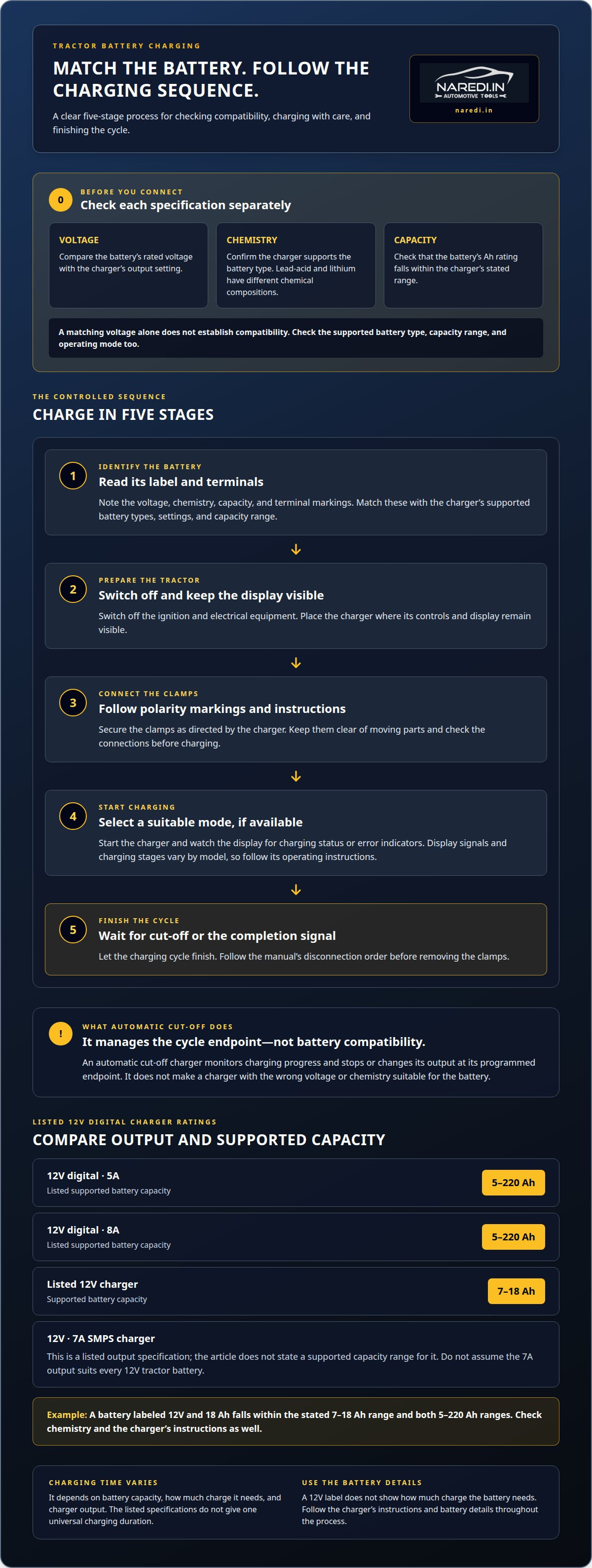
A listed 12V digital charger rated at 5A supports batteries from 5-220 Ah. A listed 12V 8A digital charger also supports 5-220 Ah, while another listed charger suits 12V batteries rated at 7-18 AH. These ratings describe different equipment, so compare the battery’s label with the charger’s stated range before choosing.
A 12V 7A SMPS battery charger is another listed specification. Don’t treat its 7A output as proof that it suits every 12V tractor battery. Check three details together: voltage, capacity range and charging current. A mismatch in voltage is a poor fit, while capacity outside the stated range falls beyond the charger’s specified support.
For example, if the battery label shows 12V and 18 Ah, compare that rating with the charger’s supported range. The 7-18 AH listing includes that capacity; the 5-220 Ah listings also cover it. This comparison helps separate voltage compatibility from capacity suitability, two details that are easy to conflate when selecting a tractor battery charger.
Tractor Battery Charging Time
Charging time varies with the battery’s Ah capacity, how much charge it needs, and the charger’s output. A 5A and an 8A charger can therefore take different amounts of time on the same battery. The listed specifications don’t provide a universal duration, so use the charger’s instructions and battery details to guide the charging process.
Start by identifying the battery’s rated capacity and current state of charge. Then compare those details with the charger’s output and charging guidance. A battery that needs more charge generally requires a longer charging cycle than one that needs less. Avoid estimating time from voltage alone; a 12V label doesn’t show how much charging the battery needs.
Follow the charger’s automatic cut-off and display guidance where provided. Digital models do not all manage charging in the same way. If charging takes unusually long or the battery does not retain charge, assess its condition. TVH identifies sulphation as the main reason a lead-acid battery loses capacity or malfunctions, so charging duration can also reflect battery health.
Automatic cut-off charging
To charge a tractor battery, match the charger to the battery, switch off the equipment and connect the clamps to the marked terminals. Check the connections before starting the charger, then let the charging cycle finish before disconnecting it.
An automatic cut-off charger monitors charging progress and stops or changes its output when it reaches its programmed endpoint. This helps prevent the main charging cycle from continuing after the battery reaches its target. Display signals and charging stages vary by model, so follow the operating instructions.
Charge in a controlled sequence
- Identify the battery. Read its voltage, chemistry and terminal markings. Match them to the charger’s supported battery types and settings.
- Prepare the tractor. Switch off the ignition and electrical equipment. Place the charger where its controls and display remain visible.
- Connect the clamps. Follow the charger’s polarity markings and instructions. Keep the clamps secure and clear of moving parts.
- Start charging. Select the suitable mode, if the charger provides options. Watch the display for charging status or error indicators.
- Finish the cycle. Wait for the automatic cut-off or completion signal. Follow the manual’s disconnection order before removing the clamps.
Automatic cut-off doesn’t make battery matching unnecessary. A charger set to the wrong voltage or chemistry can still be unsuitable, even if it stops its cycle automatically. For example, don’t assume a 12V setting fits a battery with a different voltage rating. Compare the label and charger instructions first.
After charging, note whether the display reports completion and whether the tractor starts normally. If the battery repeatedly struggles to hold charge, a battery tester can help assess its condition. For choosing a compatible model, compare battery charger specifications against the battery’s label and the charger’s operating guidance.
Battery compatibility exclusions
A battery can have the same voltage as a tractor’s system and still fall outside a charger’s supported chemistry or capacity range. Treat each specification as a separate check. A charger designed for one battery type is not automatically suitable for another, even if both labels show the same voltage. TVH says charger selection takes voltage, capacity, chemical composition and charging time into account.
Use the battery label and charger instructions to identify any exclusions before connecting them. Check the specifications in this order:
- Voltage: compare the battery’s rated voltage with the charger’s output setting.
- Chemistry: match the battery type to the charger’s supported types. Lead-acid and lithium batteries, for example, have different chemical compositions.
- Capacity: confirm the battery’s Ah rating falls within the charger’s stated range.
- Operating mode: select a mode that matches the battery, rather than assuming a general setting suits every type.
- Condition: consider whether a battery that charges poorly may have a condition issue, not a compatibility mismatch alone.
For example, a 12V label by itself doesn’t establish a match. The battery may use a chemistry that the charger doesn’t support, or its capacity may fall outside the charger’s stated range. Either mismatch is a reason to choose a different compatible charger, not to rely on voltage alone.
Battery condition matters too. TVH identifies sulphation as the main reason a lead-acid battery loses capacity or malfunctions. If a lead-acid battery struggles to retain charge, assess it rather than repeatedly trying different charger settings. TVH also says discharge time indicates the health of a traction or deep-cycle battery. A change in its usual discharge behaviour can be a clue to investigate.
Before buying a tractor battery charger, record the battery’s voltage, chemistry and capacity, then compare each detail with the charger specifications. Rule out any model that fails one of these checks. This helps prevent a partial match from being mistaken for full compatibility with an Indian tractor.
Industrial electric tractor battery chargers
Industrial electric tractors often rely on traction or deep-cycle batteries, so the charger must suit regular operating demands. TVH says selection takes voltage, capacity, chemical composition and charging time into account. Consider all four together instead of choosing by output alone.
For a fleet vehicle, start with the battery label and equipment requirements. Record the voltage, capacity and chemistry, then compare them with the charger’s supported settings. Consider the time available between operating shifts as well. A charging setup that does not fit the work cycle can leave equipment unavailable when it is needed.
Safety: Switch off the tractor before connecting a charger, follow the equipment and battery instructions, and match the terminals carefully. Keep the charging area clear, and stop if you notice damage, unusual heat or an error indication.
To distinguish a low charge from a failing battery, observe whether it accepts and retains charge, then assess its condition with a battery tester. TVH says discharge time indicates the health of a traction or deep-cycle battery. For lead-acid batteries, TVH identifies sulphation as the main reason for capacity loss or malfunction. These signs can guide an assessment, but one slow start alone does not establish that replacement is needed.
Solar charging can work for a tractor if the setup is designed for that battery. The charger’s output and control equipment must suit the battery’s voltage and chemistry. Sunlight alone does not make a panel a compatible charger; the complete setup must regulate charging appropriately. Assess it against the tractor’s operating schedule and charging needs.
For industrial use, map the battery specifications against duty cycle, available charging time and the charger’s supported chemistry. That comparison helps define the right equipment class before selection. Use battery charger options to compare charging equipment against your tractor battery’s requirements.
Naredi.in: Battery Chargers
naredi.in offers Battery Chargers for readers comparing equipment with a tractor battery’s voltage, capacity and chemistry. Use the battery label and charger specifications to narrow the options, especially for industrial or deep-cycle applications. Battery Testers can help assess battery condition if charging performance is in question. Jump Starters serve a different purpose: starting support when a battery is discharged.
Choose equipment based on the job. A charger recharges a compatible battery; a tester helps evaluate its condition. Performance Additives are another product category, but they do not replace a compatible charger or battery assessment. Visit naredi.in to explore its automotive battery equipment.
Put the next charging decision into practice
A reliable charging routine treats battery care as part of equipment planning, not just a response to a starting problem. Keep the battery information and charging history together, so future choices reflect how the tractor is used. This record can also help distinguish a one-off discharge from a recurring performance concern.
Choose a tractor battery charger for the task, from routine recharging to demanding industrial use. naredi.in offers Battery Chargers for charging needs, Battery Testers to assess battery condition, and Performance Additives as another automotive product category.
Move from comparison to a considered equipment choice. Contact naredi.in about tractor chargers and explore the available options for your application. A clear match supports a more confident next step in keeping your tractor ready for work.
Frequently Asked Questions
How to choose the right tractor battery charger in India?
Choose a tractor battery charger by matching its output to the battery’s voltage, chemistry and capacity, then consider how the tractor is used. For example, the CTEK CS One supports AGM, EFB, GEL and Lithium batteries, while the CTEK MXS 5.0 supports AGM, EFB, GEL, WET and MF batteries. Check the specific charger’s supported battery types before selecting a charging mode.
What charger amperage is suitable for a tractor battery?
Suitable amperage depends on the battery and the charger’s stated compatibility, not tractor size alone. A 12V 5A tractor battery charger is one option, while the CTEK Pro25S is a 12V 25A charger. These outputs aren’t interchangeable by default. Match the battery’s requirements to the charger instructions, and don’t assume higher amperage is automatically the better choice.
Which tractor battery chargers are available in India and how do they compare?
Options in India include the CTEK CS One, MXS 5.0, CT5 PowerSport, Pro25S and other charger models. Their supported battery types and intended uses differ. The models differ in their supported battery types and capacity ranges, so check each charger’s specifications against your battery. Compare each tractor battery charger’s specifications with your battery.
Can a car battery charger charge a tractor battery safely?
A car charger can charge a tractor battery if its specifications match the battery. Confirm compatibility with the voltage, chemistry and capacity, then follow the charger’s connection and operating instructions. A car battery charger is not automatically suitable for a tractor battery just because the voltage appears to match. Check that the charger supports the battery type and capacity.